 Add to Chrome
 Add to Firefox
 Add to Edge
Guided by Stars: Interpretable Concept Learning Over Time Series via Temporal Logic Semantics
Nov 06, 2025
Time series classification is a task of paramount importance, as this kind of data often arises in safety-critical applications. However, it is typically tackled with black-box deep learning methods, making it hard for humans to understand the rationale behind their output. To take on this challenge, we propose a novel approach, STELLE (Signal Temporal logic Embedding for Logically-grounded Learning and Explanation), a neuro-symbolic framework that unifies classification and explanation through direct embedding of trajectories into a space of temporal logic concepts. By introducing a novel STL-inspired kernel that maps raw time series to their alignment with predefined STL formulae, our model jointly optimises accuracy and interpretability, as each prediction is accompanied by the most relevant logical concepts that characterise it. This yields (i) local explanations as human-readable STL conditions justifying individual predictions, and (ii) global explanations as class-characterising formulae. Experiments demonstrate that STELLE achieves competitive accuracy while providing logically faithful explanations, validated on diverse real-world benchmarks.

A Robust Genetic Algorithm for Learning Temporal Specifications from Data
Aug 01, 2018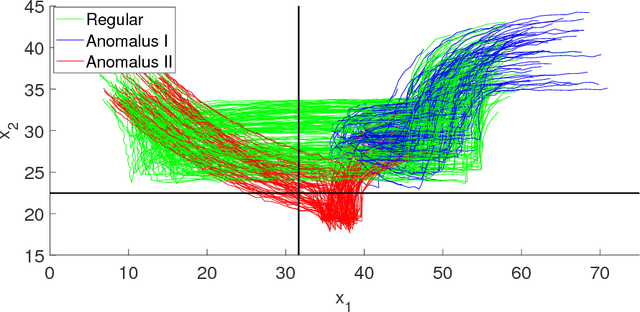
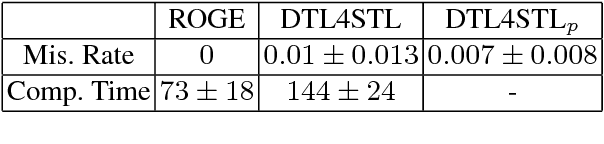
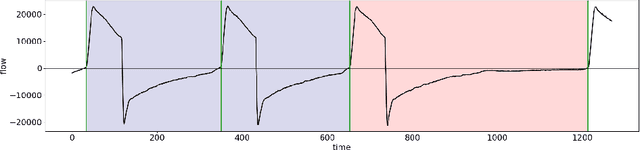
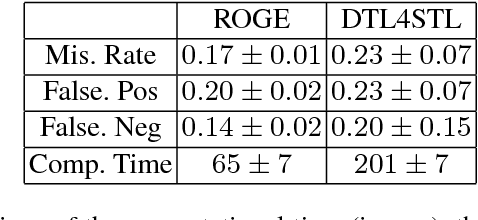
We consider the problem of mining signal temporal logical requirements from a dataset of regular (good) and anomalous (bad) trajectories of a dynamical system. We assume the training set to be labeled by human experts and that we have access only to a limited amount of data, typically noisy. We provide a systematic approach to synthesize both the syntactical structure and the parameters of the temporal logic formula using a two-steps procedure: first, we leverage a novel evolutionary algorithm for learning the structure of the formula; second, we perform the parameter synthesis operating on the statistical emulation of the average robustness for a candidate formula w.r.t. its parameters. We compare our results with our previous work [{BufoBSBLB14] and with a recently proposed decision-tree [bombara_decision_2016] based method. We present experimental results on two case studies: an anomalous trajectory detection problem of a naval surveillance system and the characterization of an Ineffective Respiratory effort, showing the usefulness of our work.