 Add to Chrome
 Add to Firefox
 Add to Edge
Recovering the Zipfian Distribution in Unsupervised Term Discovery
Jun 09, 2026
Unsupervised term discovery involves segmenting unlabelled speech into word- or syllable-like units and clustering these into a lexicon of candidate types. True lexicons follow a Zipfian distribution, yet the dominant centre-based clustering approach -- K-means -- produces a more uniform distribution due to an inductive bias toward spherical clusters. In this paper we revisit graph-based clustering as a bottom-up alternative, where segment embeddings are connected by pairwise similarity and partitioned using the Leiden algorithm. We show that graph clustering substantially outperforms centre-based approaches (K-means, GMM, BIRCH) in both word- and syllable-level lexicon discovery across three languages, producing more Zipf-like distributions. Another bottom-up approach, agglomerative clustering with average linkage, also performs well, although it is computationally less efficient and allows for less control over the resulting distribution. Our work calls into question the dominance of centre-based clustering for term discovery, and promotes graph clustering as an attractive alternative.

Revisiting Lexicon Evaluation in Unsupervised Word Discovery
Jun 04, 2026Building a lexicon from discovered word-like units is a central goal in zero-resource speech processing. But do our evaluations provide a trustworthy indication of lexicon quality? A common metric, normalized edit distance, averages the phoneme edit distances between discovered units in each cluster. We show that this metric has an inherent bias toward the quality of large clusters, inhibiting fair evaluation. Moreover, it ignores how well true classes are distributed across clusters. Based on established theory in clustering literature, we propose two metrics that address these shortcomings: a modified metric that weighs cluster size when assessing within-cluster consistency, and an inverse metric that assesses how true words are spread across clusters. Through experiments on synthetic and real-world lexicons, we demonstrate that combined, these metrics are: (1) more closely correlated with how similar a lexicon is to the ground-truth distribution, and (2) more robust to biases that skew lexicon evaluations.
ZeroSyl: Simple Zero-Resource Syllable Tokenization for Spoken Language Modeling
Feb 17, 2026Pure speech language models aim to learn language directly from raw audio without textual resources. A key challenge is that discrete tokens from self-supervised speech encoders result in excessively long sequences, motivating recent work on syllable-like units. However, methods like Sylber and SyllableLM rely on intricate multi-stage training pipelines. We propose ZeroSyl, a simple training-free method to extract syllable boundaries and embeddings directly from a frozen WavLM model. Using L2 norms of features in WavLM's intermediate layers, ZeroSyl achieves competitive syllable segmentation performance. The resulting segments are mean-pooled, discretized using K-means, and used to train a language model. ZeroSyl outperforms prior syllabic tokenizers across lexical, syntactic, and narrative benchmarks. Scaling experiments show that while finer-grained units are beneficial for lexical tasks, our discovered syllabic units exhibit better scaling behavior for syntactic modeling.
Unsupervised Word Discovery: Boundary Detection with Clustering vs. Dynamic Programming
Sep 22, 2024
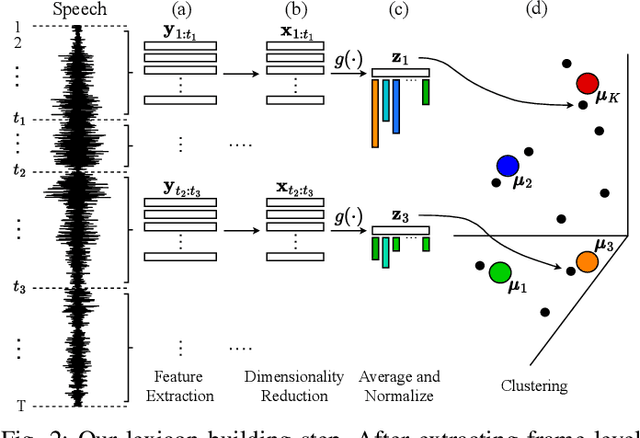

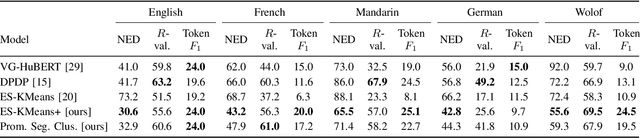
We look at the long-standing problem of segmenting unlabeled speech into word-like segments and clustering these into a lexicon. Several previous methods use a scoring model coupled with dynamic programming to find an optimal segmentation. Here we propose a much simpler strategy: we predict word boundaries using the dissimilarity between adjacent self-supervised features, then we cluster the predicted segments to construct a lexicon. For a fair comparison, we update the older ES-KMeans dynamic programming method with better features and boundary constraints. On the five-language ZeroSpeech benchmarks, our simple approach gives similar state-of-the-art results compared to the new ES-KMeans+ method, while being almost five times faster.