 Add to Chrome
 Add to Firefox
 Add to Edge
Multi-DNN Inference of Sparse Models on Edge SoCs
Mar 10, 2026
Modern edge applications increasingly require multi-DNN inference systems to execute tasks on heterogeneous processors, gaining performance from both concurrent execution and from matching each model to the most suited accelerator. However, existing systems support only a single model (or a few sparse variants) per task, which impedes the efficiency of this matching and results in high Service Level Objective violation rates. We introduce model stitching for multi-DNN inference systems, which creates model variants by recombining subgraphs from sparse models without re-training. We present a demonstrator system, SparseLoom, that shows model stitching can be deployed to SoCs. We show experimentally that SparseLoom reduces SLO violation rates by up to 74%, improves throughput by up to 2.31x, and lowers memory overhead by an average of 28% compared to state-of-the-art multi-DNN inference systems.

Autonomous Fault Detection in Self-Healing Systems using Restricted Boltzmann Machines
Jan 07, 2015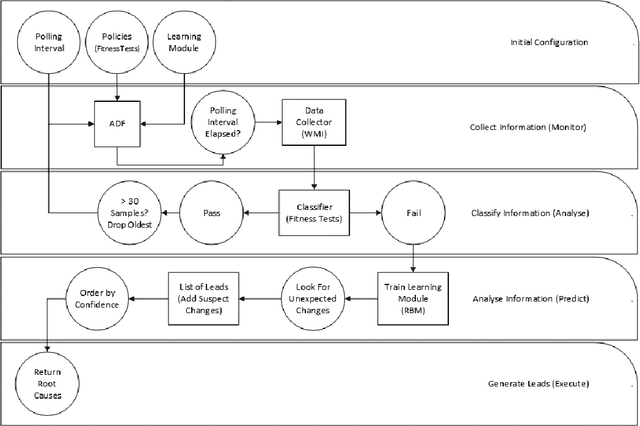
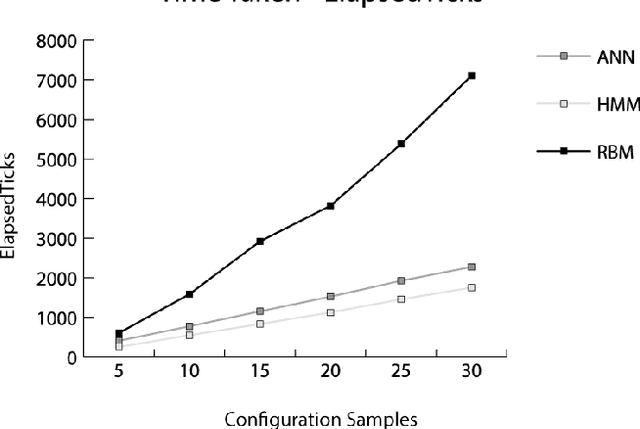
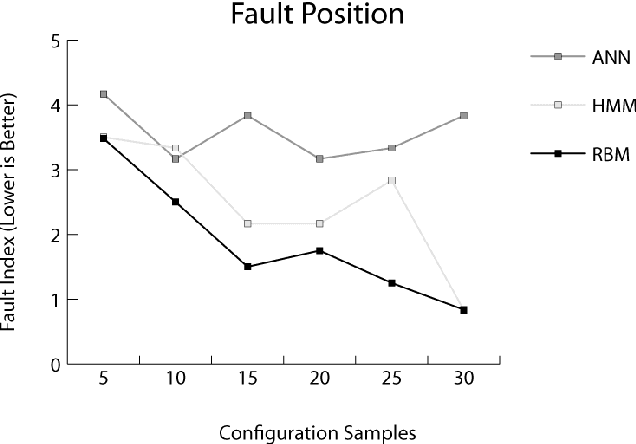
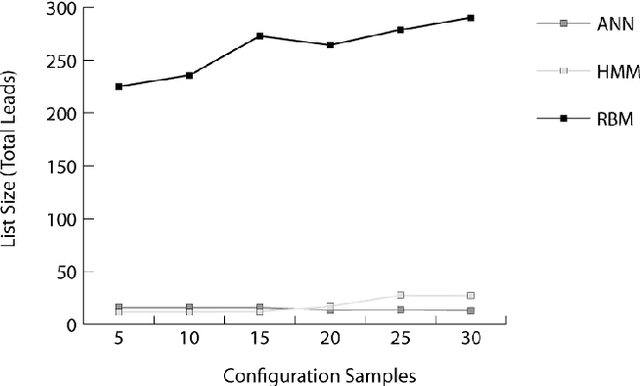
Autonomously detecting and recovering from faults is one approach for reducing the operational complexity and costs associated with managing computing environments. We present a novel methodology for autonomously generating investigation leads that help identify systems faults, and extends our previous work in this area by leveraging Restricted Boltzmann Machines (RBMs) and contrastive divergence learning to analyse changes in historical feature data. This allows us to heuristically identify the root cause of a fault, and demonstrate an improvement to the state of the art by showing feature data can be predicted heuristically beyond a single instance to include entire sequences of information.