 Add to Chrome
 Add to Firefox
 Add to Edge
Faithful, Sufficient and Understandable: Rethinking Graph Counterfactual Explanations via Discrete Diffusion Inversion
Aug 12, 2026
Graph Neural Networks (GNNs) achieve strong predictive performance on graph-structured data across domains such as chemistry, biology, and network analysis, yet they provide no intrinsic explanation of their predictions. This limits their adoption in high-stakes and safety-critical settings. Counterfactual explanations address this by revealing the minimal structural modifications that would change a model's prediction. On graphs, however, such a modification is hard to produce. The search space is discrete and combinatorial, and a valid answer must respect categorical node and edge types together with domain rules such as chemical valency in the case of molecular graphs. Existing explainers give up one of two things. Either edits are not held on the data manifold, or the search does not span the full edit space. We propose Graph Diffusion Counterfactual Explanation via Inversion (GDCE-I), which gives up neither. A discrete denoising diffusion model with a novel discrete inversion scheme enables distribution-aware edits leveraging the whole domain edit space. We further address the incomplete and inconsistent evaluation of graph counterfactuals by deriving a framework of explanation desiderata and applying it to every method under one shared protocol. Across four benchmarks, GDCE-I outperforms related work by a large margin on the defined framework. For the molecular domain, we further qualitatively show that GDCE-I attains interpretable in-distribution solutions.

Reproducibility study on how to find Spurious Correlations, Shortcut Learning, Clever Hans or Group-Distributional non-robustness and how to fix them
Apr 06, 2026Deep Neural Networks (DNNs) are increasingly utilized in high-stakes domains like medical diagnostics and autonomous driving where model reliability is critical. However, the research landscape for ensuring this reliability is terminologically fractured across communities that pursue the same goal of ensuring models rely on causally relevant features rather than confounding signals. While frameworks such as distributionally robust optimization (DRO), invariant risk minimization (IRM), shortcut learning, simplicity bias, and the Clever Hans effect all address model failure due to spurious correlations, researchers typically only reference work within their own domains. This reproducibility study unifies these perspectives through a comparative analysis of correction methods under challenging constraints like limited data availability and severe subgroup imbalance. We evaluate recently proposed correction methods based on explainable artificial intelligence (XAI) techniques alongside popular non-XAI baselines using both synthetic and real-world datasets. Findings show that XAI-based methods generally outperform non-XAI approaches, with Counterfactual Knowledge Distillation (CFKD) proving most consistently effective at improving generalization. Our experiments also reveal that the practical application of many methods is hindered by a dependency on group labels, as manual annotation is often infeasible and automated tools like Spectral Relevance Analysis (SpRAy) struggle with complex features and severe imbalance. Furthermore, the scarcity of minority group samples in validation sets renders model selection and hyperparameter tuning unreliable, posing a significant obstacle to the deployment of robust and trustworthy models in safety-critical areas.
SCE-LITE-HQ: Smooth visual counterfactual explanations with generative foundation models
Mar 17, 2026Modern neural networks achieve strong performance but remain difficult to interpret in high-dimensional visual domains. Counterfactual explanations (CFEs) provide a principled approach to interpreting black-box predictions by identifying minimal input changes that alter model outputs. However, existing CFE methods often rely on dataset-specific generative models and incur substantial computational cost, limiting their scalability to high-resolution data. We propose SCE-LITE-HQ, a scalable framework for counterfactual generation that leverages pretrained generative foundation models without task-specific retraining. The method operates in the latent space of the generator, incorporates smoothed gradients to improve optimization stability, and applies mask-based diversification to promote realistic and structurally diverse counterfactuals. We evaluate SCE-LITE-HQ on natural and medical datasets using a desiderata-driven evaluation protocol. Results show that SCE-LITE-HQ produces valid, realistic, and diverse counterfactuals competitive with or outperforming existing baselines, while avoiding the overhead of training dedicated generative models.
Protein Counterfactuals via Diffusion-Guided Latent Optimization
Mar 11, 2026Deep learning models can predict protein properties with unprecedented accuracy but rarely offer mechanistic insight or actionable guidance for engineering improved variants. When a model flags an antibody as unstable, the protein engineer is left without recourse: which mutations would rescue stability while preserving function? We introduce Manifold-Constrained Counterfactual Optimization for Proteins (MCCOP), a framework that computes minimal, biologically plausible sequence edits that flip a model's prediction to a desired target state. MCCOP operates in a continuous joint sequence-structure latent space and employs a pretrained diffusion model as a manifold prior, balancing three objectives: validity (achieving the target property), proximity (minimizing mutations), and plausibility (producing foldable proteins). We evaluate MCCOP on three protein engineering tasks - GFP fluorescence rescue, thermodynamic stability enhancement, and E3 ligase activity recovery - and show that it generates sparser, more plausible counterfactuals than both discrete and continuous baselines. The recovered mutations align with known biophysical mechanisms, including chromophore packing and hydrophobic core consolidation, establishing MCCOP as a tool for both model interpretation and hypothesis-driven protein design. Our code is publicly available at github.com/weroks/mccop.
Visual Disentangled Diffusion Autoencoders: Scalable Counterfactual Generation for Foundation Models
Jan 29, 2026Foundation models, despite their robust zero-shot capabilities, remain vulnerable to spurious correlations and 'Clever Hans' strategies. Existing mitigation methods often rely on unavailable group labels or computationally expensive gradient-based adversarial optimization. To address these limitations, we propose Visual Disentangled Diffusion Autoencoders (DiDAE), a novel framework integrating frozen foundation models with disentangled dictionary learning for efficient, gradient-free counterfactual generation directly for the foundation model. DiDAE first edits foundation model embeddings in interpretable disentangled directions of the disentangled dictionary and then decodes them via a diffusion autoencoder. This allows the generation of multiple diverse, disentangled counterfactuals for each factual, much faster than existing baselines, which generate single entangled counterfactuals. When paired with Counterfactual Knowledge Distillation, DiDAE-CFKD achieves state-of-the-art performance in mitigating shortcut learning, improving downstream performance on unbalanced datasets.
Imbalanced Classification through the Lens of Spurious Correlations
Oct 31, 2025Class imbalance poses a fundamental challenge in machine learning, frequently leading to unreliable classification performance. While prior methods focus on data- or loss-reweighting schemes, we view imbalance as a data condition that amplifies Clever Hans (CH) effects by underspecification of minority classes. In a counterfactual explanations-based approach, we propose to leverage Explainable AI to jointly identify and eliminate CH effects emerging under imbalance. Our method achieves competitive classification performance on three datasets and demonstrates how CH effects emerge under imbalance, a perspective largely overlooked by existing approaches.
Towards Desiderata-Driven Design of Visual Counterfactual Explainers
Jun 17, 2025Visual counterfactual explainers (VCEs) are a straightforward and promising approach to enhancing the transparency of image classifiers. VCEs complement other types of explanations, such as feature attribution, by revealing the specific data transformations to which a machine learning model responds most strongly. In this paper, we argue that existing VCEs focus too narrowly on optimizing sample quality or change minimality; they fail to consider the more holistic desiderata for an explanation, such as fidelity, understandability, and sufficiency. To address this shortcoming, we explore new mechanisms for counterfactual generation and investigate how they can help fulfill these desiderata. We combine these mechanisms into a novel 'smooth counterfactual explorer' (SCE) algorithm and demonstrate its effectiveness through systematic evaluations on synthetic and real data.
Diffusion Counterfactuals for Image Regressors
Mar 26, 2025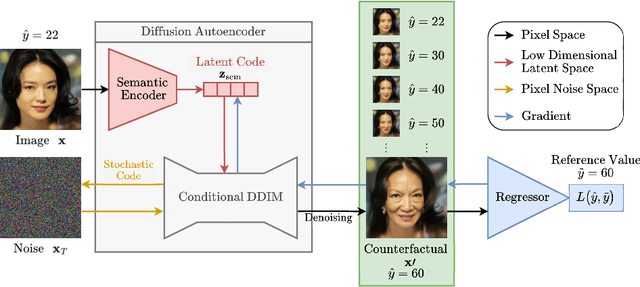

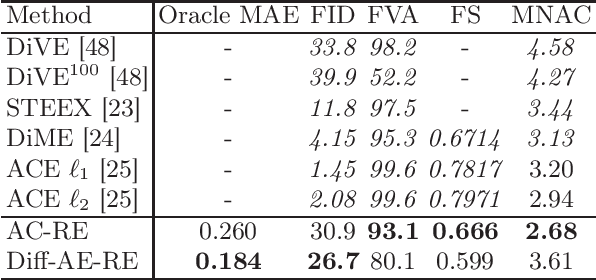
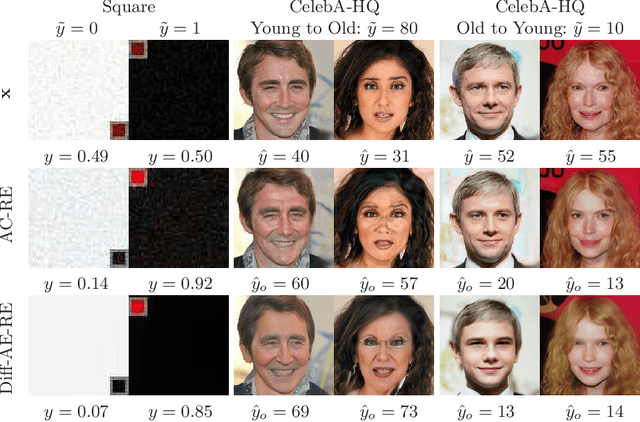
Counterfactual explanations have been successfully applied to create human interpretable explanations for various black-box models. They are handy for tasks in the image domain, where the quality of the explanations benefits from recent advances in generative models. Although counterfactual explanations have been widely applied to classification models, their application to regression tasks remains underexplored. We present two methods to create counterfactual explanations for image regression tasks using diffusion-based generative models to address challenges in sparsity and quality: 1) one based on a Denoising Diffusion Probabilistic Model that operates directly in pixel-space and 2) another based on a Diffusion Autoencoder operating in latent space. Both produce realistic, semantic, and smooth counterfactuals on CelebA-HQ and a synthetic data set, providing easily interpretable insights into the decision-making process of the regression model and reveal spurious correlations. We find that for regression counterfactuals, changes in features depend on the region of the predicted value. Large semantic changes are needed for significant changes in predicted values, making it harder to find sparse counterfactuals than with classifiers. Moreover, pixel space counterfactuals are more sparse while latent space counterfactuals are of higher quality and allow bigger semantic changes.
An Analysis of Human Alignment of Latent Diffusion Models
Mar 13, 2024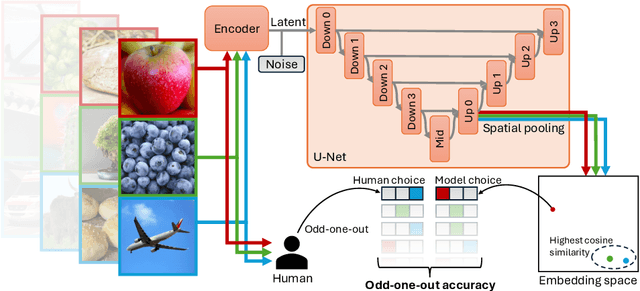
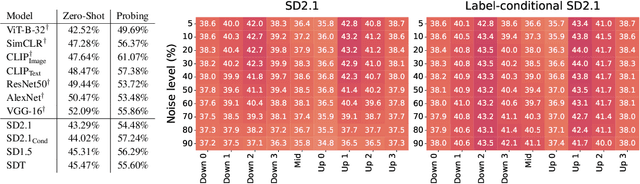
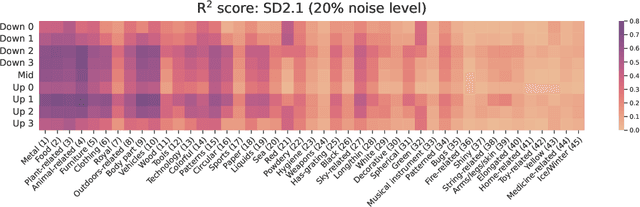
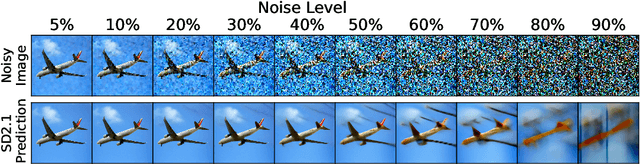
Diffusion models, trained on large amounts of data, showed remarkable performance for image synthesis. They have high error consistency with humans and low texture bias when used for classification. Furthermore, prior work demonstrated the decomposability of their bottleneck layer representations into semantic directions. In this work, we analyze how well such representations are aligned to human responses on a triplet odd-one-out task. We find that despite the aforementioned observations: I) The representational alignment with humans is comparable to that of models trained only on ImageNet-1k. II) The most aligned layers of the denoiser U-Net are intermediate layers and not the bottleneck. III) Text conditioning greatly improves alignment at high noise levels, hinting at the importance of abstract textual information, especially in the early stage of generation.
Towards Fixing Clever-Hans Predictors with Counterfactual Knowledge Distillation
Oct 03, 2023This paper introduces a novel technique called counterfactual knowledge distillation (CFKD) to detect and remove reliance on confounders in deep learning models with the help of human expert feedback. Confounders are spurious features that models tend to rely on, which can result in unexpected errors in regulated or safety-critical domains. The paper highlights the benefit of CFKD in such domains and shows some advantages of counterfactual explanations over other types of explanations. We propose an experiment scheme to quantitatively evaluate the success of CFKD and different teachers that can give feedback to the model. We also introduce a new metric that is better correlated with true test performance than validation accuracy. The paper demonstrates the effectiveness of CFKD on synthetically augmented datasets and on real-world histopathological datasets.