 Add to Chrome
 Add to Firefox
 Add to Edge
Graph Neural Networks for Interferometer Simulations
Dec 18, 2025

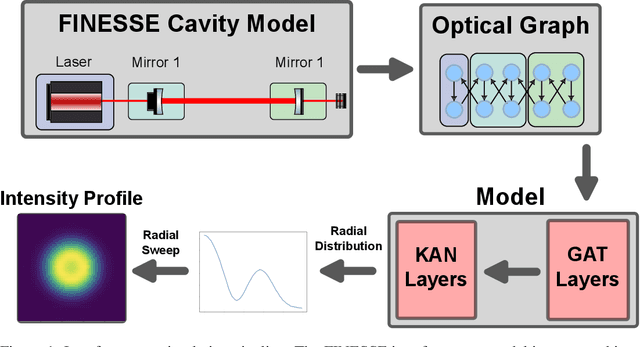
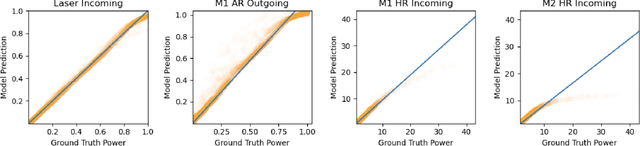
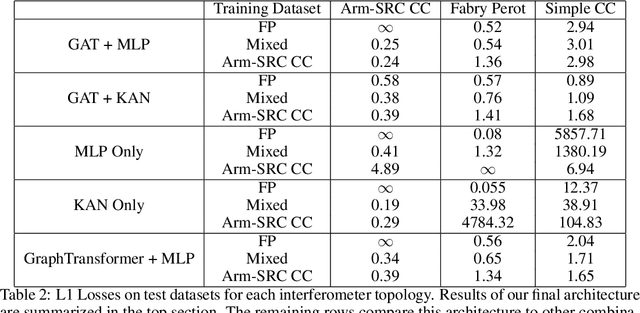
In recent years, graph neural networks (GNNs) have shown tremendous promise in solving problems in high energy physics, materials science, and fluid dynamics. In this work, we introduce a new application for GNNs in the physical sciences: instrumentation design. As a case study, we apply GNNs to simulate models of the Laser Interferometer Gravitational-Wave Observatory (LIGO) and show that they are capable of accurately capturing the complex optical physics at play, while achieving runtimes 815 times faster than state of the art simulation packages. We discuss the unique challenges this problem provides for machine learning models. In addition, we provide a dataset of high-fidelity optical physics simulations for three interferometer topologies, which can be used as a benchmarking suite for future work in this direction.

CosmoFlow: Scale-Aware Representation Learning for Cosmology with Flow Matching
Jul 16, 2025Generative machine learning models have been demonstrated to be able to learn low dimensional representations of data that preserve information required for downstream tasks. In this work, we demonstrate that flow matching based generative models can learn compact, semantically rich latent representations of field level cold dark matter (CDM) simulation data without supervision. Our model, CosmoFlow, learns representations 32x smaller than the raw field data, usable for field level reconstruction, synthetic data generation, and parameter inference. Our model also learns interpretable representations, in which different latent channels correspond to features at different cosmological scales.