 Add to Chrome
 Add to Firefox
 Add to Edge
VENOM: Versatile Embodied Network for Omni-bodied Motion tracking
Jun 15, 2026
Achieving expert-level expressive full-body motion tracking across multiple humanoids solely from demonstration data remains a challenging and relatively an underexplored problem in humanoid robot learning. Cross-embodiment motion tracking policies are mostly trained by decoupling the control problem into upper and lower body control. This work proposes VENOM, a cross-embodiment full-body motion tracking model for humanoids in simulation. VENOM is a GPT-based motion tracker trained on multiple humanoid data that can track the entire body without the requirement to split into upper and lower body control. We curate a multi-humanoid motion tracking dataset called the VENOM dataset that contains states, actions, and rewards and train VENOM and the baselines on this dataset. In this letter, we evaluate VENOM's performance against baselines and show that we can achieve a stable motion tracker across different humanoids more capable than an MLP trained on multiple humanoid data with supervised learning alone, and also show that despite lack of reward feedback, VENOM closely matches the tracking capability of experts that were trained using asymmetric-actor critic reinforcement learning.

Data-Efficient Approach to Humanoid Control via Fine-Tuning a Pre-Trained GPT on Action Data
May 29, 2024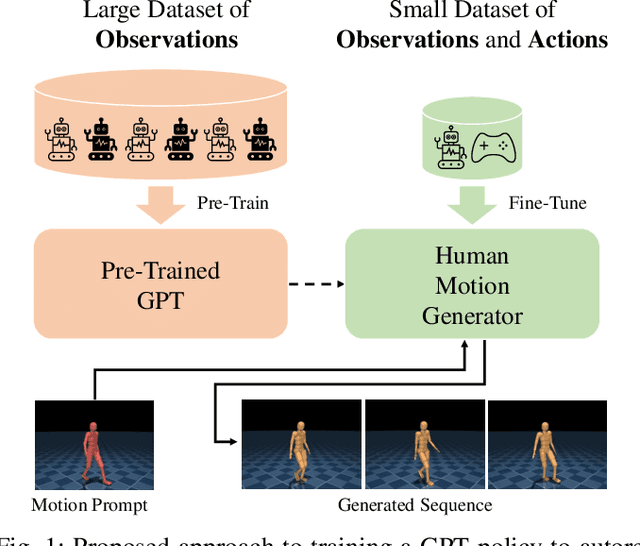
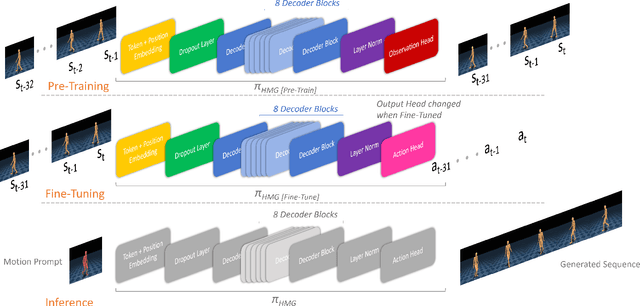
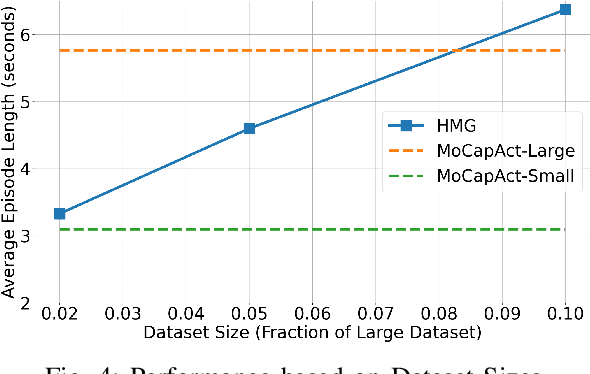
There are several challenges in developing a model for multi-tasking humanoid control. Reinforcement learning and imitation learning approaches are quite popular in this domain. However, there is a trade-off between the two. Reinforcement learning is not the best option for training a humanoid to perform multiple behaviors due to training time and model size, and imitation learning using kinematics data alone is not appropriate to realize the actual physics of the motion. Training models to perform multiple complex tasks take long training time due to high DoF and complexities of the movements. Although training models offline would be beneficial, another issue is the size of the dataset, usually being quite large to encapsulate multiple movements. Many papers have implemented state of the art deep learning models such as transformers to control humanoid characters and predict their motion based on a large dataset of recorded/reference motion. In this paper, we train a GPT on a large dataset of noisy expert policy rollout observations from a humanoid motion dataset as a pre-trained model and fine tune that model on a smaller dataset of noisy expert policy rollout observations and actions to autoregressively generate physically plausible motion trajectories. We show that it is possible to train a GPT-based foundation model on a smaller dataset in shorter training time to control a humanoid in a realistic physics environment to perform human-like movements.