 Add to Chrome
 Add to Firefox
 Add to Edge
How Far Do Simple Transformations Translate Across Text Embedding Models?
Aug 06, 2026
We investigate whether simple transformations can translate representations across heterogeneous text embedding models. Understanding how independently trained models organize semantic information is an enabler for AI-to-AI latent communication without decoding into human-readable text. Focusing on lightweight translators such as linear mappings, we test the literature hypothesis of latent universality in a realistic text setting beyond simplified benchmarks. Across nine embedding models differing in architecture, pooling strategy, and training objective, we evaluate compatibility using CKA, downstream transfer, fidelity, and retrieval. Simple translators recover meaningful shared structure and support transfer for some compatible pairs, but fail sharply for others. Compatibility depends jointly on architecture, training objective, pooling, and data distribution. Overall, the results show that heterogeneous embedding spaces are not universally related by simple mappings as often suggested in some literature.

Self-supervised classification of dynamic obstacles using the temporal information provided by videos
Oct 21, 2019
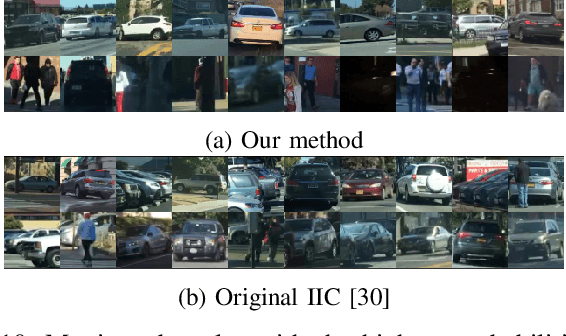
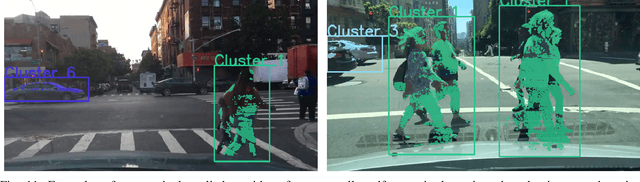
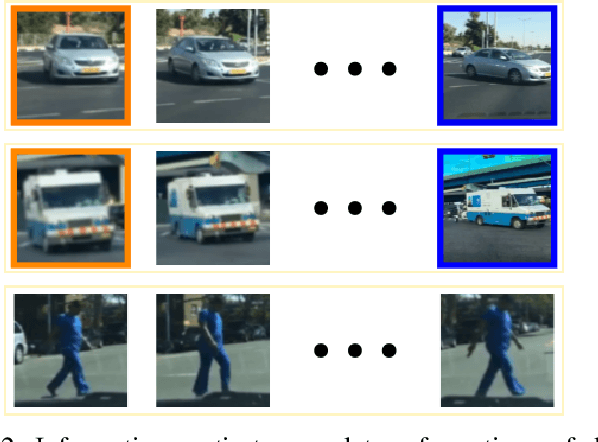
Nowadays, autonomous driving systems can detect, segment, and classify the surrounding obstacles using a monocular camera. However, state-of-the-art methods solving these tasks generally perform a fully supervised learning process and require a large amount of training labeled data. On another note, some self-supervised learning approaches can deal with detection and segmentation of dynamic obstacles using the temporal information available in video sequences. In this work, we propose in addition to classifiy the detected obstacles depending on their motion pattern. We present a novel self-supervised framework consisting of learning offline clusters from temporal patch sequences and using these clusters as pseudo labels to train a real-time image classifier. The presented model outperforms state-of-the-art unsupervised image classification methods on BDD100K dataset.