 Add to Chrome
 Add to Firefox
 Add to Edge
How Far Do Simple Transformations Translate Across Text Embedding Models?
Aug 06, 2026
We investigate whether simple transformations can translate representations across heterogeneous text embedding models. Understanding how independently trained models organize semantic information is an enabler for AI-to-AI latent communication without decoding into human-readable text. Focusing on lightweight translators such as linear mappings, we test the literature hypothesis of latent universality in a realistic text setting beyond simplified benchmarks. Across nine embedding models differing in architecture, pooling strategy, and training objective, we evaluate compatibility using CKA, downstream transfer, fidelity, and retrieval. Simple translators recover meaningful shared structure and support transfer for some compatible pairs, but fail sharply for others. Compatibility depends jointly on architecture, training objective, pooling, and data distribution. Overall, the results show that heterogeneous embedding spaces are not universally related by simple mappings as often suggested in some literature.

Learning Compression Rules for Network Traffic
Aug 05, 2026We study the problem of learning compact rule-based compressors for structured network traffic. Each packet is a record of header fields that are highly redundant within a flow, and a compressor is a small set of rules matching such records and replacing predictable fields with short codes. We cast rule learning as a two-stage problem: (i) an unsupervised structure-discovery stage that recursively partitions training packets using a normalized entropy-ratio criterion robust to small samples, and (ii) a constrained selection stage that uses dynamic programming to pick the rule subset maximizing expected compression gain under a hard budget on the number of installable rules. We instantiate the framework on Static Context Header Compression (SCHC), the IETF standard for rule-based header compression in constrained networks, and evaluate it on four real-world Internet-of-Things and 5G core-network datasets. Our method, Robust Entropy Clustering for Adaptive comPression (RECAP), surpasses expert-engineered rule sets with a small number of learned rules and removes the need for manual rule design.
Learning High-Dimensional Parity Functions with Product Networks using Gradient Descent
May 27, 2026Parity functions are fundamental Boolean operations with critical applications across machine learning, cryptography, and error correction. Yet, learning high-dimensional parity functions poses significant challenges: in a general setting, standard neural network architectures typically require exponential sample complexity, making gradient-based optimization intractable for large number of inputs $N$. We demonstrate that compact product-based neural architectures combined with stochastic data sparsity (Bernoulli inputs with $p_e \leq 1/N$) and appropriate hyperparameter choice enable efficient parity learning, with theoretical guarantees of convergence. Experiments validate our theory across dimensions up to $N = 100{,}000$, with empirical evidence showing optimal hyperparameter choices for $p_e$ and learning rate $α$, as well as polynomial complexity scaling laws. This work establishes fundamental connections between architectural inductive bias and data sparsity, opening new possibilities for neural arithmetic, structured reasoning, binary neural networks, and machine learning applied to automated protocol discovery.
Learning Linear Block Codes with Gradient Quantization
Mar 20, 2025This study investigates the problem of learning linear block codes optimized for Belief-Propagation decoders significantly improving performance compared to the state-of-the-art. Our previous research is extended with an enhanced system design that facilitates a more effective learning process for the parity check matrix. We simplify the input dataset, restrict the number of parameters to learn and improve the gradient back-propagation within the model. We also introduce novel optimizers specifically designed for discrete-valued weights. Based on conventional gradient computation, these optimizers provide discrete weights updates, enabling finer control and improving explainability of the learning process. Through these changes, we consistently achieve improved code performance, provided appropriately chosen hyper-parameters. To rigorously evaluate the performance of learned codes in the context of short to medium block lengths, we propose a comprehensive code performance assessment framework. This framework enables a fair comparison between our learning methodology and random search approaches, ensuring statistical significance in our results. The proposed model pave the way for a new approach to the efficient learning of linear block codes tailored to specific decoder structures.
Minimizing Energy Consumption for 5G NR Beam Management for RedCap Devices
Sep 26, 2023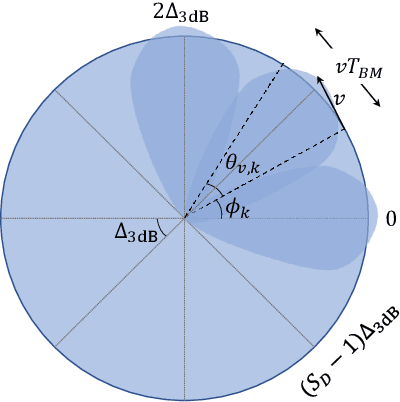
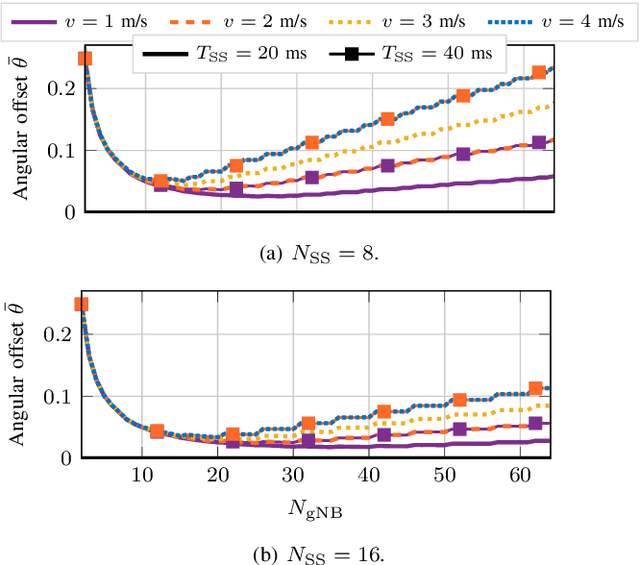
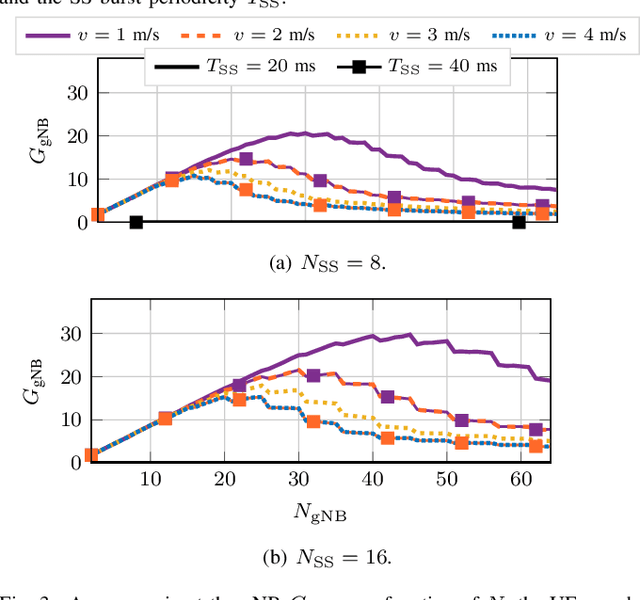
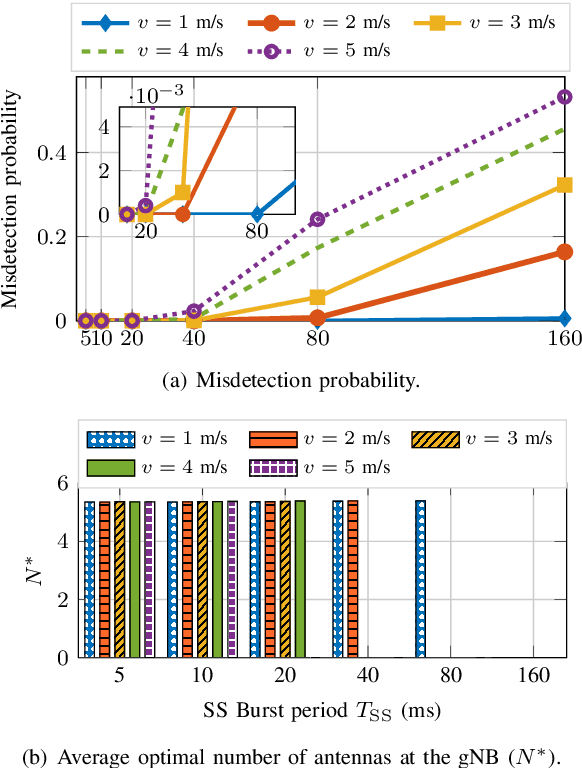
In 5G New Radio (NR), beam management entails periodic and continuous transmission and reception of control signals in the form of synchronization signal blocks (SSBs), used to perform initial access and/or channel estimation. However, this procedure demands continuous energy consumption, which is particularly challenging to handle for low-cost, low-complexity, and battery-constrained devices, such as RedCap devices to support mid-market Internet of Things (IoT) use cases. In this context, this work aims at reducing the energy consumption during beam management for RedCap devices, while ensuring that the desired Quality of Service (QoS) requirements are met. To do so, we formalize an optimization problem in an Indoor Factory (InF) scenario to select the best beam management parameters, including the beam update periodicity and the beamwidth, to minimize energy consumption based on users' distribution and their speed. The analysis yields the regions of feasibility, i.e., the upper limit(s) on the beam management parameters for RedCap devices, that we use to provide design guidelines accordingly.
Can 5G NR-Light Operate at Millimeter Waves? Design Guidelines for Mid-Market IoT Use Cases
Sep 30, 2021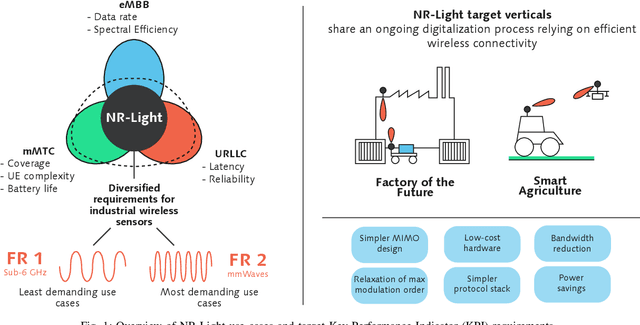
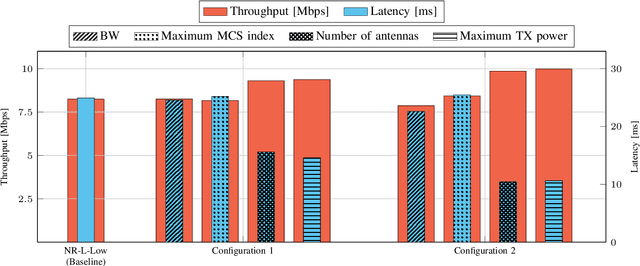
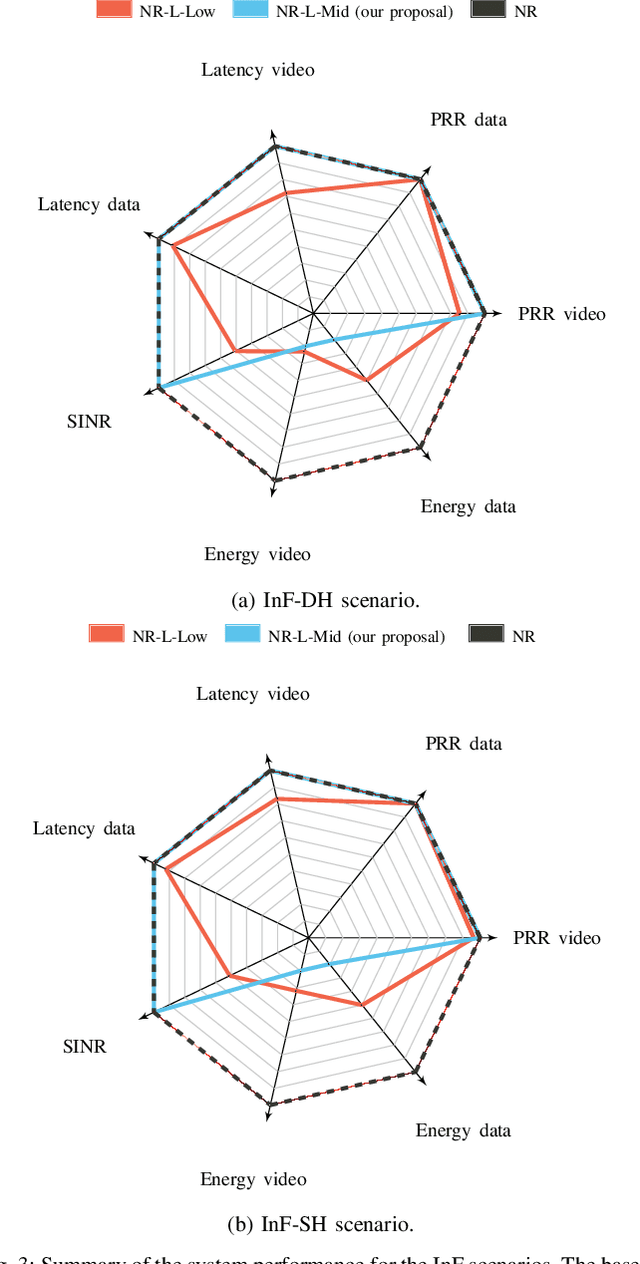
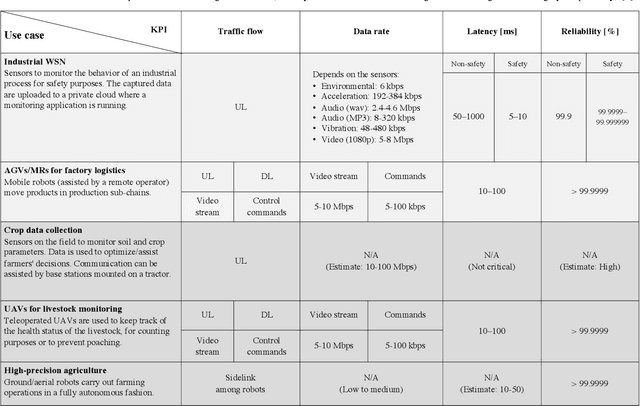
5th generation (5G) systems have been designed with three main objectives in mind: increasing throughput, reducing latency, and enabling reliable communications. To meet these (often conflicting) constraints, in 2019 the 3GPP released a set of specifications for 5G NR, one of the main innovations being the support for communications in the millimeter wave (mmWave) bands. However, how to implement lower complexity, energy efficient, mid-market Internet of Things (IoT) applications is still an on-going investigation, currently led by the 3GPP which is extending the NR standard with NR-Light specifications to support devices with reduced capabilities (REDCAP). In this paper we investigate the feasibility of operating such devices at mmWaves, in view of the requirements and expectations for NR- Light applications in terms of cost and complexity, throughput, and latency. Contributions of this paper are threefold. First, we il- lustrate the potential of mmWave communication for mid-market IoT use cases. Then, we highlight and motivate the design of an NR-Light candidate interface derived from NR by a selection of features. Finally, we demonstrate the technical soundness of this interface in an industrial IoT setup via simulations.