 Add to Chrome
 Add to Firefox
 Add to Edge
A Parameter-Free First-Order Algorithm for Non-Convex Optimization with $\tilde{\mkern1mu O}(ε^{-5/3})$ Global Rate
May 04, 2026
We introduce PF-AGD, the first parameter-free, deterministic, accelerated first-order method to achieve $O(ε^{-5/3}\log(1/ε))$ oracle complexity bound when minimizing sufficiently smooth, non-convex functions; this is the best-known bound for first-order methods on smooth non-convex objectives. Unlike existing methods possessing this rate that require a priori knowledge of smoothness constants, we use an adaptive backtracking scheme and a gradient-based restart mechanism to estimate local curvature. This yields a practical algorithm that matches best-known theoretical rates. Empirically, PF-AGD outperforms the practical variant of AGD-Until-Guilty (Carmon et al., 2017), as well as other parameter-free variants, and is a viable alternative to nonlinear conjugate gradient methods.

GPTree: Towards Explainable Decision-Making via LLM-powered Decision Trees
Nov 13, 2024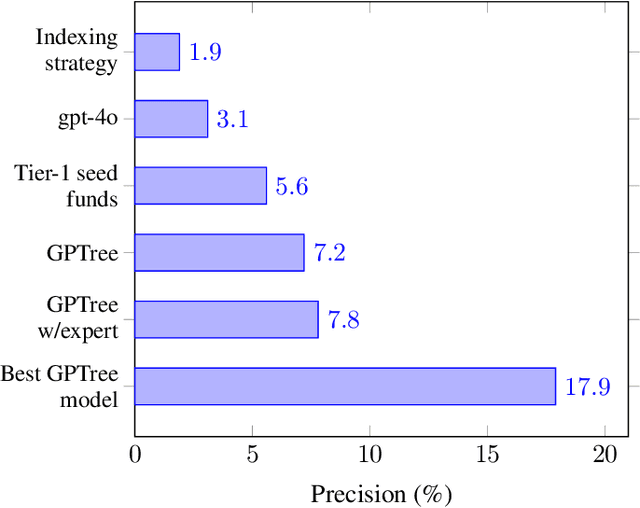
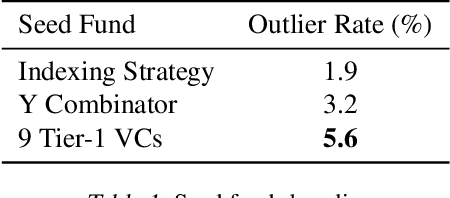
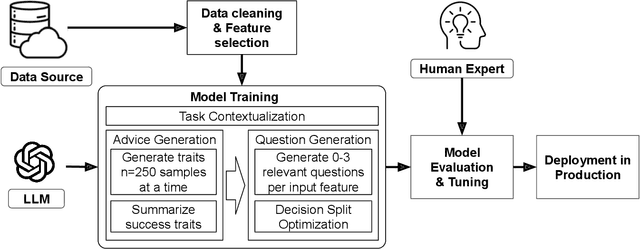
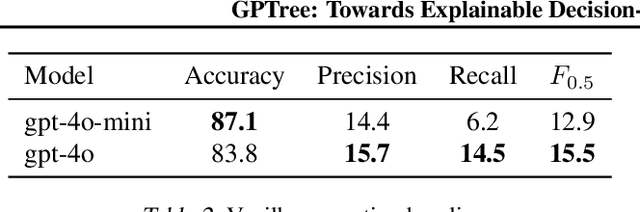
Traditional decision tree algorithms are explainable but struggle with non-linear, high-dimensional data, limiting its applicability in complex decision-making. Neural networks excel at capturing complex patterns but sacrifice explainability in the process. In this work, we present GPTree, a novel framework combining explainability of decision trees with the advanced reasoning capabilities of LLMs. GPTree eliminates the need for feature engineering and prompt chaining, requiring only a task-specific prompt and leveraging a tree-based structure to dynamically split samples. We also introduce an expert-in-the-loop feedback mechanism to further enhance performance by enabling human intervention to refine and rebuild decision paths, emphasizing the harmony between human expertise and machine intelligence. Our decision tree achieved a 7.8% precision rate for identifying "unicorn" startups at the inception stage of a startup, surpassing gpt-4o with few-shot learning as well as the best human decision-makers (3.1% to 5.6%).
Founder-GPT: Self-play to evaluate the Founder-Idea fit
Dec 20, 2023This research introduces an innovative evaluation method for the "founder-idea" fit in early-stage startups, utilizing advanced large language model techniques to assess founders' profiles against their startup ideas to enhance decision-making. Embeddings, self-play, tree-of-thought, and critique-based refinement techniques show early promising results that each idea's success patterns are unique and they should be evaluated based on the context of the founder's background.