 Add to Chrome
 Add to Firefox
 Add to Edge
Tight Bounds for Learning Polyhedra with a Margin
Apr 16, 2026
We give an algorithm for PAC learning intersections of $k$ halfspaces with a $ρ$ margin to within error $\varepsilon$ that runs in time $\textsf{poly}(k, \varepsilon^{-1}, ρ^{-1}) \cdot \exp \left(O(\sqrt{n \log(1/ρ) \log k})\right)$. Notably, this improves on prior work which had an exponential dependence on either $k$ or $ρ^{-1}$ and matches known cryptographic and Statistical Query lower bounds up to the logarithmic factors in $k$ and $ρ$ in the exponent. Our learning algorithm extends to the more general setting when we are only promised that most points have distance at least $ρ$ from the boundary of the polyhedron, making it applicable to continuous distributions as well.

Target-Specific Action Classification for Automated Assessment of Human Motor Behavior from Video
Sep 20, 2019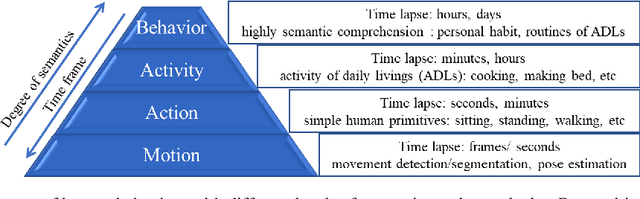
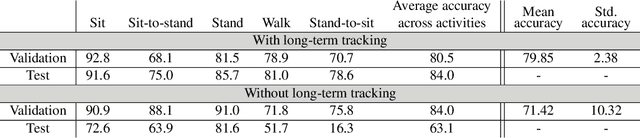
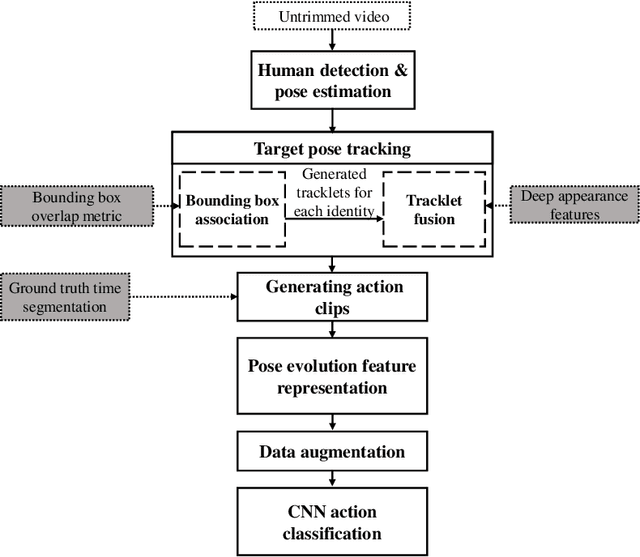
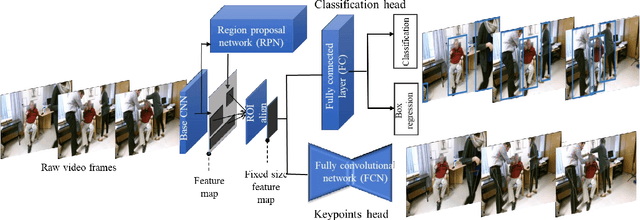
Objective monitoring and assessment of human motor behavior can improve the diagnosis and management of several medical conditions. Over the past decade, significant advances have been made in the use of wearable technology for continuously monitoring human motor behavior in free-living conditions. However, wearable technology remains ill-suited for applications which require monitoring and interpretation of complex motor behaviors (e.g. involving interactions with the environment). Recent advances in computer vision and deep learning have opened up new possibilities for extracting information from video recordings. In this paper, we present a hierarchical vision-based behavior phenotyping method for classification of basic human actions in video recordings performed using a single RGB camera. Our method addresses challenges associated with tracking multiple human actors and classification of actions in videos recorded in changing environments with different fields of view. We implement a cascaded pose tracker that uses temporal relationships between detections for short-term tracking and appearance-based tracklet fusion for long-term tracking. Furthermore, for action classification, we use pose evolution maps derived from the cascaded pose tracker as low-dimensional and interpretable representations of the movement sequences for training a convolutional neural network. The cascaded pose tracker achieves an average accuracy of 88\% in tracking the target human actor in our video recordings, and overall system achieves average test accuracy of 84\% for target-specific action classification in untrimmed video recordings.