 Add to Chrome
 Add to Firefox
 Add to Edge
TwinLoop: Simulation-in-the-Loop Digital Twins for Online Multi-Agent Reinforcement Learning
Apr 08, 2026
Decentralised online learning enables runtime adaptation in cyber-physical multi-agent systems, but when operating conditions change, learned policies often require substantial trial-and-error interaction before recovering performance. To address this, we propose TwinLoop, a simulation-in-the-loop digital twin framework for online multi-agent reinforcement learning. When a context shift occurs, the digital twin is triggered to reconstruct the current system state, initialise from the latest agent policies, and perform accelerated policy improvement with simulation what-if analysis before synchronising updated parameters back to the agents in the physical system. We evaluate TwinLoop in a vehicular edge computing task-offloading scenario with changing workload and infrastructure conditions. The results suggest that digital twins can improve post-shift adaptation efficiency and reduce reliance on costly online trial-and-error.

A Comprehensive Review on Noise Control of Diffusion Model
Feb 07, 2025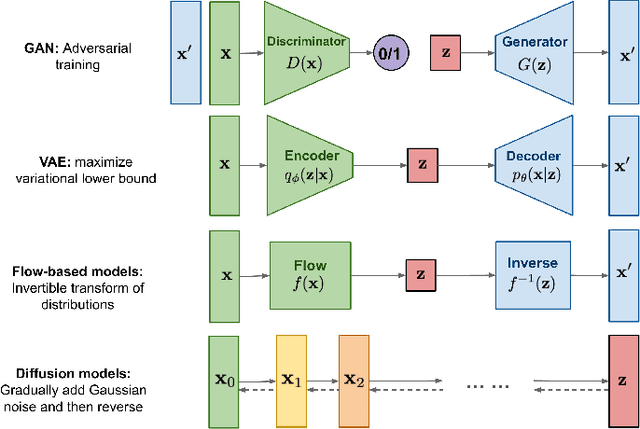
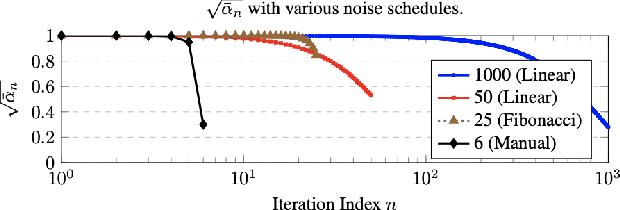
Diffusion models have recently emerged as powerful generative frameworks for producing high-quality images. A pivotal component of these models is the noise schedule, which governs the rate of noise injection during the diffusion process. Since the noise schedule substantially influences sampling quality and training quality, understanding its design and implications is crucial. In this discussion, various noise schedules are examined, and their distinguishing features and performance characteristics are highlighted.
A Comprehensive Study on Quantization Techniques for Large Language Models
Oct 30, 2024Large Language Models (LLMs) have been extensively researched and used in both academia and industry since the rise in popularity of the Transformer model, which demonstrates excellent performance in AI. However, the computational demands of LLMs are immense, and the energy resources required to run them are often limited. For instance, popular models like GPT-3, with 175 billion parameters and a storage requirement of 350 GB, present significant challenges for deployment on resource-constrained IoT devices and embedded systems. These systems often lack the computational capacity to handle such large models. Quantization, a technique that reduces the precision of model values to a smaller set of discrete values, offers a promising solution by reducing the size of LLMs and accelerating inference. In this research, we provide a comprehensive analysis of quantization techniques within the machine learning field, with a particular focus on their application to LLMs. We begin by exploring the mathematical theory of quantization, followed by a review of common quantization methods and how they are implemented. Furthermore, we examine several prominent quantization methods applied to LLMs, detailing their algorithms and performance outcomes.