 Add to Chrome
 Add to Firefox
 Add to Edge
OT-ALD: Aligning Latent Distributions with Optimal Transport for Accelerated Image-to-Image Translation
Nov 14, 2025
The Dual Diffusion Implicit Bridge (DDIB) is an emerging image-to-image (I2I) translation method that preserves cycle consistency while achieving strong flexibility. It links two independently trained diffusion models (DMs) in the source and target domains by first adding noise to a source image to obtain a latent code, then denoising it in the target domain to generate the translated image. However, this method faces two key challenges: (1) low translation efficiency, and (2) translation trajectory deviations caused by mismatched latent distributions. To address these issues, we propose a novel I2I translation framework, OT-ALD, grounded in optimal transport (OT) theory, which retains the strengths of DDIB-based approach. Specifically, we compute an OT map from the latent distribution of the source domain to that of the target domain, and use the mapped distribution as the starting point for the reverse diffusion process in the target domain. Our error analysis confirms that OT-ALD eliminates latent distribution mismatches. Moreover, OT-ALD effectively balances faster image translation with improved image quality. Experiments on four translation tasks across three high-resolution datasets show that OT-ALD improves sampling efficiency by 20.29% and reduces the FID score by 2.6 on average compared to the top-performing baseline models.

Solving Prior Distribution Mismatch in Diffusion Models via Optimal Transport
Oct 17, 2024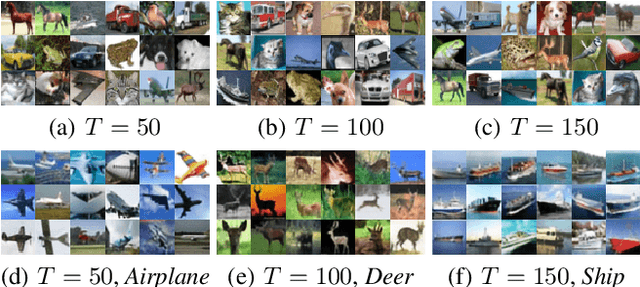


In recent years, the knowledge surrounding diffusion models(DMs) has grown significantly, though several theoretical gaps remain. Particularly noteworthy is prior error, defined as the discrepancy between the termination distribution of the forward process and the initial distribution of the reverse process. To address these deficiencies, this paper explores the deeper relationship between optimal transport(OT) theory and DMs with discrete initial distribution. Specifically, we demonstrate that the two stages of DMs fundamentally involve computing time-dependent OT. However, unavoidable prior error result in deviation during the reverse process under quadratic transport cost. By proving that as the diffusion termination time increases, the probability flow exponentially converges to the gradient of the solution to the classical Monge-Amp\`ere equation, we establish a vital link between these fields. Therefore, static OT emerges as the most intrinsic single-step method for bridging this theoretical potential gap. Additionally, we apply these insights to accelerate sampling in both unconditional and conditional generation scenarios. Experimental results across multiple image datasets validate the effectiveness of our approach.