 Add to Chrome
 Add to Firefox
 Add to Edge
The Verification Gap in Networked Physical AI: A Post-Semantic Communication Framework
Aug 20, 2026
A task-effective proposal is not yet a justified physical action. In networked Physical AI, a proposal may be understood while valid, timely, proposal-bound evidence or the authority required to finalize an action remains unavailable. We call this mismatch the verification gap and introduce a Post-Semantic Communication Framework for the systems interface between proposal formation and physical execution. The framework begins with application-declared evidence requirements, represents qualifying observations as evidence records, validates supporting and conflicting records through one path, and separates evidence sufficiency from authorized finalization and a downstream runtime gate. It further distinguishes evidence transfer, which can enlarge the record set reachable by a finalizer, from evidence coordination, which can suppress transmission around records already held at the finalization endpoint. Finite-state framework checks verify that the evaluator implements the declared distinctions consistently. Under the declared model, the controlled communication study exposes a finalizer-dependent asymmetry: sender-finalized Feedback uses evidence transfer to expand evidence reachability throughout the feasible plotted region, whereas receiver-finalized Feedback uses coordination to suppress redundant payload until loss, latency, freshness, and deadline costs shift selection to One-way. Finally, an episode-level reporting schema defines common denominators for future measured Physical-AI studies.

XRLoc: Accurate UWB Localization for XR Systems
Jul 24, 2023Understanding the location of ultra-wideband (UWB) tag-attached objects and people in the real world is vital to enabling a smooth cyber-physical transition. However, most UWB localization systems today require multiple anchors in the environment, which can be very cumbersome to set up. In this work, we develop XRLoc, providing an accuracy of a few centimeters in many real-world scenarios. This paper will delineate the key ideas which allow us to overcome the fundamental restrictions that plague a single anchor point from localization of a device to within an error of a few centimeters. We deploy a VR chess game using everyday objects as a demo and find that our system achieves $2.4$ cm median accuracy and $5.3$ cm $90^\mathrm{th}$ percentile accuracy in dynamic scenarios, performing at least $8\times$ better than state-of-art localization systems. Additionally, we implement a MAC protocol to furnish these locations for over $10$ tags at update rates of $100$ Hz, with a localization latency of $\sim 1$ ms.
CSI2Image: Image Reconstruction from Channel State Information Using Generative Adversarial Networks
Sep 16, 2020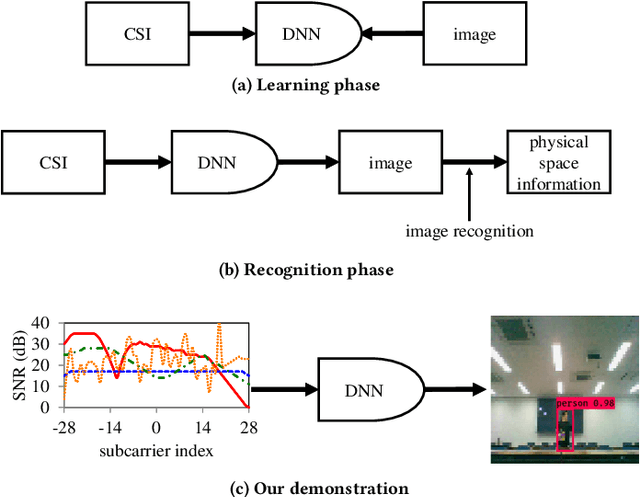
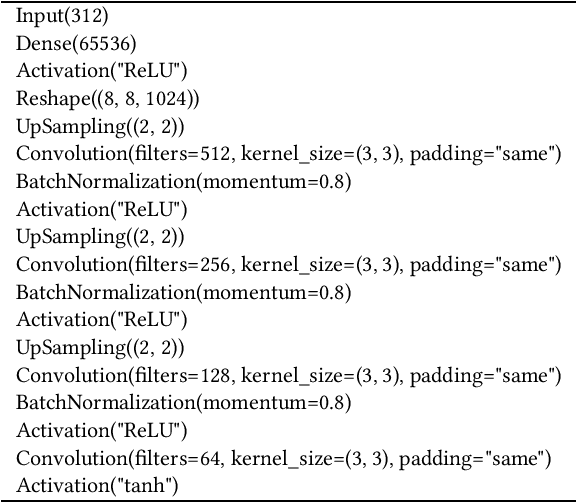
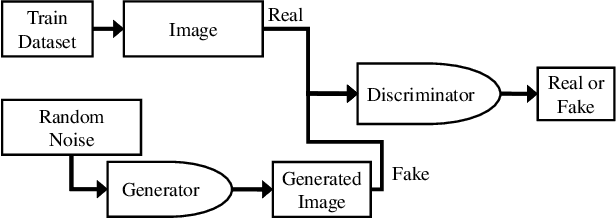
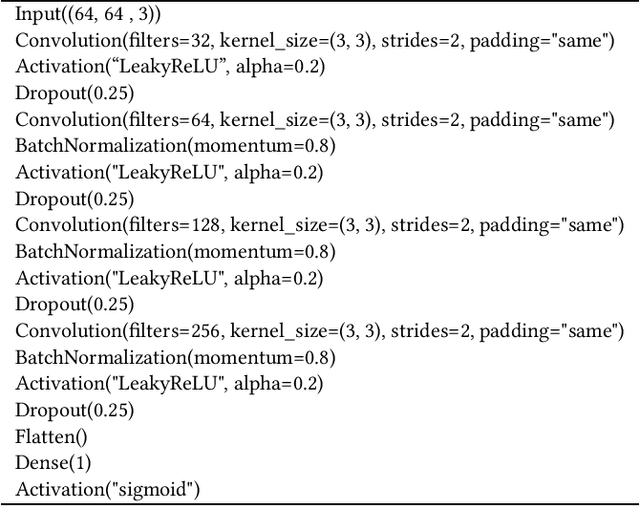
This study aims to find the upper limit of the wireless sensing capability of acquiring physical space information. This is a challenging objective, because at present, wireless sensing studies continue to succeed in acquiring novel phenomena. Thus, although a complete answer cannot be obtained yet, a step is taken towards it here. To achieve this, CSI2Image, a novel channel-state-information (CSI)-to-image conversion method based on generative adversarial networks (GANs), is proposed. The type of physical information acquired using wireless sensing can be estimated by checking wheth\-er the reconstructed image captures the desired physical space information. Three types of learning methods are demonstrated: gen\-er\-a\-tor-only learning, GAN-only learning, and hybrid learning. Evaluating the performance of CSI2Image is difficult, because both the clarity of the image and the presence of the desired physical space information must be evaluated. To solve this problem, a quantitative evaluation methodology using an object detection library is also proposed. CSI2Image was implemented using IEEE 802.11ac compressed CSI, and the evaluation results show that the image was successfully reconstructed. The results demonstrate that gen\-er\-a\-tor-only learning is sufficient for simple wireless sensing problems, but in complex wireless sensing problems, GANs are important for reconstructing generalized images with more accurate physical space information.