 Add to Chrome
 Add to Firefox
 Add to Edge
Rethinking Math Reasoning Evaluation: A Robust LLM-as-a-Judge Framework Beyond Symbolic Rigidity
Apr 24, 2026
Recent advancements in large language models have led to significant improvements across various tasks, including mathematical reasoning, which is used to assess models' intelligence in logical reasoning and problem-solving. Models are evaluated on mathematical reasoning benchmarks by verifying the correctness of the final answer against a ground truth answer. A common approach for this verification is based on symbolic mathematics comparison, which fails to generalize across diverse mathematical representations and solution formats. In this work, we offer a robust and flexible alternative to rule-based symbolic mathematics comparison. We propose an LLM-based evaluation framework for evaluating model-generated answers, enabling accurate evaluation across diverse mathematical representations and answer formats. We present failure cases of symbolic evaluation in two popular frameworks, Lighteval and SimpleRL, and compare them to our approach, demonstrating clear improvements over commonly used methods. Our framework enables more reliable evaluation and benchmarking, leading to more accurate performance monitoring, which is important for advancing mathematical problem-solving and intelligent systems.

Scene-VLM: Multimodal Video Scene Segmentation via Vision-Language Models
Dec 25, 2025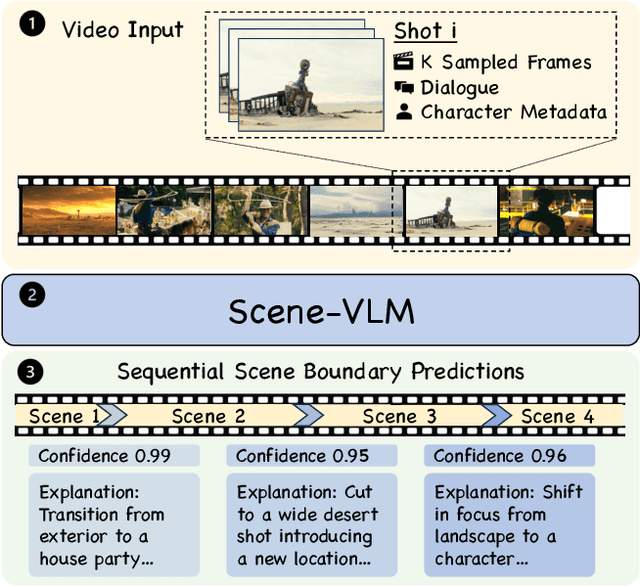
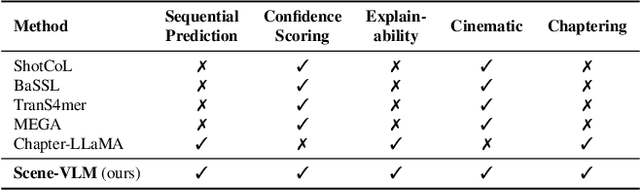
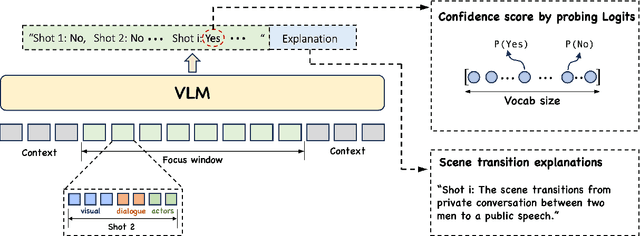
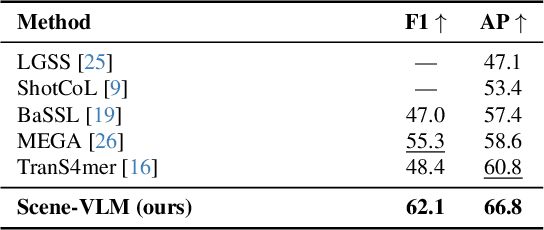
Segmenting long-form videos into semantically coherent scenes is a fundamental task in large-scale video understanding. Existing encoder-based methods are limited by visual-centric biases, classify each shot in isolation without leveraging sequential dependencies, and lack both narrative understanding and explainability. In this paper, we present Scene-VLM, the first fine-tuned vision-language model (VLM) framework for video scene segmentation. Scene-VLM jointly processes visual and textual cues including frames, transcriptions, and optional metadata to enable multimodal reasoning across consecutive shots. The model generates predictions sequentially with causal dependencies among shots and introduces a context-focus window mechanism to ensure sufficient temporal context for each shot-level decision. In addition, we propose a scheme to extract confidence scores from the token-level logits of the VLM, enabling controllable precision-recall trade-offs that were previously limited to encoder-based methods. Furthermore, we demonstrate that our model can be aligned to generate coherent natural-language rationales for its boundary decisions through minimal targeted supervision. Our approach achieves state-of-the-art performance on standard scene segmentation benchmarks. On MovieNet, for example, Scene-VLM yields significant improvements of +6 AP and +13.7 F1 over the previous leading method.
Group-Aware Reinforcement Learning for Output Diversity in Large Language Models
Nov 16, 2025Large Language Models (LLMs) often suffer from mode collapse, repeatedly generating the same few completions even when many valid answers exist, limiting their diversity across a wide range of tasks. We introduce Group-Aware Policy Optimization (GAPO), a simple extension of the recent and popular Group Relative Policy Optimization (GRPO) that computes rewards over the group as a whole. GAPO enables learning from the group-level properties such as diversity and coverage. We demonstrate GAPO using a frequency-aware reward function that encourages uniform sampling over valid LLM completions, and show that GAPO-trained models produce valid and more diverse model responses. Beyond this setup, GAPO generalizes to open-ended prompts and improves response diversity without compromising accuracy on standard LLM benchmarks (GSM8K, MATH, HumanEval, MMLU-Pro). Our code will be made publicly available.