 Add to Chrome
 Add to Firefox
 Add to Edge
Improving Generalization by Permutation Routing Across Model Copies
May 10, 2026
We introduce a use of the \(M\)-cover (or \(M\)-layer) transform for machine learning. The method replicates a model \(M\) times, but instead of coupling the copies through parameter averaging or an explicit attractive force, as in replicated SGD or Elastic SGD, it rewires the contexts in which local learning messages are computed. Each local loss is evaluated on a routed model whose parameters are drawn from different copies according to permutations sampled from a structured mixing kernel \(Q\). Training then uses the original local update rule, while the resulting learning messages are redistributed across the copies through these routed computational paths. Thus \(Q\) defines a topology for message transport and controls the long-loop structure of the lifted factor graph. We formulate this construction for perceptrons, committee machines, and multilayer perceptrons, showing that the same principle applies from discrete models to differentiable neural networks. The resulting framework provides a mechanism for improving generalization through structured message sharing rather than replica collapse or parameter-space coupling.

Uncertainty-Aware Sparse Identification of Dynamical Systems via Bayesian Model Averaging
Apr 12, 2026In many problems of data-driven modeling for dynamical systems, the governing equations are not known a priori and must be selected phenomenologically from a large set of candidate interactions and basis functions. In such situations, point estimates alone can be misleading, because multiple model components may explain the observed data comparably well, especially when the data are limited or the dynamics exhibit poor identifiability. Quantifying the uncertainty associated with model selection is therefore essential for constructing reliable dynamical models from data. In this work, we develop a Bayesian sparse identification framework for dynamical systems with coupled components, aimed at inferring both interaction structure and functional form together with principled uncertainty quantification. The proposed method combines sparse modeling with Bayesian model averaging, yielding posterior inclusion probabilities that quantify the credibility of each candidate interaction and basis component. Through numerical experiments on oscillator networks, we show that the framework accurately recovers sparse interaction structures with quantified uncertainty, including higher-order harmonic components, phase-lag effects, and multi-body interactions. We also demonstrate that, even in a phenomenological setting where the true governing equations are not contained in the assumed model class, the method can identify effective functional components with quantified uncertainty. These results highlight the importance of Bayesian uncertainty quantification in data-driven discovery of dynamical models.
Effect of Weight Quantization on Learning Models by Typical Case Analysis
Jan 30, 2024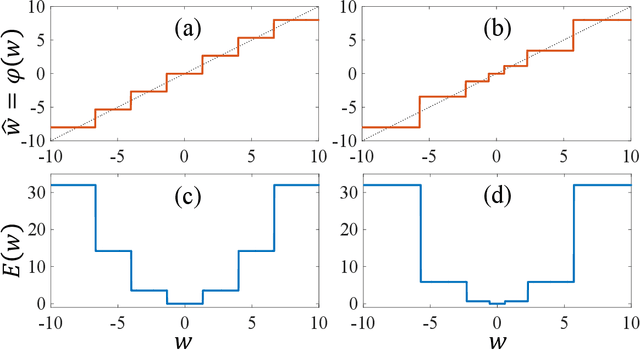
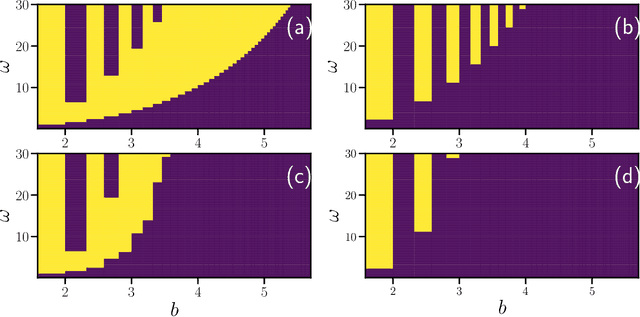
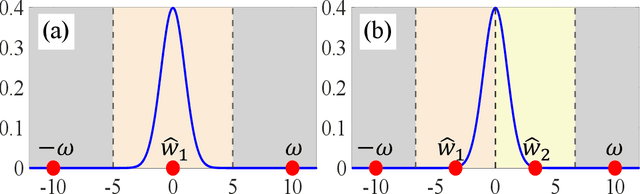
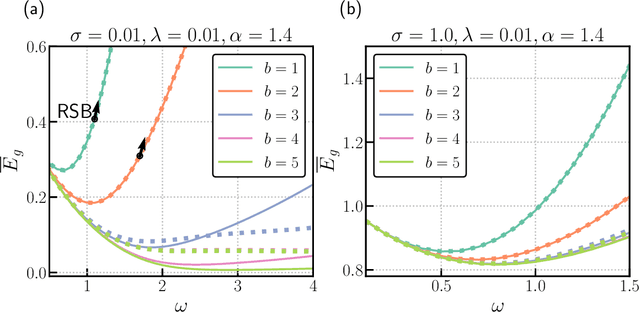
This paper examines the quantization methods used in large-scale data analysis models and their hyperparameter choices. The recent surge in data analysis scale has significantly increased computational resource requirements. To address this, quantizing model weights has become a prevalent practice in data analysis applications such as deep learning. Quantization is particularly vital for deploying large models on devices with limited computational resources. However, the selection of quantization hyperparameters, like the number of bits and value range for weight quantization, remains an underexplored area. In this study, we employ the typical case analysis from statistical physics, specifically the replica method, to explore the impact of hyperparameters on the quantization of simple learning models. Our analysis yields three key findings: (i) an unstable hyperparameter phase, known as replica symmetry breaking, occurs with a small number of bits and a large quantization width; (ii) there is an optimal quantization width that minimizes error; and (iii) quantization delays the onset of overparameterization, helping to mitigate overfitting as indicated by the double descent phenomenon. We also discover that non-uniform quantization can enhance stability. Additionally, we develop an approximate message-passing algorithm to validate our theoretical results.