 Add to Chrome
 Add to Firefox
 Add to Edge
Masked Diffusion Decoding as $x$-Prediction Flow
Jun 27, 2026
Masked diffusion language models (MDLMs) generate text by iteratively unmasking tokens, but their standard decoder reduces each step to a binary action: a position is either committed to a single token or left fully masked, with no representation of partial belief in between. This all-or-nothing regime discards rich predictive information and forces premature, irrevocable commitments, leading to poor performance under a limited decoding budget. In this paper, we reinterpret mask prediction as clean-state prediction ($x$-prediction) and show that it can be used to induce a continuous flow in input embedding space. Building on this view, we propose a continuous decoding framework for MDLMs where tokens can accumulate partial progress at each diffusion step and remain revisable. To match the uneven contextual constraints across positions in language, we replace the globally synchronous schedule in image diffusion with a confidence-based asynchronous update in which the diffusion progress is token-wise accumulated. Additionally, we introduce a lightweight policy network and formulate its training as a reinforcement learning problem. Applied to pretrained LLaDA, our continuous decoder reaches 97% of its performance on the HumanEval dataset with 25% of decoding budget.

Logic Synthesis Meets Machine Learning: Trading Exactness for Generalization
Dec 15, 2020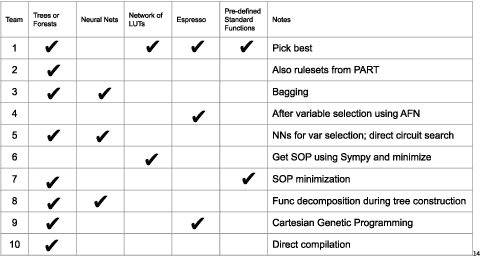
Logic synthesis is a fundamental step in hardware design whose goal is to find structural representations of Boolean functions while minimizing delay and area. If the function is completely-specified, the implementation accurately represents the function. If the function is incompletely-specified, the implementation has to be true only on the care set. While most of the algorithms in logic synthesis rely on SAT and Boolean methods to exactly implement the care set, we investigate learning in logic synthesis, attempting to trade exactness for generalization. This work is directly related to machine learning where the care set is the training set and the implementation is expected to generalize on a validation set. We present learning incompletely-specified functions based on the results of a competition conducted at IWLS 2020. The goal of the competition was to implement 100 functions given by a set of care minterms for training, while testing the implementation using a set of validation minterms sampled from the same function. We make this benchmark suite available and offer a detailed comparative analysis of the different approaches to learning