 Add to Chrome
 Add to Firefox
 Add to Edge
Hypothesis-Driven Shelf Generation for Personalised Recommendation
Jul 28, 2026
Modern recommendation interfaces organise content into shelves: themed rows such as "More of What You Like" or "New Releases for You." In production systems, these shelves are typically defined through hand-crafted templates coupled with dedicated retrieval logic. While effective for broad recommendation intents, this approach does not scale to the long tail of individual taste. We present a content-hypothesis-driven shelf generation system for Spotify Home that replaces fixed templates with natural-language hypotheses describing what a personalised shelf should contain. The system has four stages hypothesis generation, catalogue fulfilment, shelf alignment, and offline serving. This decomposition decouples shelf planning from catalogue fulfilment, supports independent optimisation of planning and retrieval, and enables both constrained generative retrieval over catalogue entities and distillation of frontier LLM behaviour into compact models. Our production pipeline combines hypothesis generation, generative retrieval, candidate selection and shelf alignment, offline LLM-as-a-judge evaluation, and precomputed serving. We describe the end-to-end architecture and evaluate it through offline analyses and an early online evaluation under uniform random exposure on Spotify Home. Results show that hypothesis-driven shelves substantially expand personalised recommendation supply with engagement that varies by content type and is competitive with strong existing shelves in some settings.

Addressing speaker gender bias in large scale speech translation systems
Jan 10, 2025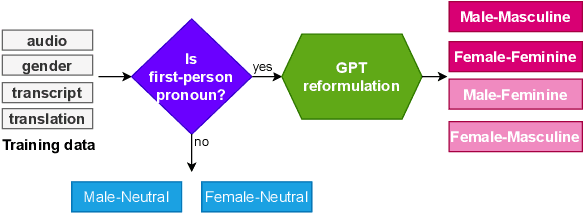
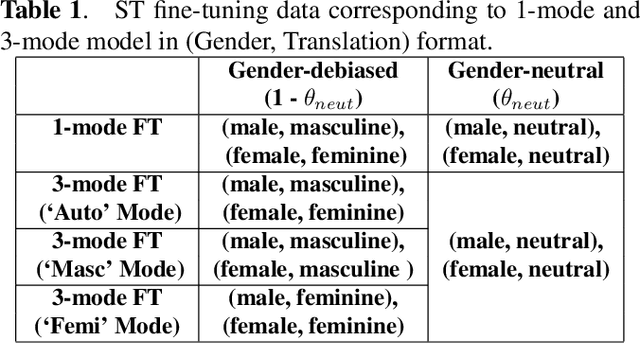


This study addresses the issue of speaker gender bias in Speech Translation (ST) systems, which can lead to offensive and inaccurate translations. The masculine bias often found in large-scale ST systems is typically perpetuated through training data derived from Machine Translation (MT) systems. Our approach involves two key steps. First, we employ Large Language Models (LLMs) to rectify translations based on the speaker's gender in a cost-effective manner. Second, we fine-tune the ST model with the corrected data, enabling the model to generate gender-specific translations directly from audio cues, without the need for explicit gender input. Additionally, we propose a three-mode fine-tuned model for scenarios where the speaker's gender is either predefined or should not be inferred from speech cues. We demonstrate a 70% improvement in translations for female speakers compared to our baseline and other large-scale ST systems, such as Seamless M4T and Canary, on the MuST-SHE test set.