 Add to Chrome
 Add to Firefox
 Add to Edge
Mind-Omni: A Unified Multi-Task Framework for Brain-Vision-Language Modeling via Discrete Diffusion
May 28, 2026
Modeling the interplay between external stimuli and internal neural representations is a pivotal research area for Brain-Computer Interfaces (BCIs). A major limitation of prior work is the prevailing paradigm of specialized, single-task models, which curtails versatility and neglects inter-task synergies. To address this, we propose Mind-Omni, the first versatile framework that unifies seven distinct encoding and decoding tasks through a discrete diffusion paradigm. At its core is a novel Brain Tokenizer that transforms heterogeneous, continuous brain signals into standardized, discrete tokens. This enables direct, token-level interactions for mutual understanding and generation between any two or more modalities within a shared semantic space. To unlock advanced reasoning capabilities, we further curate a specialized Brain Question Answering (BQA) instruction-tuning dataset. Our model not only establishes a new state-of-the-art among multi-task unified frameworks but also provides strong evidence for multi-task synergy. By demonstrating performance competitive with, and at times superior to, larger specialized models, our work offers a powerful new paradigm for neural modeling and paves the way for foundation models of neural activity. The code is publicly available at https://github.com/ReedOnePeck/Mind-Omni.

NeuralOOD: Improving Out-of-Distribution Generalization Performance with Brain-machine Fusion Learning Framework
Aug 27, 2024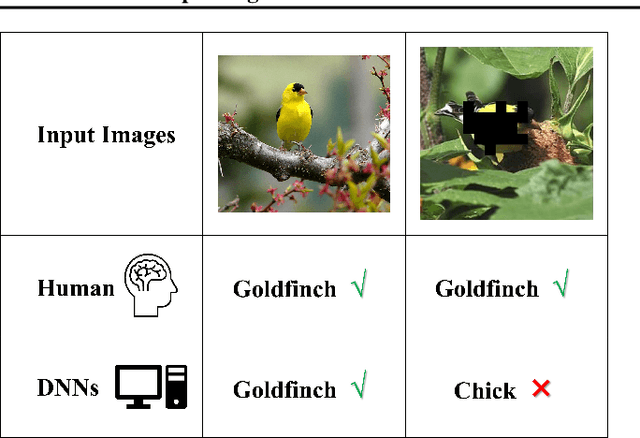
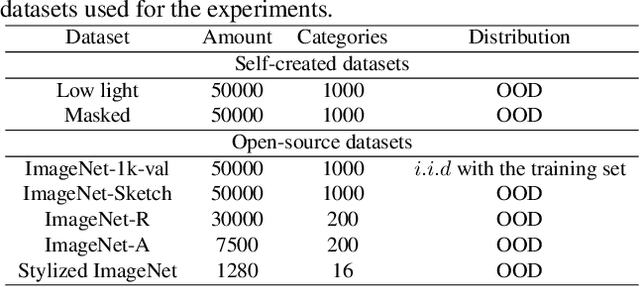
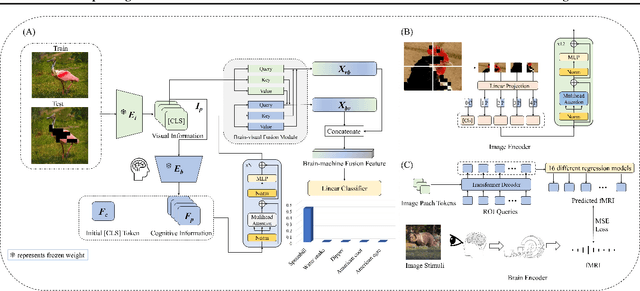
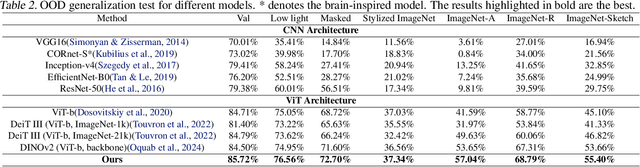
Deep Neural Networks (DNNs) have demonstrated exceptional recognition capabilities in traditional computer vision (CV) tasks. However, existing CV models often suffer a significant decrease in accuracy when confronted with out-of-distribution (OOD) data. In contrast to these DNN models, human can maintain a consistently low error rate when facing OOD scenes, partly attributed to the rich prior cognitive knowledge stored in the human brain. Previous OOD generalization researches only focus on the single modal, overlooking the advantages of multimodal learning method. In this paper, we utilize the multimodal learning method to improve the OOD generalization and propose a novel Brain-machine Fusion Learning (BMFL) framework. We adopt the cross-attention mechanism to fuse the visual knowledge from CV model and prior cognitive knowledge from the human brain. Specially, we employ a pre-trained visual neural encoding model to predict the functional Magnetic Resonance Imaging (fMRI) from visual features which eliminates the need for the fMRI data collection and pre-processing, effectively reduces the workload associated with conventional BMFL methods. Furthermore, we construct a brain transformer to facilitate the extraction of knowledge inside the fMRI data. Moreover, we introduce the Pearson correlation coefficient maximization regularization method into the training process, which improves the fusion capability with better constrains. Our model outperforms the DINOv2 and baseline models on the ImageNet-1k validation dataset as well as six curated OOD datasets, showcasing its superior performance in diverse scenarios.