 Add to Chrome
 Add to Firefox
 Add to Edge
Q-RUN: Quantum-Inspired Data Re-uploading Networks
Dec 18, 2025
Data re-uploading quantum circuits (DRQC) are a key approach to implementing quantum neural networks and have been shown to outperform classical neural networks in fitting high-frequency functions. However, their practical application is limited by the scalability of current quantum hardware. In this paper, we introduce the mathematical paradigm of DRQC into classical models by proposing a quantum-inspired data re-uploading network (Q-RUN), which retains the Fourier-expressive advantages of quantum models without any quantum hardware. Experimental results demonstrate that Q-RUN delivers superior performance across both data modeling and predictive modeling tasks. Compared to the fully connected layers and the state-of-the-art neural network layers, Q-RUN reduces model parameters while decreasing error by approximately one to three orders of magnitude on certain tasks. Notably, Q-RUN can serve as a drop-in replacement for standard fully connected layers, improving the performance of a wide range of neural architectures. This work illustrates how principles from quantum machine learning can guide the design of more expressive artificial intelligence.

IE-NeRF: Inpainting Enhanced Neural Radiance Fields in the Wild
Jul 15, 2024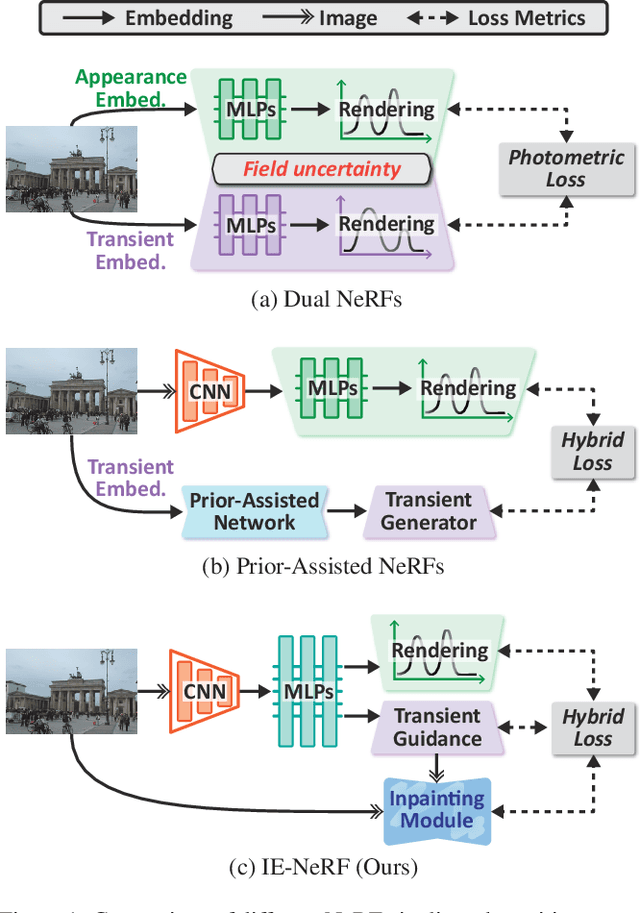

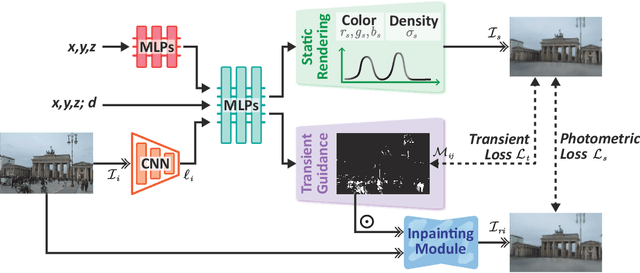
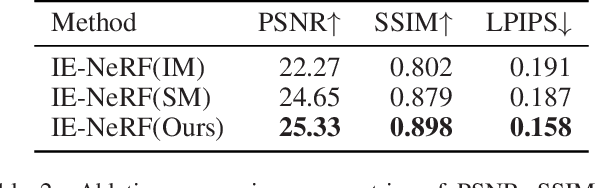
We present a novel approach for synthesizing realistic novel views using Neural Radiance Fields (NeRF) with uncontrolled photos in the wild. While NeRF has shown impressive results in controlled settings, it struggles with transient objects commonly found in dynamic and time-varying scenes. Our framework called \textit{Inpainting Enhanced NeRF}, or \ours, enhances the conventional NeRF by drawing inspiration from the technique of image inpainting. Specifically, our approach extends the Multi-Layer Perceptrons (MLP) of NeRF, enabling it to simultaneously generate intrinsic properties (static color, density) and extrinsic transient masks. We introduce an inpainting module that leverages the transient masks to effectively exclude occlusions, resulting in improved volume rendering quality. Additionally, we propose a new training strategy with frequency regularization to address the sparsity issue of low-frequency transient components. We evaluate our approach on internet photo collections of landmarks, demonstrating its ability to generate high-quality novel views and achieve state-of-the-art performance.