 Add to Chrome
 Add to Firefox
 Add to Edge
Federated LoRA Fine-Tuning for LLMs via Collaborative Alignment
May 20, 2026
Low-rank adaptation (LoRA) has emerged as a powerful tool for parameter-efficient fine-tuning of large language models (LLMs). This paper studies LoRA under a federated learning setting, enabling collaborative fine-tuning across clients while preserving parameter efficiency. We focus on a highly heterogeneous regime in which clients share only partial structure and a substantial subset may be contaminated. We propose Collaborative Low-rank Alignment and Identifiable Recovery (CLAIR), a contamination-aware framework that relies only on preliminary local estimators. Its formulation applies broadly, from linear regression to neural network and LLM modules, whenever local adaptation can be represented by matrix-valued updates. CLAIR recovers the shared LoRA subspace and detects contaminated clients via a structured low-rank plus block-sparse decomposition. We prove exact recovery of the shared LoRA subspace in the noiseless case, stable recovery under preliminary estimation error, and consistent collaborative-set recovery under mild separation conditions. We further quantify the gain from CLAIR refinement: it reduces off-subspace estimation error through cross-client averaging while preserving client-specific variation within the shared LoRA subspace, thus improves over local fine-tuning whenever this oracle gain outweighs the costs of subspace estimation and benign-client heterogeneity. Empirically, we demonstrate the benefits of CLAIR by fine-tuning a Transformer architecture on a text-copying task. The results show accurate contamination detection and improved benign-client performance compared with local fine-tuning and non-robust federated averaging.

Differentially private sliced inverse regression in the federated paradigm
Jun 10, 2023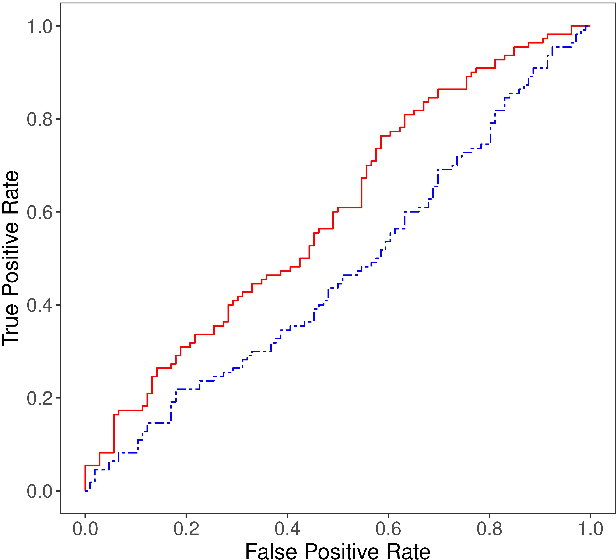
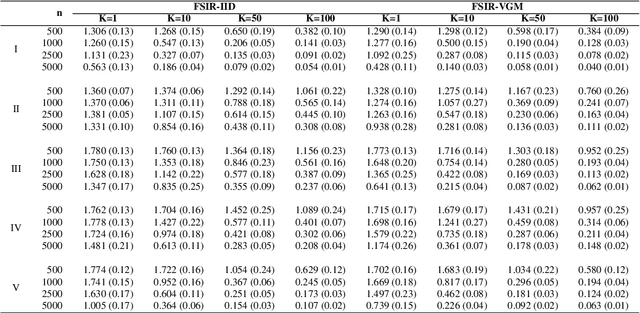
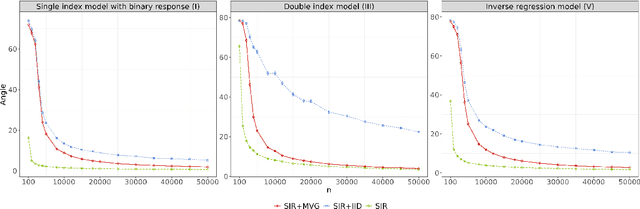
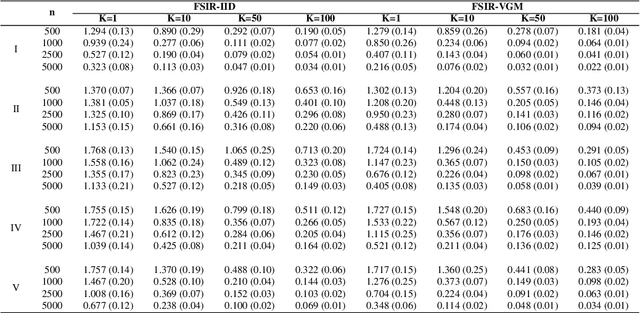
We extend the celebrated sliced inverse regression to address the challenges of decentralized data, prioritizing privacy and communication efficiency. Our approach, federated sliced inverse regression (FSIR), facilitates collaborative estimation of the sufficient dimension reduction subspace among multiple clients, solely sharing local estimates to protect sensitive datasets from exposure. To guard against potential adversary attacks, FSIR further employs diverse perturbation strategies, including a novel multivariate Gaussian mechanism that guarantees differential privacy at a low cost of statistical accuracy. Additionally, FSIR naturally incorporates a collaborative variable screening step, enabling effective handling of high-dimensional client data. Theoretical properties of FSIR are established for both low-dimensional and high-dimensional settings, supported by extensive numerical experiments and real data analysis.