 Add to Chrome
 Add to Firefox
 Add to Edge
Adaptation of Generalist Robot Policies with Minimal Data
Aug 11, 2026
A central goal in robot learning is to move beyond task-specific human data collection toward robots that improve through autonomous interaction. Yet fully autonomous learning remains difficult with current policies: sparse rewards and weak zero-shot exploration make it unlikely that a robot will discover successful behavior from scratch. We study minimal-data adaptation, a regime in which a pre-trained robot policy must learn a new task from as little as one demonstration followed by autonomous online interaction. This setting serves as the closest tractable proxy for fully autonomous improvement, allowing us to study whether minimal human guidance can bootstrap autonomous learning and what algorithmic ingredients make it feasible. We build MiDAS, a simple offline-to-online RL recipe that first anchors a pre-trained VLA to the target task with behavior cloning on single/few demonstrations, then improves it through value-based online RL on a residual policy parameterization. Across LIBERO and RoboCasa, MiDAS recovers strong task performance from as little as one demonstration, substantially outperforming baselines and generalizing beyond demonstrated conditions. We further evaluate MiDAS on a bimanual YAM platform. Starting from a fragile low-success policy obtained from a single demonstration, MiDAS improves its robustness and learns new successful behaviors over ~6 hours of online interaction. To the best of our knowledge, this is the first demonstration of reliable robot policy adaptation from a single task demonstration.

Graph Representation Learning for Road Type Classification
Aug 19, 2021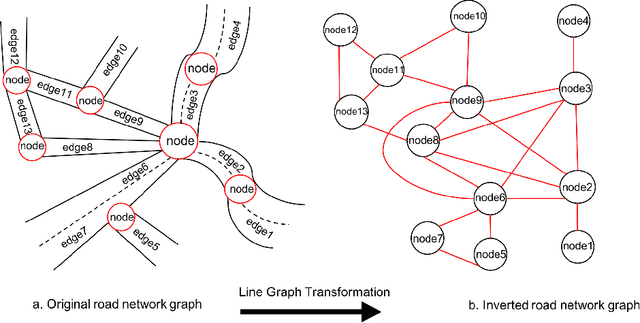
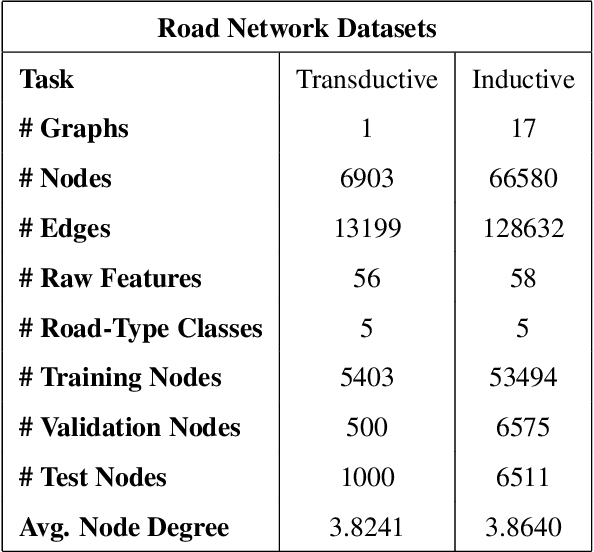
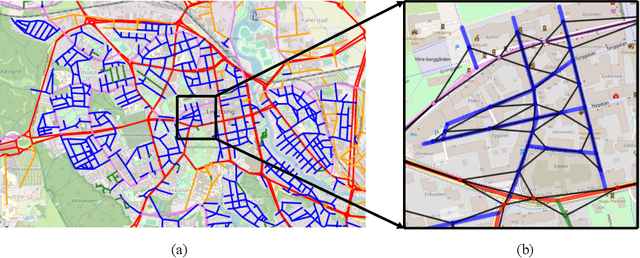
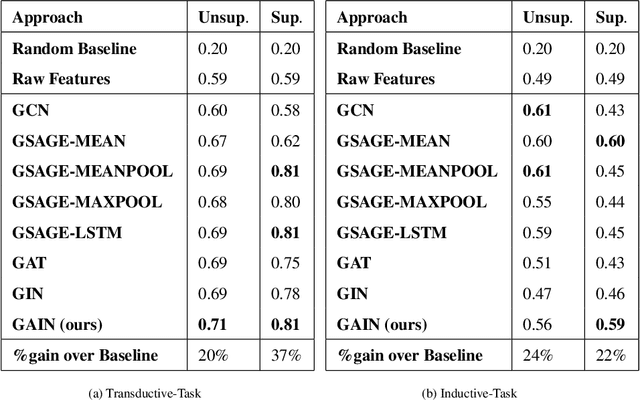
We present a novel learning-based approach to graph representations of road networks employing state-of-the-art graph convolutional neural networks. Our approach is applied to realistic road networks of 17 cities from Open Street Map. While edge features are crucial to generate descriptive graph representations of road networks, graph convolutional networks usually rely on node features only. We show that the highly representative edge features can still be integrated into such networks by applying a line graph transformation. We also propose a method for neighborhood sampling based on a topological neighborhood composed of both local and global neighbors. We compare the performance of learning representations using different types of neighborhood aggregation functions in transductive and inductive tasks and in supervised and unsupervised learning. Furthermore, we propose a novel aggregation approach, Graph Attention Isomorphism Network, GAIN. Our results show that GAIN outperforms state-of-the-art methods on the road type classification problem.