 Add to Chrome
 Add to Firefox
 Add to Edge
Fixed-Point Reasoners: Stable and Adaptive Deep Looped Transformers
Jun 16, 2026
Looped architectures provide an inductive bias toward learning step-by-step procedures for tasks that require compositional reasoning. The number of effective layers reached by looping determines the quality of the solution these models find. Like deep architectures, looped architectures are prone to a signal propagation problem induced by depth as the halting decision is postponed. In this paper, we address this signal propagation issue using pre-norm layers and residual scaling. Building on these architectural modifications, we propose FPRM, a Transformer-based Fixed-Point Reasoning Model that uses fixed-point convergence as an end-to-end halting mechanism in a looped architecture. We show that fixed-point halting allows FPRM to adapt its compute to task difficulty. FPRM is effective on common reasoning benchmarks, namely Sudoku, Maze, state-tracking, and ARC-AGI.

Data Augmentations Go Beyond Encoding Invariances: A Theoretical Study on Self-Supervised Learning
Nov 04, 2024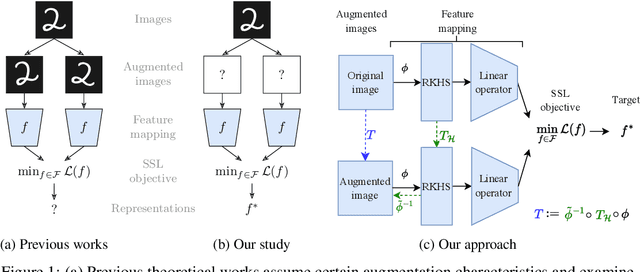
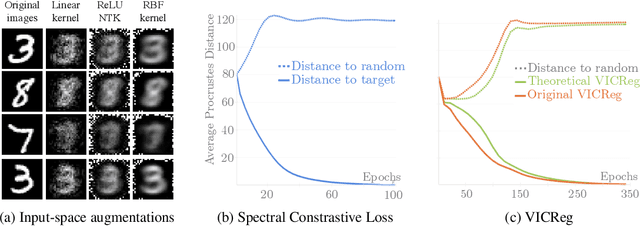
Understanding the role of data augmentations is critical for applying Self-Supervised Learning (SSL) methods in new domains. Data augmentations are commonly understood as encoding invariances into the learned representations. This interpretation suggests that SSL would require diverse augmentations that resemble the original data. However, in practice, augmentations do not need to be similar to the original data nor be diverse, and can be neither at the same time. We provide a theoretical insight into this phenomenon. We show that for different SSL losses, any non-redundant representation can be learned with a single suitable augmentation. We provide an algorithm to reconstruct such augmentations and give insights into augmentation choices in SSL.