 Add to Chrome
 Add to Firefox
 Add to Edge
Ada-RS: Adaptive Rejection Sampling for Selective Thinking
Feb 23, 2026
Large language models (LLMs) are increasingly being deployed in cost and latency-sensitive settings. While chain-of-thought improves reasoning, it can waste tokens on simple requests. We study selective thinking for tool-using LLMs and introduce Adaptive Rejection Sampling (Ada-RS), an algorithm-agnostic sample filtering framework for learning selective and efficient reasoning. For each given context, Ada-RS scores multiple sampled completions with an adaptive length-penalized reward then applies stochastic rejection sampling to retain only high-reward candidates (or preference pairs) for downstream optimization. We demonstrate how Ada-RS plugs into both preference pair (e.g. DPO) or grouped policy optimization strategies (e.g. DAPO). Using Qwen3-8B with LoRA on a synthetic tool call-oriented e-commerce benchmark, Ada-RS improves the accuracy-efficiency frontier over standard algorithms by reducing average output tokens by up to 80% and reducing thinking rate by up to 95% while maintaining or improving tool call accuracy. These results highlight that training-signal selection is a powerful lever for efficient reasoning in latency-sensitive deployments.

Toward Scalable Verifiable Reward: Proxy State-Based Evaluation for Multi-turn Tool-Calling LLM Agents
Feb 18, 2026Interactive large language model (LLM) agents operating via multi-turn dialogue and multi-step tool calling are increasingly used in production. Benchmarks for these agents must both reliably compare models and yield on-policy training data. Prior agentic benchmarks (e.g., tau-bench, tau2-bench, AppWorld) rely on fully deterministic backends, which are costly to build and iterate. We propose Proxy State-Based Evaluation, an LLM-driven simulation framework that preserves final state-based evaluation without a deterministic database. Specifically, a scenario specifies the user goal, user/system facts, expected final state, and expected agent behavior, and an LLM state tracker infers a structured proxy state from the full interaction trace. LLM judges then verify goal completion and detect tool/user hallucinations against scenario constraints. Empirically, our benchmark produces stable, model-differentiating rankings across families and inference-time reasoning efforts, and its on-/off-policy rollouts provide supervision that transfers to unseen scenarios. Careful scenario specification yields near-zero simulator hallucination rates as supported by ablation studies. The framework also supports sensitivity analyses over user personas. Human-LLM judge agreement exceeds 90%, indicating reliable automated evaluation. Overall, proxy state-based evaluation offers a practical, scalable alternative to deterministic agentic benchmarks for industrial LLM agents.
Coupling Symbolic Reasoning with Language Modeling for Efficient Longitudinal Understanding of Unstructured Electronic Medical Records
Aug 07, 2023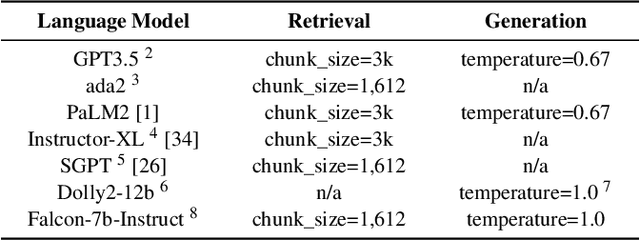
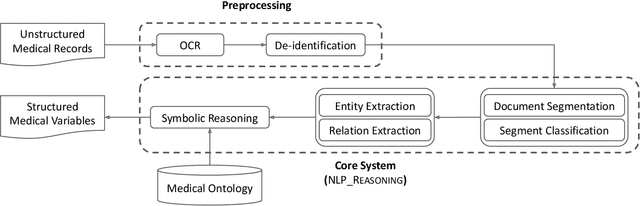
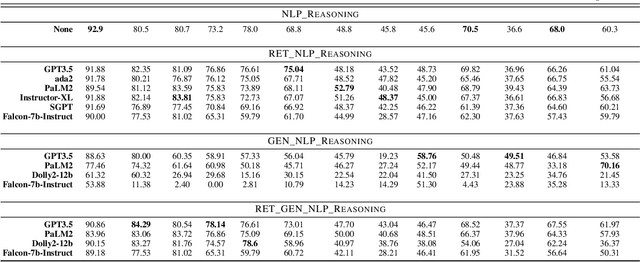

The application of Artificial Intelligence (AI) in healthcare has been revolutionary, especially with the recent advancements in transformer-based Large Language Models (LLMs). However, the task of understanding unstructured electronic medical records remains a challenge given the nature of the records (e.g., disorganization, inconsistency, and redundancy) and the inability of LLMs to derive reasoning paradigms that allow for comprehensive understanding of medical variables. In this work, we examine the power of coupling symbolic reasoning with language modeling toward improved understanding of unstructured clinical texts. We show that such a combination improves the extraction of several medical variables from unstructured records. In addition, we show that the state-of-the-art commercially-free LLMs enjoy retrieval capabilities comparable to those provided by their commercial counterparts. Finally, we elaborate on the need for LLM steering through the application of symbolic reasoning as the exclusive use of LLMs results in the lowest performance.