 Add to Chrome
 Add to Firefox
 Add to Edge
AI Generalisation Gap In Comorbid Sleep Disorder Staging
Mar 24, 2026
Accurate sleep staging is essential for diagnosing OSA and hypopnea in stroke patients. Although PSG is reliable, it is costly, labor-intensive, and manually scored. While deep learning enables automated EEG-based sleep staging in healthy subjects, our analysis shows poor generalization to clinical populations with disrupted sleep. Using Grad-CAM interpretations, we systematically demonstrate this limitation. We introduce iSLEEPS, a newly clinically annotated ischemic stroke dataset (to be publicly released), and evaluate a SE-ResNet plus bidirectional LSTM model for single-channel EEG sleep staging. As expected, cross-domain performance between healthy and diseased subjects is poor. Attention visualizations, supported by clinical expert feedback, show the model focuses on physiologically uninformative EEG regions in patient data. Statistical and computational analyses further confirm significant sleep architecture differences between healthy and ischemic stroke cohorts, highlighting the need for subject-aware or disease-specific models with clinical validation before deployment. A summary of the paper and the code is available at https://himalayansaswatabose.github.io/iSLEEPS_Explainability.github.io/

mulEEG: A Multi-View Representation Learning on EEG Signals
Apr 07, 2022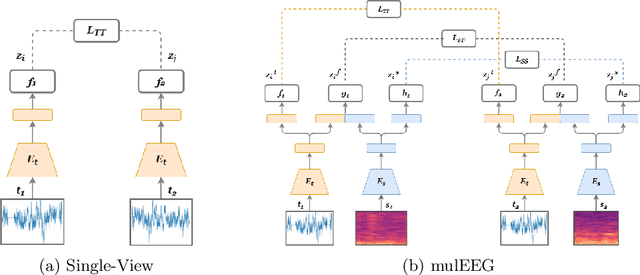
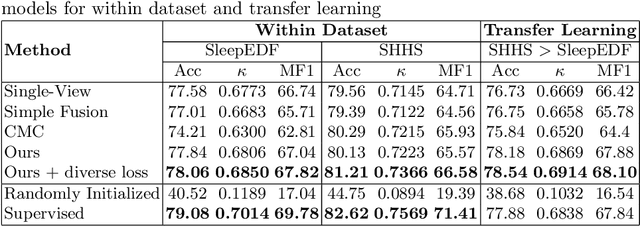
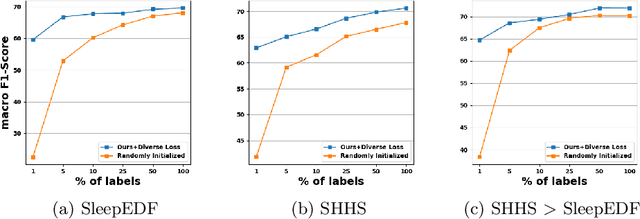
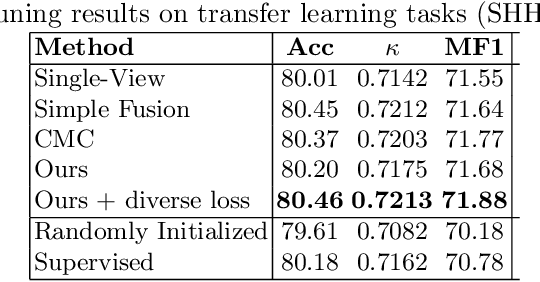
Modeling effective representations using multiple views that positively influence each other is challenging, and the existing methods perform poorly on Electroencephalogram (EEG) signals for sleep-staging tasks. In this paper, we propose a novel multi-view self-supervised method (mulEEG) for unsupervised EEG representation learning. Our method attempts to effectively utilize the complementary information available in multiple views to learn better representations. We introduce diverse loss that further encourages complementary information across multiple views. Our method with no access to labels beats the supervised training while outperforming multi-view baseline methods on transfer learning experiments carried out on sleep-staging tasks. We posit that our method was able to learn better representations by using complementary multi-views.