 Add to Chrome
 Add to Firefox
 Add to Edge
AI Generalisation Gap In Comorbid Sleep Disorder Staging
Mar 24, 2026
Accurate sleep staging is essential for diagnosing OSA and hypopnea in stroke patients. Although PSG is reliable, it is costly, labor-intensive, and manually scored. While deep learning enables automated EEG-based sleep staging in healthy subjects, our analysis shows poor generalization to clinical populations with disrupted sleep. Using Grad-CAM interpretations, we systematically demonstrate this limitation. We introduce iSLEEPS, a newly clinically annotated ischemic stroke dataset (to be publicly released), and evaluate a SE-ResNet plus bidirectional LSTM model for single-channel EEG sleep staging. As expected, cross-domain performance between healthy and diseased subjects is poor. Attention visualizations, supported by clinical expert feedback, show the model focuses on physiologically uninformative EEG regions in patient data. Statistical and computational analyses further confirm significant sleep architecture differences between healthy and ischemic stroke cohorts, highlighting the need for subject-aware or disease-specific models with clinical validation before deployment. A summary of the paper and the code is available at https://himalayansaswatabose.github.io/iSLEEPS_Explainability.github.io/

Data-efficient Deep Learning Approach for Single-Channel EEG-Based Sleep Stage Classification with Model Interpretability
Sep 28, 2023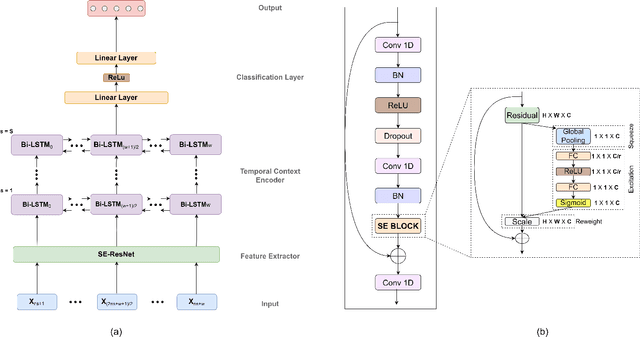
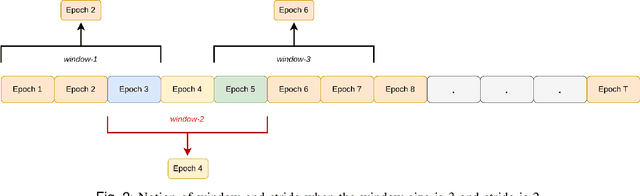
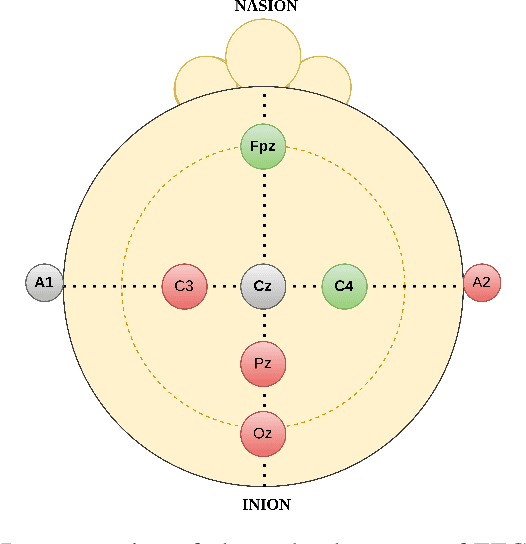
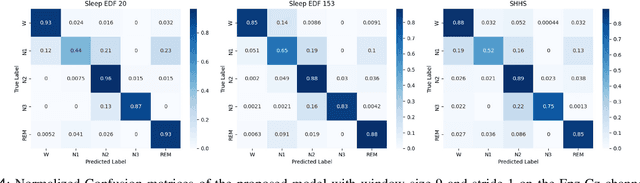
Sleep, a fundamental physiological process, occupies a significant portion of our lives. Accurate classification of sleep stages serves as a crucial tool for evaluating sleep quality and identifying probable sleep disorders. Our work introduces a novel methodology that utilizes a SE-Resnet-Bi-LSTM architecture to classify sleep into five separate stages. The classification process is based on the analysis of single-channel electroencephalograms (EEGs). The suggested framework consists of two fundamental elements: a feature extractor that utilizes SE-ResNet, and a temporal context encoder that uses stacks of Bi-LSTM units. The effectiveness of our approach is substantiated by thorough assessments conducted on three different datasets, namely SleepEDF-20, SleepEDF-78, and SHHS. The proposed methodology achieves significant model performance, with Macro-F1 scores of 82.5, 78.9, and 81.9 for the respective datasets. We employ 1D-GradCAM visualization as a methodology to elucidate the decision-making process inherent in our model in the realm of sleep stage classification. This visualization method not only provides valuable insights into the model's classification rationale but also aligns its outcomes with the annotations made by sleep experts. One notable feature of our research lies in the incorporation of an efficient training approach, which adeptly upholds the model's resilience in terms of performance. The experimental evaluations provide a comprehensive evaluation of the effectiveness of our proposed model in comparison to the existing approaches, highlighting its potential for practical applications.