 Add to Chrome
 Add to Firefox
 Add to Edge
Optimal Time Window and Frequency Bandwidth Parameter Combination for Subject-Specific Motor Imagery EEG Classification
May 20, 2026
Motor-imagery (MI) EEG can be classified using supervised machine learning techniques such as Linear Discriminant Analysis applied to features extracted by Common Spatial Patterns. Performance of these models varies widely, possibly due to MI studies commonly utilising differing post-cue time windows and frequency bands to one another. This study aims to assess how the simultaneous optimisation of both these parameters impact MI classification performance. This is done by iteratively training and testing a series of subject-specific models on different combinations of frequency bandwidth and time window options across 109 subjects. This is followed by a statistical analysis using repeated measures ANOVA to uncover significant differences between different bandwidths and time windows in terms of accuracy across the patient cohort. The resulting visualisations and statistical tests show that there are, indeed, significant differences between both specific time windows and specific bandwidths in terms of accuracy. While the comparison of classification accuracies across 23 frequency bandwidths during five different time windows demonstrates an optimal temporal and spectral scale combination of (0, 4) s at the range of (4, 12) Hz across all subjects, the subjects demonstrate similar accuracies for other parameter combinations. These findings highlight the efficacy of personalised models to detect optimal temporal and spectral parameter combinations to best classify MI EEG signals that inherently vary across subjects.

Single Channel-based Motor Imagery Classification using Fisher's Ratio and Pearson Correlation
Jun 20, 2024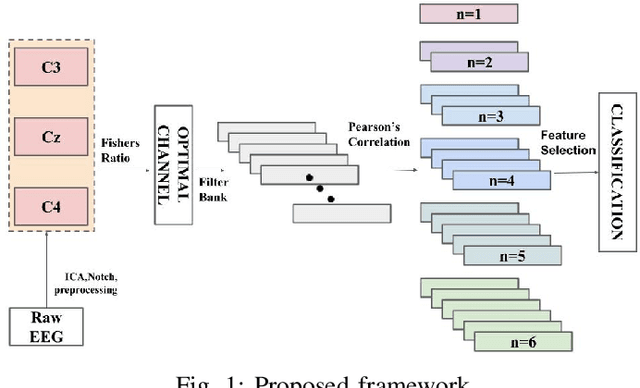
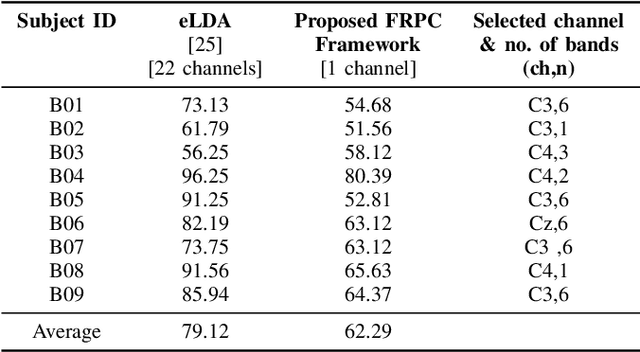
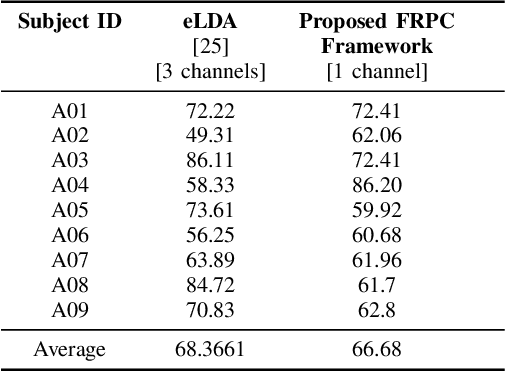
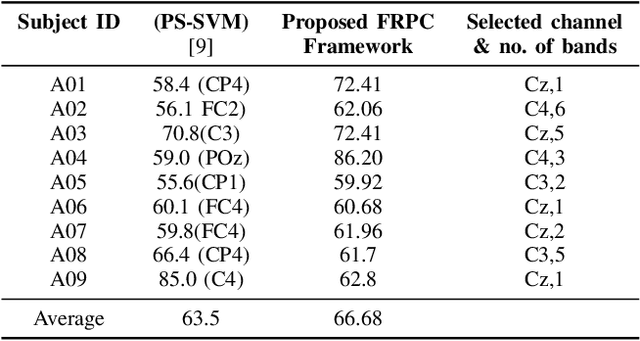
Motor imagery-based BCI systems have been promising and gaining popularity in rehabilitation and Activities of daily life(ADL). Despite this, the technology is still emerging and has not yet been outside the laboratory constraints. Channel reduction is one contributing avenue to make these systems part of ADL. Although Motor Imagery classification heavily depends on spatial factors, single channel-based classification remains an avenue to be explored thoroughly. Since Fisher's ratio and Pearson Correlation are powerful measures actively used in the domain, we propose an integrated framework (FRPC integrated framework) that integrates Fisher's Ratio to select the best channel and Pearson correlation to select optimal filter banks and extract spectral and temporal features respectively. The framework is tested for a 2-class motor imagery classification on 2 open-source datasets and 1 collected dataset and compared with state-of-art work. Apart from implementing the framework, this study also explores the most optimal channel among all the subjects and later explores classes where the single-channel framework is efficient.
Guiding Soft Robots with Motor-Imagery Brain Signals and Impedance Control
Jan 24, 2024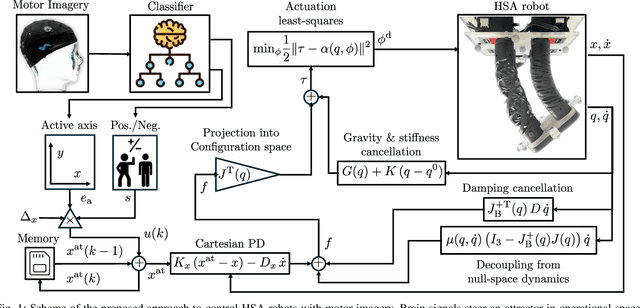
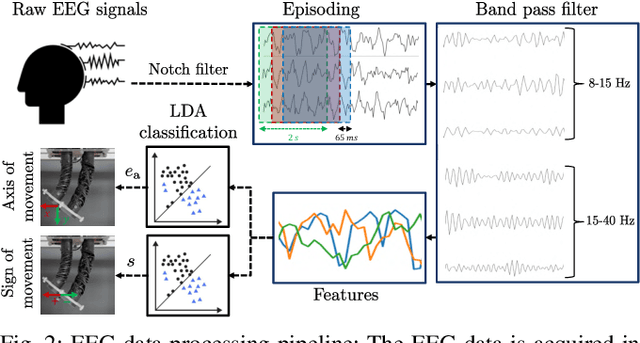
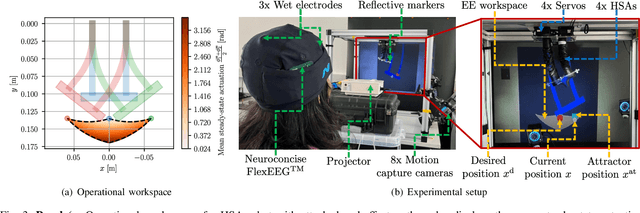
Integrating Brain-Machine Interfaces into non-clinical applications like robot motion control remains difficult - despite remarkable advancements in clinical settings. Specifically, EEG-based motor imagery systems are still error-prone, posing safety risks when rigid robots operate near humans. This work presents an alternative pathway towards safe and effective operation by combining wearable EEG with physically embodied safety in soft robots. We introduce and test a pipeline that allows a user to move a soft robot's end effector in real time via brain waves that are measured by as few as three EEG channels. A robust motor imagery algorithm interprets the user's intentions to move the position of a virtual attractor to which the end effector is attracted, thanks to a new Cartesian impedance controller. We specifically focus here on planar soft robot-based architected metamaterials, which require the development of a novel control architecture to deal with the peculiar nonlinearities - e.g., non-affinity in control. We preliminarily but quantitatively evaluate the approach on the task of setpoint regulation. We observe that the user reaches the proximity of the setpoint in 66% of steps and that for successful steps, the average response time is 21.5s. We also demonstrate the execution of simple real-world tasks involving interaction with the environment, which would be extremely hard to perform if it were not for the robot's softness.