 Add to Chrome
 Add to Firefox
 Add to Edge
Alt-CC-PINN: An Alternating Optimization Framework with Implicit Neural Representation for Microwave Inverse Scattering Imaging
May 25, 2026
Microwave inverse scattering imaging (MISI) is a crucial computational technique in microwave nondestructive evaluation and near-field microwave sensing systems. However, quantitative reconstruction of high-contrast targets remains a formidable challenge due to severe multiple scattering effects and the inherent ill-posedness of electromagnetic inverse problems. To overcome this fundamental bottleneck in computational microwave imaging, this paper proposes an alternating optimization framework based on cross-correlated physics-informed neural network (Alt-CC-PINN). This architecture deeply decouples the evolution of the microwave physical field from the neural-network-based dielectric parameter inference, replacing traditional joint optimization with a hybrid alternating engine. Specifically, the method employs an analytical Polak-Ribière conjugate gradient (PR-CG) algorithm driven by a cross-correlated loss to optimally update the contrast sources, and deploys batched zero-padded 2D-FFT to ensure high computational efficiency. Subsequently, a deep learning optimizer is utilized to update the continuous neural representation. Extensive validations based on simulated and measured data demonstrate that Alt-CC-PINN effectively overcomes the local minima problem in high-contrast and low-signal-to-noise-ratio (SNR) environments. It exhibits superior reconstruction fidelity and robustness under the frequency-hopping probing strategy, providing a powerful and reliable computational electromagnetic solver for practical microwave imaging systems.

Beyond Data-Physics Consistency: A Cross-Correlated Physics-Informed Neural Network for Robust Inverse Scattering
May 03, 2026The electromagnetic inverse scattering problem (ISP), due to its inherent strong nonlinearity and severe ill-posedness, has long been a core challenge in microwave imaging. In recent years, physics-informed neural networks (PINNs) have provided a novel paradigm for solving ISPs by embedding Maxwell's equations into the deep learning optimization process. However, conventional PINN methods rely solely on independent data-equation and state-equation residuals to construct the consistency loss, which easily causes them to fall into local minima and suffer from low computational efficiency when facing high-contrast targets or multi-frequency observation data. To transcend the traditional data-physics consistency framework, this paper proposes a novel cross-correlated physics-informed neural network (CC-PINN). The core innovations of this work include: (1) constructing a Fourier feature MLP network architecture based on weight normalization, which possesses excellent capability for solving inverse scattering problems; (2) introducing a cross-correlated residual term that directly couples the reconstructed dielectric parameters and the predicted internal total field to the external observation field, breaking the decoupling between the contrast source and the permittivity optimization in traditional PINNs and significantly enhancing the robustness of PINNs for ISP; (3) introducing a zero-padding-based 2D-FFT acceleration algorithm, which reduces the computational complexity of the forward Green's function integration. Experimental results on synthetic and measured data demonstrate that CC-PINN can reconstruct high-contrast dielectric targets with high fidelity, and its convergence robustness far exceeds that of PINN algorithms using classical cost functions, regardless of whether simultaneous multi-frequency processing or frequency-hopping strategies are employed.
Electromagnetic Quantitative Inversion for Translationally Moving Targets via Phase Correlation Registration of Back-Projection Images
Nov 19, 2025A novel electromagnetic quantitative inversion scheme for translationally moving targets via phase correlation registration of back-projection (BP) images is proposed. Based on a time division multiplexing multiple-input multiple-output (TDM-MIMO) radar architecture, the scheme first achieves high-precision relative positioning of the target, then applies relative motion compensation to perform iterative inversion on multi-cycle MIMO measurement data, thereby reconstructing the target's electromagnetic parameters. As a general framework compatible with other mainstream inversion algorithms, we exemplify our approach by incorporating the classical cross-correlated contrast source inversion (CC-CSI) into iterative optimization step of the scheme, resulting in a new algorithm termed RMC-CC-CSI. Numerical and experimental results demonstrate that RMC-CC-CSI offers accelerated convergence, enhanced reconstruction fidelity, and improved noise immunity over conventional CC-CSI for stationary targets despite increased computational cost.
PTRL: Prior Transfer Deep Reinforcement Learning for Legged Robots Locomotion
Apr 08, 2025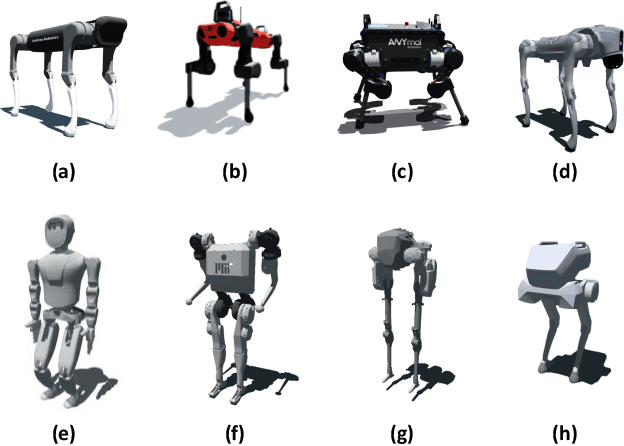
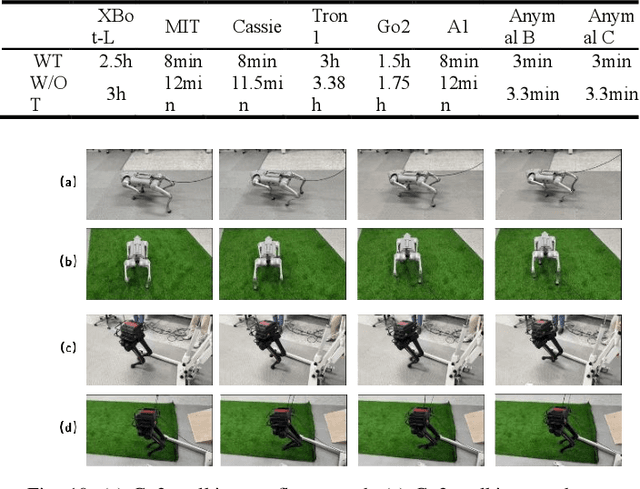
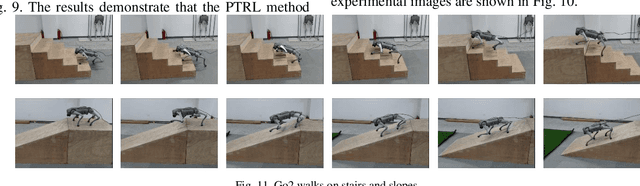
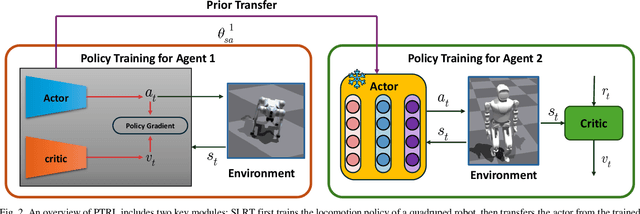
In the field of legged robot motion control, reinforcement learning (RL) holds great promise but faces two major challenges: high computational cost for training individual robots and poor generalization of trained models. To address these problems, this paper proposes a novel framework called Prior Transfer Reinforcement Learning (PTRL), which improves both training efficiency and model transferability across different robots. Drawing inspiration from model transfer techniques in deep learning, PTRL introduces a fine-tuning mechanism that selectively freezes layers of the policy network during transfer, making it the first to apply such a method in RL. The framework consists of three stages: pre-training on a source robot using the Proximal Policy Optimization (PPO) algorithm, transferring the learned policy to a target robot, and fine-tuning with partial network freezing. Extensive experiments on various robot platforms confirm that this approach significantly reduces training time while maintaining or even improving performance. Moreover, the study quantitatively analyzes how the ratio of frozen layers affects transfer results, providing valuable insights into optimizing the process. The experimental outcomes show that PTRL achieves better walking control performance and demonstrates strong generalization and adaptability, offering a promising solution for efficient and scalable RL-based control of legged robots.