 Add to Chrome
 Add to Firefox
 Add to Edge
STLDM: Spatio-Temporal Latent Diffusion Model for Precipitation Nowcasting
Dec 24, 2025
Precipitation nowcasting is a critical spatio-temporal prediction task for society to prevent severe damage owing to extreme weather events. Despite the advances in this field, the complex and stochastic nature of this task still poses challenges to existing approaches. Specifically, deterministic models tend to produce blurry predictions while generative models often struggle with poor accuracy. In this paper, we present a simple yet effective model architecture termed STLDM, a diffusion-based model that learns the latent representation from end to end alongside both the Variational Autoencoder and the conditioning network. STLDM decomposes this task into two stages: a deterministic forecasting stage handled by the conditioning network, and an enhancement stage performed by the latent diffusion model. Experimental results on multiple radar datasets demonstrate that STLDM achieves superior performance compared to the state of the art, while also improving inference efficiency. The code is available in https://github.com/sqfoo/stldm_official.

Fourier Amplitude and Correlation Loss: Beyond Using L2 Loss for Skillful Precipitation Nowcasting
Oct 30, 2024
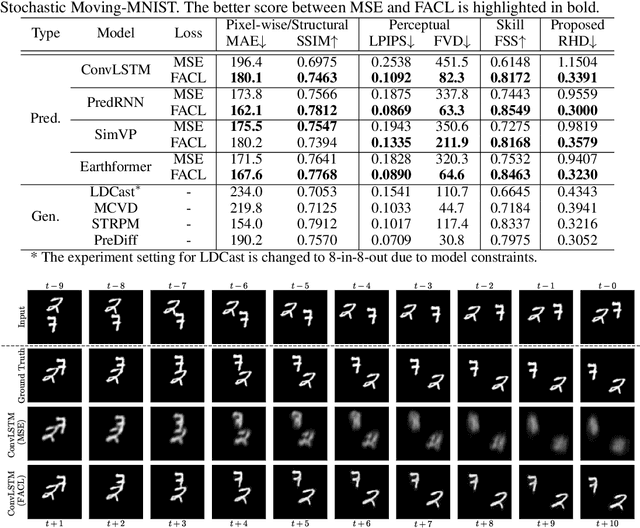
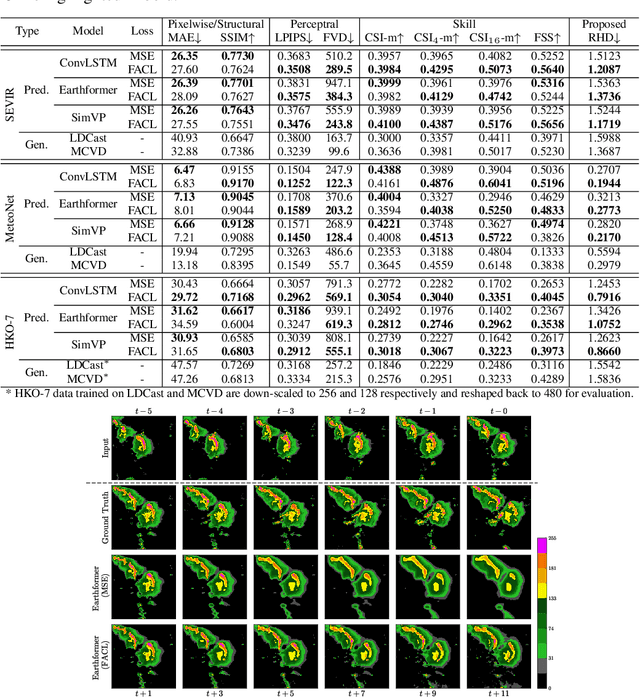

Deep learning approaches have been widely adopted for precipitation nowcasting in recent years. Previous studies mainly focus on proposing new model architectures to improve pixel-wise metrics. However, they frequently result in blurry predictions which provide limited utility to forecasting operations. In this work, we propose a new Fourier Amplitude and Correlation Loss (FACL) which consists of two novel loss terms: Fourier Amplitude Loss (FAL) and Fourier Correlation Loss (FCL). FAL regularizes the Fourier amplitude of the model prediction and FCL complements the missing phase information. The two loss terms work together to replace the traditional $L_2$ losses such as MSE and weighted MSE for the spatiotemporal prediction problem on signal-based data. Our method is generic, parameter-free and efficient. Extensive experiments using one synthetic dataset and three radar echo datasets demonstrate that our method improves perceptual metrics and meteorology skill scores, with a small trade-off to pixel-wise accuracy and structural similarity. Moreover, to improve the error margin in meteorological skill scores such as Critical Success Index (CSI) and Fractions Skill Score (FSS), we propose and adopt the Regional Histogram Divergence (RHD), a distance metric that considers the patch-wise similarity between signal-based imagery patterns with tolerance to local transforms. Code is available at https://github.com/argenycw/FACL