 Add to Chrome
 Add to Firefox
 Add to Edge
Recommending Search Filters To Improve Conversions At Airbnb
Feb 27, 2026
Airbnb, a two-sided online marketplace connecting guests and hosts, offers a diverse and unique inventory of accommodations, experiences, and services. Search filters play an important role in helping guests navigate this variety by refining search results to align with their needs. Yet, while search filters are designed to facilitate conversions in online marketplaces, their direct impact on driving conversions remains underexplored in the existing literature. This paper bridges this gap by presenting a novel application of machine learning techniques to recommend search filters aimed at improving booking conversions. We introduce a modeling framework that directly targets lower-funnel conversions (bookings) by recommending intermediate tools, i.e. search filters. Leveraging the framework, we designed and built the filter recommendation system at Airbnb from the ground up, addressing challenges like cold start and stringent serving requirements. The filter recommendation system we developed has been successfully deployed at Airbnb, powering multiple user interfaces and driving incremental booking conversion lifts, as validated through online A/B testing. An ablation study further validates the effectiveness of our approach and key design choices. By focusing on conversion-oriented filter recommendations, our work ensures that search filters serve their ultimate purpose at Airbnb - helping guests find and book their ideal accommodations.

Learning to Rank for Maps at Airbnb
Jun 25, 2024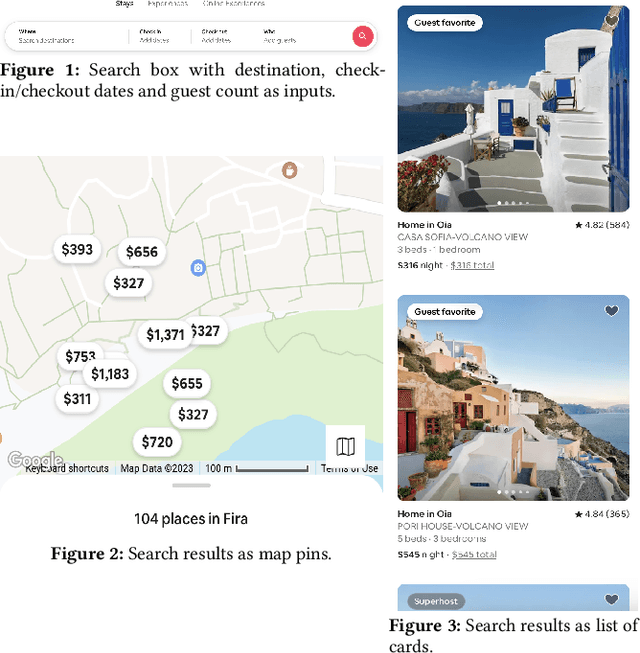
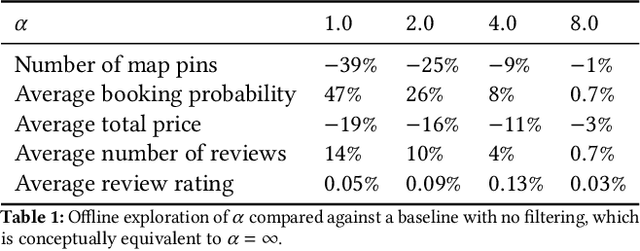
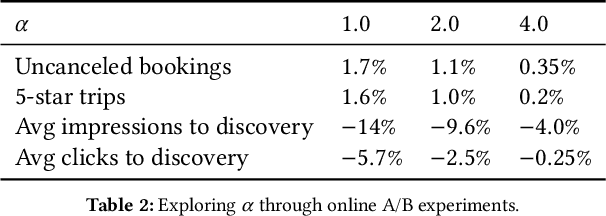
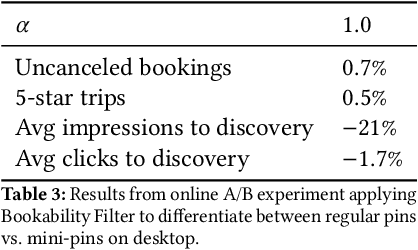
As a two-sided marketplace, Airbnb brings together hosts who own listings for rent with prospective guests from around the globe. Results from a guest's search for listings are displayed primarily through two interfaces: (1) as a list of rectangular cards that contain on them the listing image, price, rating, and other details, referred to as list-results (2) as oval pins on a map showing the listing price, called map-results. Both these interfaces, since their inception, have used the same ranking algorithm that orders listings by their booking probabilities and selects the top listings for display. But some of the basic assumptions underlying ranking, built for a world where search results are presented as lists, simply break down for maps. This paper describes how we rebuilt ranking for maps by revising the mathematical foundations of how users interact with search results. Our iterative and experiment-driven approach led us through a path full of twists and turns, ending in a unified theory for the two interfaces. Our journey shows how assumptions taken for granted when designing machine learning algorithms may not apply equally across all user interfaces, and how they can be adapted. The net impact was one of the largest improvements in user experience for Airbnb which we discuss as a series of experimental validations.