 Add to Chrome
 Add to Firefox
 Add to Edge
HiF-DTA: Hierarchical Feature Learning Network for Drug-Target Affinity Prediction
Oct 31, 2025
Accurate prediction of Drug-Target Affinity (DTA) is crucial for reducing experimental costs and accelerating early screening in computational drug discovery. While sequence-based deep learning methods avoid reliance on costly 3D structures, they still overlook simultaneous modeling of global sequence semantic features and local topological structural features within drugs and proteins, and represent drugs as flat sequences without atomic-level, substructural-level, and molecular-level multi-scale features. We propose HiF-DTA, a hierarchical network that adopts a dual-pathway strategy to extract both global sequence semantic and local topological features from drug and protein sequences, and models drugs multi-scale to learn atomic, substructural, and molecular representations fused via a multi-scale bilinear attention module. Experiments on Davis, KIBA, and Metz datasets show HiF-DTA outperforms state-of-the-art baselines, with ablations confirming the importance of global-local extraction and multi-scale fusion.

ViDTA: Enhanced Drug-Target Affinity Prediction via Virtual Graph Nodes and Attention-based Feature Fusion
Dec 27, 2024

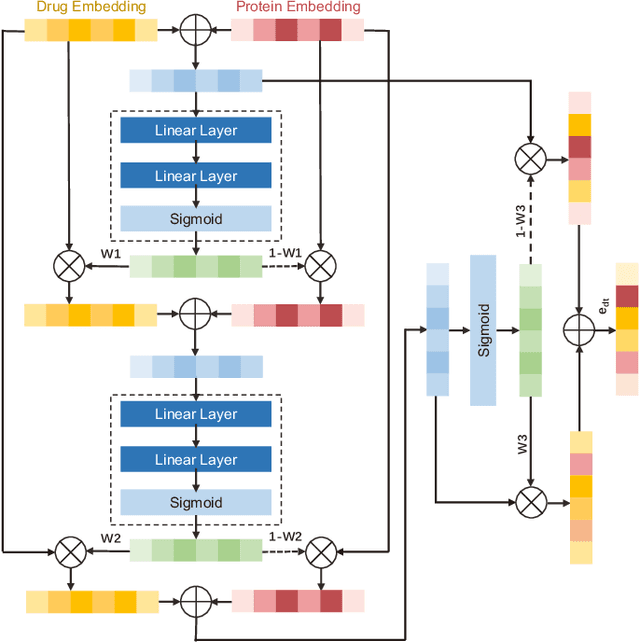
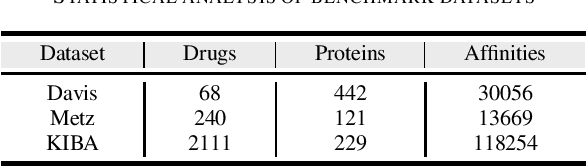
Drug-target interaction is fundamental in understanding how drugs affect biological systems, and accurately predicting drug-target affinity (DTA) is vital for drug discovery. Recently, deep learning methods have emerged as a significant approach for estimating the binding strength between drugs and target proteins. However, existing methods simply utilize the drug's local information from molecular topology rather than global information. Additionally, the features of drugs and proteins are usually fused with a simple concatenation operation, limiting their effectiveness. To address these challenges, we proposed ViDTA, an enhanced DTA prediction framework. We introduce virtual nodes into the Graph Neural Network (GNN)-based drug feature extraction network, which acts as a global memory to exchange messages more efficiently. By incorporating virtual graph nodes, we seamlessly integrate local and global features of drug molecular structures, expanding the GNN's receptive field. Additionally, we propose an attention-based linear feature fusion network for better capturing the interaction information between drugs and proteins. Experimental results evaluated on various benchmarks including Davis, Metz, and KIBA demonstrate that our proposed ViDTA outperforms the state-of-the-art baselines.
Revisiting Gradient Pruning: A Dual Realization for Defending against Gradient Attacks
Jan 30, 2024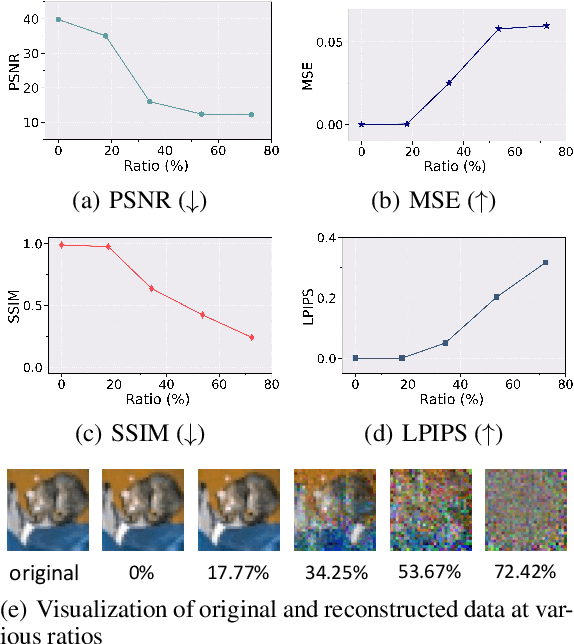

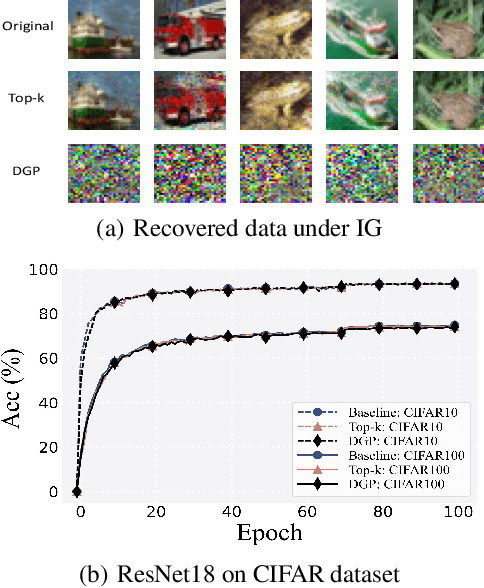

Collaborative learning (CL) is a distributed learning framework that aims to protect user privacy by allowing users to jointly train a model by sharing their gradient updates only. However, gradient inversion attacks (GIAs), which recover users' training data from shared gradients, impose severe privacy threats to CL. Existing defense methods adopt different techniques, e.g., differential privacy, cryptography, and perturbation defenses, to defend against the GIAs. Nevertheless, all current defense methods suffer from a poor trade-off between privacy, utility, and efficiency. To mitigate the weaknesses of existing solutions, we propose a novel defense method, Dual Gradient Pruning (DGP), based on gradient pruning, which can improve communication efficiency while preserving the utility and privacy of CL. Specifically, DGP slightly changes gradient pruning with a stronger privacy guarantee. And DGP can also significantly improve communication efficiency with a theoretical analysis of its convergence and generalization. Our extensive experiments show that DGP can effectively defend against the most powerful GIAs and reduce the communication cost without sacrificing the model's utility.