 Add to Chrome
 Add to Firefox
 Add to Edge
Conjugate Equivariant Neural Network for Precoder Learning
Aug 14, 2026
Exploiting mathematical properties of wireless policies in deep neural network (DNN) design can improve learning performance and generalizability while reducing training complexity. Permutation equivariance and permutation invariance have been incorporated into DNN architectures. In this paper, we investigate conjugation equivariance (CE) and propose a general conjugation-equivariant neural network (CENN) framework for precoder learning. We first establish that the optimal policies for a unified class of precoding problems satisfy CE, i.e., when the channel matrices are conjugated, the conjugate of an optimal precoder remains optimal. We then show that, for DNNs with linear processing functions, enforcing CE restricts their ability to learn optimal precoding policies. To overcome this limitation, we develop a general nonlinear construction and prove that it converts an arbitrary base function into a CE processing function while preserving the base function's original equivariance properties. This construction enables existing equivariant networks to incorporate CE without adding learnable parameters. Simulations for fully digital and RIS-aided precoding show that the resulting CE-enhanced networks improve learning and generalization performance while requiring fewer training samples and shorter training time than their original counterparts.

Learning-Based Beamforming for Energy Efficiency of Continuous Aperture Array Systems
Jul 14, 2026This paper jointly optimizes the base-station (BS) continuous aperture array (CAPA) dimensions and beamforming functions to maximize energy efficiency (EE) of the downlink multiuser multi-CAPA system, where both the BS and the users are equipped with CAPAs. Since the beamforming functions are continuous current distribution over the BS CAPA, the resulting EE maximization problem is a nontrivial functional optimization problem that couples aperture sizing and beamforming design. To address this challenge, we propose a cascaded network architecture consisting of a graph neural network (GNN) and a functional-gradient based implicit neural representation (FGB-INR) to learn the BS CAPA dimensions and beamforming functions, respectively. Both networks exploit the permutation equivariance of the optimal optimization policy, and the update equations of FGB-INR are designed according to the functional-gradient structure of the EE objective. Simulation results show that the proposed method approaches the EE of the numerical method while substantially reducing inference latency. They also demonstrates that the functional-gradient structure in FGB-INR improves EE while reducing sample complexity and training time.
Implicit Neural Representation for Multiuser Continuous Aperture Array Beamforming
Mar 17, 2026Implicit neural representations (INRs) can parameterize continuous beamforming functions in continuous aperture arrays (CAPAs) and thus enable efficient online inference. Existing INR-based beamforming methods for CAPAs, however, typically suffer from high training complexity and limited generalizability. To address these issues, we first derive a closed-form expression for the achievable sum rate in multiuser multi-CAPA systems where both the base station and the users are equipped with CAPAs. For sum-rate maximization, we then develop a functional weighted minimum mean-squared error (WMMSE) algorithm by using orthonormal basis expansion to convert the functional optimization into an equivalent parameter optimization problem. Based on this functional WMMSE algorithm, we further propose BeamINR, an INR-based beamforming method implemented with a graph neural network to exploit the permutation-equivariant structure of the optimal beamforming policy; its update equation is designed from the structure of the functional WMMSE iterations. Simulation results show that the functional WMMSE algorithm achieves the highest sum rate at the cost of high online complexity. Compared with baseline INRs, BeamINR substantially reduces inference latency, lowers training complexity, and generalizes better across the number of users and carrier frequency.
Association-Aware GNN for Precoder Learning in Cell-Free Systems
Mar 13, 2026Deep learning has been widely recognized as a promising approach for optimizing multi-user multi-antenna precoders in traditional cellular systems. However, a critical distinction between cell-free and cellular systems lies in the flexibility of user equipment (UE)-access point (AP) associations. Consequently, the optimal precoder depends not only on channel state information but also on the dynamic UE-AP association status. In this paper, we propose an association-aware graph neural network (AAGNN) that explicitly incorporates association status into the precoding design. We leverage the permutation equivariance properties of the cell-free precoding policy to reduce the training complexity of AAGNN and employ an attention mechanism to enhance its generalization performance. Simulation results demonstrate that the proposed AAGNN outperforms baseline learning methods in both learning performance and generalization capabilities while maintaining low training and inference complexity.
A Model-based DNN for Learning HMIMO Beamforming
Apr 28, 2025Holographic MIMO (HMIMO) is a promising technique for large-scale MIMO systems to enhance spectral efficiency while maintaining low hardware cost and power consumption. Existing alternating optimization algorithms can effectively optimize the hybrid beamforming of HMIMO to improve the system performance, while their high computational complexity hinders real-time application. In this paper, we propose a model-based deep neural network (MB-DNN), which leverages permutation equivalent properties and the optimal beamforming structure to jointly optimize the holographic and digital beamforming. Simulation results demonstrate that the proposed MB-DNN outperforms benchmark schemes and requires much less inference time than existing alternating optimization algorithms.
Precoder Learning by Leveraging Unitary Equivariance Property
Mar 12, 2025Incorporating mathematical properties of a wireless policy to be learned into the design of deep neural networks (DNNs) is effective for enhancing learning efficiency. Multi-user precoding policy in multi-antenna system, which is the mapping from channel matrix to precoding matrix, possesses a permutation equivariance property, which has been harnessed to design the parameter sharing structure of the weight matrix of DNNs. In this paper, we study a stronger property than permutation equivariance, namely unitary equivariance, for precoder learning. We first show that a DNN with unitary equivariance designed by further introducing parameter sharing into a permutation equivariant DNN is unable to learn the optimal precoder. We proceed to develop a novel non-linear weighting process satisfying unitary equivariance and then construct a joint unitary and permutation equivariant DNN. Simulation results demonstrate that the proposed DNN not only outperforms existing learning methods in learning performance and generalizability but also reduces training complexity.
Quantization Design for Deep Learning-Based CSI Feedback
Mar 11, 2025Deep learning-based autoencoders have been employed to compress and reconstruct channel state information (CSI) in frequency-division duplex systems. Practical implementations require judicious quantization of encoder outputs for digital transmission. In this paper, we propose a novel quantization module with bit allocation among encoder outputs and develop a method for joint training the module and the autoencoder. To enhance learning performance, we design a loss function that adaptively weights the quantization loss and the logarithm of reconstruction loss. Simulation results show the performance gain of the proposed method over existing baselines.
Distributed Resource Block Allocation for Wideband Cell-free System
Mar 10, 2025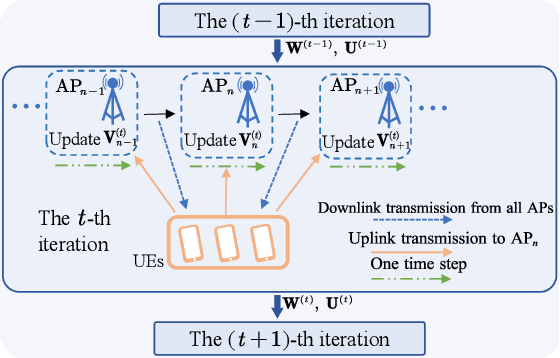
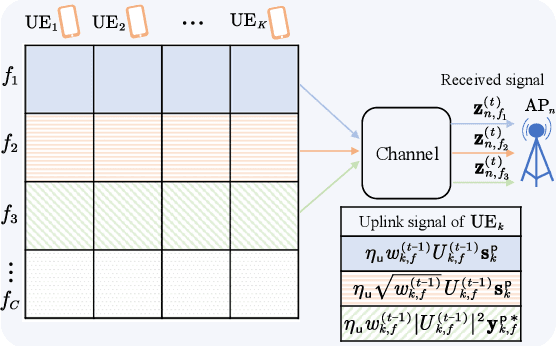
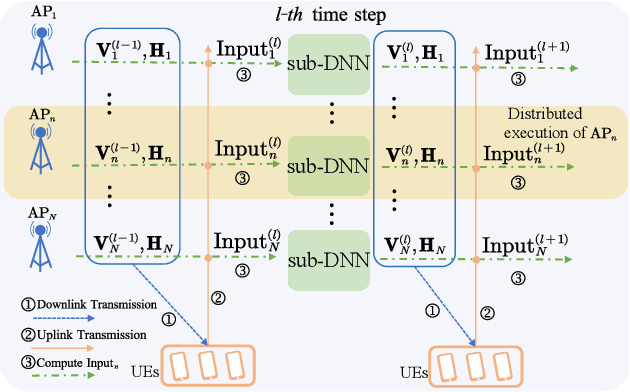
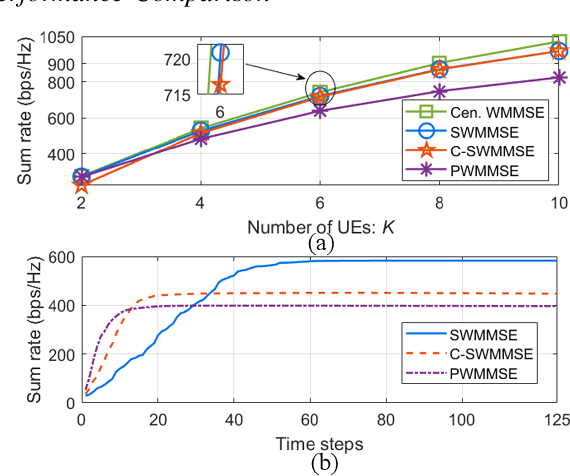
This paper studies distributed resource block (RB) allocation in wideband orthogonal frequency-division multiplexing (OFDM) cell-free systems. We propose a novel distributed sequential algorithm and its two variants, which optimize RB allocation based on the information obtained through over-the-air (OTA) transmissions between access points (APs) and user equipments, enabling local decision updates at each AP. To reduce the overhead of OTA transmission, we further develop a distributed deep learning (DL)-based method to learn the RB allocation policy. Simulation results demonstrate that the proposed distributed algorithms perform close to the centralized algorithm, while the DL-based method outperforms existing baseline methods.
Learning of Uplink Resource Allocation with Multiuser QoS Constraints
Mar 09, 2025In the paper the joint optimization of uplink multiuser power and resource block (RB) allocation are studied, where each user has quality of service (QoS) constraints on both long- and short-blocklength transmissions. The objective is to minimize the consumption of RBs for meeting the QoS requirements, leading to a mixed-integer nonlinear programming (MINLP) problem. We resort to deep learning to solve the problem with low inference complexity. To provide a performance benchmark for learning based methods, we propose a hierarchical algorithm to find the global optimal solution in the single-user scenario, which is then extended to the multiuser scenario. The design of the learning method, however, is challenging due to the discrete policy to be learned, which results in either vanishing or exploding gradient during neural network training. We introduce two types of smoothing functions to approximate the involved discretizing processes and propose a smoothing parameter adaption method. Another critical challenge lies in guaranteeing the QoS constraints. To address it, we design a nonlinear function to intensify the penalties for minor constraint violations. Simulation results demonstrate the advantages of the proposed method in reducing the number of occupied RBs and satisfying QoS constraints reliably.
Gradient-Driven Graph Neural Networks for Learning Digital and Hybrid Precoder
Mar 08, 2025The optimization of multi-user multi-input multi-output (MU-MIMO) precoders is a widely recognized challenging problem. Existing work has demonstrated the potential of graph neural networks (GNNs) in learning precoding policies. However, existing GNNs often exhibit poor generalizability for the numbers of users or antennas. In this paper, we develop a gradient-driven GNN design method for the learning of fully digital and hybrid precoding policies. The proposed GNNs leverage two kinds of knowledge, namely the gradient of signal-to-interference-plus-noise ratio (SINR) to the precoders and the permutation equivariant property of the precoding policy. To demonstrate the flexibility of the proposed method for accommodating different optimization objectives and different precoding policies, we first apply the proposed method to learn the fully digital precoding policies. We study two precoder optimization problems for spectral efficiency (SE) maximization and log-SE maximization to achieve proportional fairness. We then apply the proposed method to learn the hybrid precoding policy, where the gradients to analog and digital precoders are exploited for the design of the GNN. Simulation results show the effectiveness of the proposed methods for learning different precoding policies and better generalization performance to the numbers of both users and antennas compared to baseline GNNs.