 Add to Chrome
 Add to Firefox
 Add to Edge
Magnetic activity of ultracool dwarfs in the LAMOST DR11
Dec 09, 2025
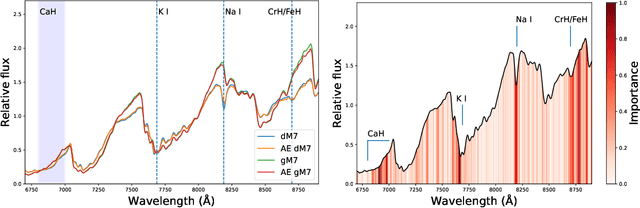
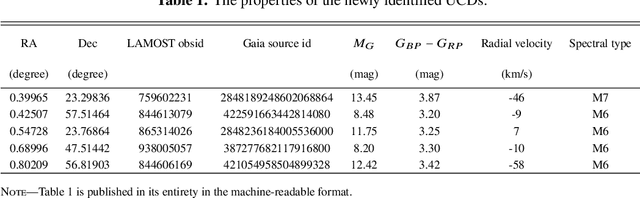
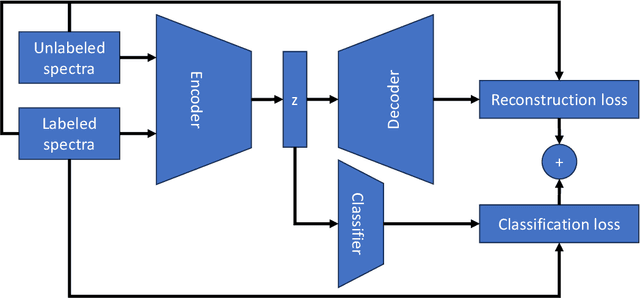
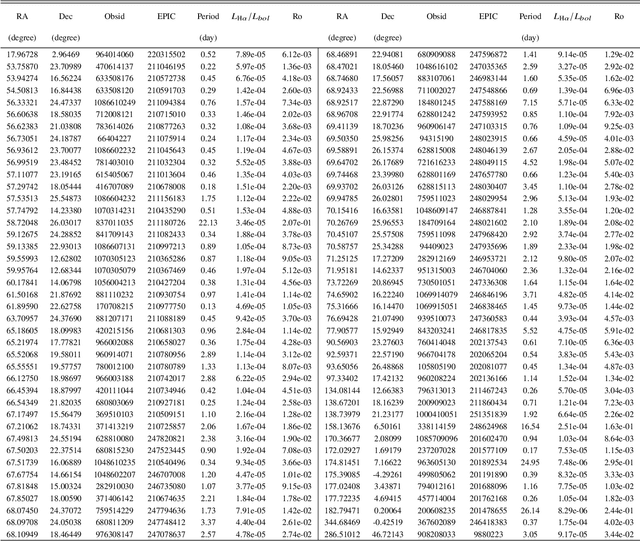
Ultracool dwarfs consist of lowest-mass stars and brown dwarfs. Their interior is fully convective, different from that of the partly-convective Sun-like stars. Magnetic field generation process beneath the surface of ultracool dwarfs is still poorly understood and controversial. To increase samples of active ultracool dwarfs significantly, we have identified 962 ultracool dwarfs in the latest LAMOST data release, DR11. We also simulate the Chinese Space Station Survey Telescope (CSST) low-resolution slitless spectra by degrading the LAMOST spectra. A semi-supervised machine learning approach with an autoencoder model is built to identify ultracool dwarfs with the simulated CSST spectra, which demonstrates the capability of the CSST all-sky slitless spectroscopic survey on the detection of ultracool dwarfs. Magnetic activity of the ultracool dwarfs is investigated by using the H$α$ line emission as a proxy. The rotational periods of 82 ultracool dwarfs are derived based on the Kepler/K2 light curves. We also derive the activity-rotation relation of the ultracool dwarfs, which is saturated around a Rossby number of 0.12.

Taxonomic analysis of asteroids with artificial neural networks
Nov 18, 2023We study the surface composition of asteroids with visible and/or infrared spectroscopy. For example, asteroid taxonomy is based on the spectral features or multiple color indices in visible and near-infrared wavelengths. The composition of asteroids gives key information to understand their origin and evolution. However, we lack compositional information for faint asteroids due to limits of ground-based observational instruments. In the near future, the Chinese Space Survey telescope (CSST) will provide multiple colors and spectroscopic data for asteroids of apparent magnitude brighter than 25 mag and 23 mag, respectively. For the aim of analysis of the CSST spectroscopic data, we applied an algorithm using artificial neural networks (ANNs) to establish a preliminary classification model for asteroid taxonomy according to the design of the survey module of CSST. Using the SMASS II spectra and the Bus-Binzel taxonomy system, our ANN classification tool composed of 5 individual ANNs is constructed, and the accuracy of this classification system is higher than 92 %. As the first application of our ANN tool, 64 spectra of 42 asteroids obtained in 2006 and 2007 by us with the 2.16-m telescope in the Xinglong station (Observatory Code 327) of National Astronomical Observatory of China are analyzed. The predicted labels of these spectra using our ANN tool are found to be reasonable when compared to their known taxonomic labels. Considering the accuracy and stability, our ANN tool can be applied to analyse the CSST asteroid spectra in the future.
Investigation of stellar magnetic activity using variational autoencoder based on low-resolution spectroscopic survey
Jun 16, 2022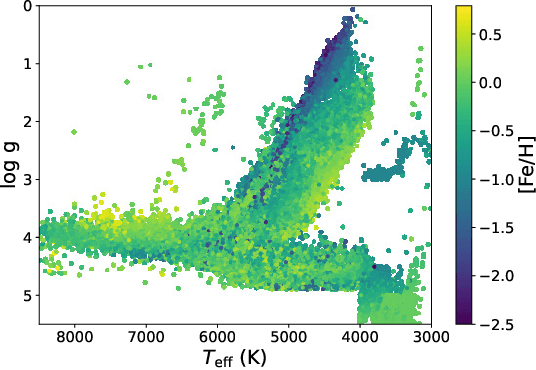

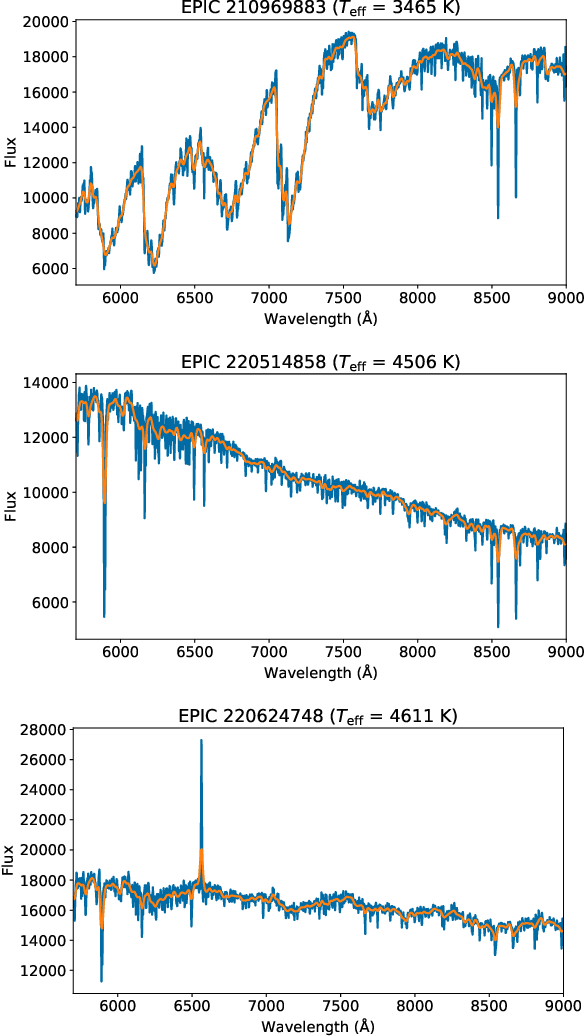
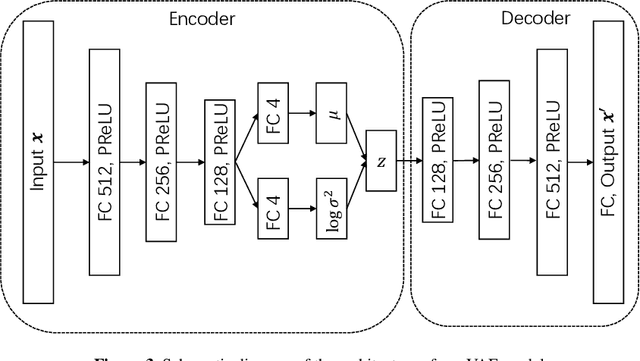
We apply the variational autoencoder (VAE) to the LAMOST-K2 low-resolution spectra to detect the magnetic activity of the stars in the K2 field. After the training on the spectra of the selected inactive stars, the VAE model can efficiently generate the synthetic reference templates needed by the spectral subtraction procedure, without knowing any stellar parameters. Then we detect the peculiar spectral features, such as chromospheric emissions, strong nebular emissions and lithium absorptions, in our sample. We measure the emissions of the chromospheric activity indicators, H$\alpha$ and Ca$~{\rm {\small II}}$ infrared triplet (IRT) lines, to quantify the stellar magnetic activity. The excess emissions of H$\alpha$ and Ca$~{\rm {\small II}}$ IRT lines of the active stars are correlated well to the rotational periods and the amplitudes of light curves derived from the K2 photometry. We degrade the LAMOST spectra to simulate the slitless spectra of the planned China Space Station Telescope (CSST) and apply the VAE to the simulated data. For cool active stars, we reveal a good agreement between the equivalent widths (EWs) of H$\alpha$ line derived from the spectra with two resolutions. The result indicates the ability of identifying the magnetically active stars in the future CSST survey, which will deliver an unprecedented large database of low-resolution spectra as well as simultaneous multi-band photometry of stars.