 Add to Chrome
 Add to Firefox
 Add to Edge
MambaPSA: A Mamba-based Replacement for C2PSA in YOLO26
Jul 14, 2026
State space models (SSMs), notably Mamba, have recently emerged as efficient alternatives to self-attention with linear computational complexity. We investigate the integration of Mamba into YOLO26, the latest non-maximum suppression (NMS)-free object detection framework, by proposing MambaPSA, a lightweight Mamba-based replacement for the C2PSA block at the end of the backbone. To complement this study, we additionally insert a bidirectional Vision Mamba (BiViM) module at the P3, P4, and P5 levels of the neck. Experiments on PASCAL VOC 2007+2012 show that MambaPSA reduces parameters by 2.9%, FLOPs by 12.1%, and improves CPU inference throughput by 17.6% (from 17 to 20 FPS) with negligible accuracy change (-0.1 mAP50:95), while the P4 BiViM placement yields the best accuracy gain (+0.9 mAP50:95). These results suggest that SSMs offer a favorable efficiency-accuracy trade-off when replacing attention-based blocks in NMS-free lightweight detectors.

DR-Mamba: Automatic Inference-Time Domain Adaptation for Document Image Binarization via Sample-Conditioned Detail-Background Suppression
Jun 21, 2026Degraded document image binarization is sensitive to domain shifts caused by paper aging, bleed-through, stains, shadows, and uneven illumination, and the foreground-background separation of recent learning-based methods can become unstable on unseen degradation domains. We propose DR-Mamba, a sample-conditioned detail-background suppression framework that performs automatic inference-time domain adaptation for document image binarization. Unlike test-time adaptation methods that require gradient updates or auxiliary data at inference, DR-Mamba adapts to each input document through input-dependent gates within a single forward pass, requiring no target-domain labels, no fine-tuning, and no test-time parameter updates. Instead of using Mamba-style selective scanning as a single generic feature path, DR-Mamba reinterprets it as fast-slow route modeling: a fast detail route captures local stroke structures, while a slow background route accumulates spatially persistent degradation responses. The two routes are integrated through an input-dependent subtractive gate that explicitly suppresses background interference rather than fusing features by addition or concatenation. We further add full-resolution detail-guided reconstruction and thin-stroke-aware supervision to recover fine strokes lost during downsampling. Evaluated under a leave-one-year-out protocol on DIBCO-style benchmarks, where each held-out year is treated as an unseen degradation domain, DR-Mamba shows that per-document, per-location subtractive suppression improves cross-domain robustness, with particularly strong performance on the most severely degraded held-out fold.
Reload-Mamba: Hierarchical Anti-Dilution State-Space Modeling for Multi-Class Semantic Segmentation
Jun 16, 2026Mamba-based state space models offer linear-time long-range modeling for high-resolution dense prediction, but sequential state-space propagation can attenuate boundary-sensitive and detail-sensitive responses that are critical in multi-class semantic segmentation. We propose Reload-Mamba, a semantic segmentation framework that addresses this propagation-induced response dilution through three segmentation-specific designs: (i) a boundary-supervised local detail prior that is explicitly trained with ground-truth boundary masks to identify regions requiring response restoration; (ii) a class-uncertainty-aware Reload Gate that incorporates per-pixel class entropy from a pre-reload auxiliary head as an additional gating signal, a formulation that is informative only under multi-class dense prediction; and (iii) a hierarchical multi-level Reload mechanism that applies anti-dilution refinement at three decoder levels and fuses the restored representations top-down. Built upon a ConvNeXt-Tiny encoder with a multi-scale decoder and four-directional Mamba scanning with pixel-wise directional attention, Reload-Mamba achieves 47.9% single-scale (48.9% multi-scale) mIoU on ADE20K and 83.2% single-scale mIoU on Cityscapes. With ResNet-101 + COCO pre-training under the standard DeepLab-style protocol, Reload-Mamba reaches 87.8% mIoU on PASCAL VOC 2012 val. Controlled ablations show that each of the three segmentation-specific designs contributes beyond a direct port of the prior anti-dilution architecture proposed for binarization, cumulatively improving over the direct-port baseline by +2.2 mIoU on ADE20K.
ERN-Net : Evolving Reason Node-Net for Document Binarization
Jun 10, 2026This paper presents ERN-Net, an Evolving Reason Node-Net for efficient document image binarization. ERN-Net enhances degradation-sensitive regions, such as faint strokes, broken characters, and noisy backgrounds, through evolving reason nodes and multi-scale reasoning. We further compare ResNet-101, ConvNeXt-Tiny, and ConvNeXt-Base, and find that ConvNeXt-Tiny provides the best practical trade-off between accuracy and memory usage. In addition, DIBCO-based pretraining improves binarization performance without increasing model memory consumption, requiring only about 1.5 additional training hours. Experiments on DIBCO-style benchmarks show that ERN-Net is effective under low-data and low-memory settings.
DeepMine-Mamba: Mitigating Information Dilution in Mamba-Based State Space Models for Document Image Binarization
Jun 07, 2026Document image binarization aims to separate foreground text from degraded backgrounds while preserving thin, broken, and low-contrast strokes. Although deep learning methods have improved binarization performance, most existing approaches rely on convolutional, transformer-based, or generative architectures, while Mamba-based state space models remain largely unexplored for this task. In this work, we investigate Mamba-based feature propagation and observe that direct state-space propagation may dilute weak foreground cues during long-range modeling, especially faint ink traces, fragmented characters, and boundary-sensitive stroke details. To address this problem, we propose DeepMine-Mamba, a Mamba-based binarization framework equipped with a novel Anti-Dilution Gate that estimates propagation-induced feature changes and selectively restores stroke-sensitive local responses while suppressing unnecessary background enhancement. Experiments on DIBCO/H-DIBCO benchmarks under a strict leave-one-year-out protocol show that DeepMine-Mamba achieves competitive overall performance, with strong average FM and Fps across benchmark years. Ablation results further demonstrate that the Anti-Dilution Gate improves stroke preservation and reduces perceptually significant binarization errors.
Generalizing Geometry-Guided Mamba as a Plug-and-Play Context Module for CNN-based Semantic Segmentation
Jun 07, 2026CNN-based semantic segmentation networks usually rely on context heads such as ASPP, PPM, or attention modules to enlarge the receptive field. These heads are effective but may introduce heavy computation, memory cost, or boundary leakage. This paper revisits Directional Geometric Mamba (G-Mamba) from DGM-Net and studies it as a plug-and-play context aggregation module rather than a complete new segmentation architecture. The key idea is to inject geometric guidance into the selective scan process, allowing long-range feature propagation to be modulated by boundary and centripetal-flow cues. We replace the original context heads of six representative CNN segmentation models, including DeepLabV3+, DANet, CCNet, PSPNet, PSANet, and OCRNet, while keeping the ResNet-101 backbone unchanged. Results on Cityscapes show consistent mIoU gains with only moderate extra GFLOPs at $1024\times1024$ resolution, suggesting that geometry-guided SSM modules can serve as practical alternatives or enhancements to conventional CNN context heads.
ATV-Net: Adaptive Triple-View Network with Dynamic Feature Fusion
May 25, 2026Recent semantic segmentation research has increasingly moved toward stronger context modeling, dense attention, and transformer-based architectures. Although these models achieve impressive performance, classical CNN-based segmentation pipelines remain attractive because of their simplicity, efficiency, and ease of implementation. This paper revisits a practical question: how far can a ResNet-based segmentation model be improved by only modifying the segmentation head? We propose ATV-Net, an Adaptive Triple-View Network that strengthens a ResNet-101 backbone using three simple but complementary receptive-field views. The micro view captures point-wise semantic responses, the local view models neighborhood structures and object boundaries, and the scout view provides enlarged contextual cues. Instead of fusing these views with fixed weights, ATV-Net introduces an Adaptive Decision Gate that dynamically selects receptive-field responses according to input scene characteristics. A compact global coordination layer is further applied to improve spatial and semantic consistency. Experiments on the Cityscapes validation set show that ATV-Net achieves 80.31\% mIoU. This result suggests that classical CNN-based segmentation is still far from obsolete: with simple receptive-field views and adaptive fusion, a ResNet-based pipeline can reach a competitive accuracy level without relying on transformer-style global attention or overly complex context modules.
FoR-Net: Learning to Focus on Hard Regions for Efficient Semantic Segmentation
May 04, 2026We present FoR-Net, a lightweight architecture for semantic segmentation that focuses on identifying and enhancing hard regions. Instead of relying on heavy global modeling, FoR-Net adopts an efficient strategy that selectively emphasizes informative regions through a learned importance map and a Top-K activation mechanism. Specifically, a selector module predicts region-wise importance, enabling the model to focus on challenging areas such as thin structures and object boundaries. Multi-scale reasoning is achieved using convolutional branches with different receptive fields, allowing diverse spatial context aggregation. We evaluate FoR-Net on the Cityscapes benchmark under limited computational resources. Despite its lightweight design and standard training configuration, FoR-Net achieves competitive performance and demonstrates improved consistency in challenging regions. These results suggest that region-focused reasoning provides a simple yet effective inductive bias for efficient semantic segmentation.
Breaking the Resource Wall: Geometry-Guided Sequence Modeling for Efficient Semantic Segmentation
Apr 25, 2026High-performance semantic segmentation has achieved significant progress in recent years, often driven by increasingly large backbones and higher computational budgets. While effective, such approaches introduce substantial computational overhead and limit accessibility under constrained hardware settings. In this paper, we propose DGM-Net (Directional Geometric Mamba Network), an efficient architecture that improves modeling capability through structural design rather than increasing model capacity. We introduce Directional Geometric Mamba (G-Mamba), a linear-complexity O(N) operator as an alternative to conventional context modeling modules such as ASPP and PPM. To further enhance structural awareness in state space model (SSM)-based modeling, we design the DGM-Module, which extracts centripetal flow fields and topological skeletons to guide the scanning process and improve boundary preservation. Without relying on large-scale pretraining or heavy backbone scaling, DGM-Net achieves 80.8% mIoU within 28k iterations, 82.3% mIoU on Cityscapes test set, and 45.24% mIoU on ADE20K. In addition, the model maintains stable performance under constrained hardware settings (e.g., batch size of 2 on 8GB VRAM), highlighting its efficiency and practicality. These results demonstrate that incorporating geometric guidance into SSM-based architectures provides an effective and resource-efficient direction for semantic segmentation.
Multi-Class Lane Semantic Segmentation using Efficient Convolutional Networks
Jul 22, 2019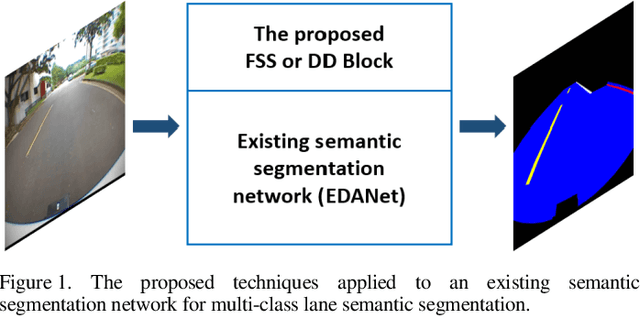


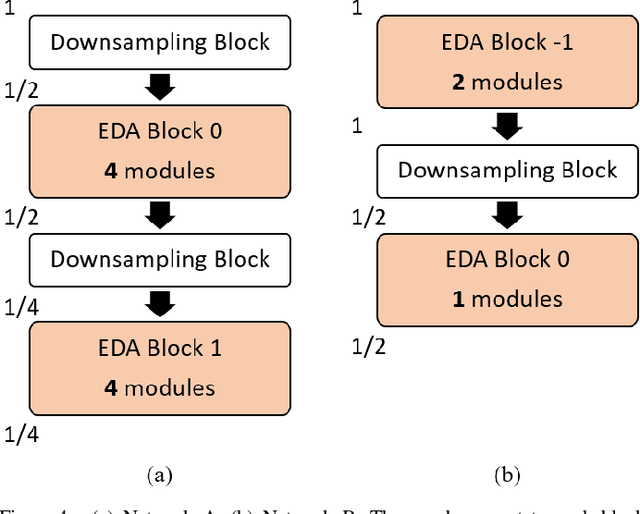
Lane detection plays an important role in a self-driving vehicle. Several studies leverage a semantic segmentation network to extract robust lane features, but few of them can distinguish different types of lanes. In this paper, we focus on the problem of multi-class lane semantic segmentation. Based on the observation that the lane is a small-size and narrow-width object in a road scene image, we propose two techniques, Feature Size Selection (FSS) and Degressive Dilation Block (DD Block). The FSS allows a network to extract thin lane features using appropriate feature sizes. To acquire fine-grained spatial information, the DD Block is made of a series of dilated convolutions with degressive dilation rates. Experimental results show that the proposed techniques provide obvious improvement in accuracy, while they achieve the same or faster inference speed compared to the baseline system, and can run at real-time on high-resolution images.