 Add to Chrome
 Add to Firefox
 Add to Edge
SFMformer: A Spatial-Frequency Modulation Transformer for Lightweight Image Super-Resolution
Aug 18, 2026
Sparse attention mechanisms, which score all token pairs but propagate only the strongest, now underpin the most efficient Transformers for lightweight image super-resolution. This paper observes that sparsification changes what it means to improve such a network. A dense attention layer has one place where representation quality matters: the aggregation of attended features. A sparse layer has two, because the top-k operator first decides which tokens survive and only then decides what to do with them, and a token discarded at the selection stage cannot be recovered downstream. Selection quality and aggregation quality are therefore separable targets, addressed by modules placed before and after the attention respectively. We test this by pairing a dual-branch spatial enhancement on the input of a progressive focused attention with a wavelet-domain modulation on its output, forming SFMformer. Measuring each module alone and jointly over all fifteen benchmark-scale pairs, we find their gains are not additive: the joint gain exceeds the sum of the individual gains on nine pairs, and the sign of the discrepancy is predicted by how much the weaker module contributes on its own (r = -0.72), so the two compound when they relieve different constraints and overlap when they relieve the same one. Enabling spectral modulation once per block rather than once per layer retains the effect at roughly one-sixth of its cost, keeping the model below one million parameters at every scale. SFMformer ranks first on 28 of 30 PSNR/SSIM entries across five benchmarks and three upscaling factors. We report the cases where the pairing does not help, and deploy the model on a Raspberry Pi 5 to confirm the design is practical under tight resource budgets.

MambaPSA: A Mamba-based Replacement for C2PSA in YOLO26
Jul 14, 2026State space models (SSMs), notably Mamba, have recently emerged as efficient alternatives to self-attention with linear computational complexity. We investigate the integration of Mamba into YOLO26, the latest non-maximum suppression (NMS)-free object detection framework, by proposing MambaPSA, a lightweight Mamba-based replacement for the C2PSA block at the end of the backbone. To complement this study, we additionally insert a bidirectional Vision Mamba (BiViM) module at the P3, P4, and P5 levels of the neck. Experiments on PASCAL VOC 2007+2012 show that MambaPSA reduces parameters by 2.9%, FLOPs by 12.1%, and improves CPU inference throughput by 17.6% (from 17 to 20 FPS) with negligible accuracy change (-0.1 mAP50:95), while the P4 BiViM placement yields the best accuracy gain (+0.9 mAP50:95). These results suggest that SSMs offer a favorable efficiency-accuracy trade-off when replacing attention-based blocks in NMS-free lightweight detectors.
YOLO-AMC: An Improved YOLO Architecture with Attention Mechanisms for Building Crack Detection
Jun 11, 2026Crack detection plays an important role in infrastructure inspection and Structural Health Monitoring (SHM). However, cracks typically appear as thin, low-contrast structures and are easily affected by background noise, posing challenges for existing object detection models. This study proposes an improved YOLO-based architecture with integrated attention mechanisms, termed YOLO-AMC (YOLO with Attention Mechanisms for Crack Detection), to enhance automated crack detection performance. Based on YOLOv11, the original C2PSA module is removed, and multiple attention mechanisms, including Global Attention Mechanism (GAM), Residual Convolutional Block Attention Module (Res-CBAM), and Shuffle Attention (SA), are introduced into the multi-scale feature fusion layers of the Neck to strengthen cross-scale feature integration. Experimental results demonstrate that YOLO-AMC consistently outperforms baseline models YOLOv11n and YOLOv8n across multiple evaluation metrics. Among the evaluated attention modules, GAM achieves the best detection performance, obtaining mAP@0.5 = 0.9917 and mAP@0.5:0.95 = 0.9506 on the test dataset, which are higher than those of YOLOv11 (0.9833 / 0.9112) and YOLOv8 (0.9707 / 0.8921). Furthermore, while maintaining a computational complexity of 7.6 GFLOPs, the proposed model achieves 110.95 FPS on an NVIDIA RTX 4090 platform and approximately 5 FPS on a Raspberry Pi 5 edge device, demonstrating a favorable trade-off between accuracy and deployment efficiency. The implementation code for this study is available on GitHub at https://github.com/CY-Tsai24/YOLO-AMC.
DeepMine-Mamba: Mitigating Information Dilution in Mamba-Based State Space Models for Document Image Binarization
Jun 07, 2026Document image binarization aims to separate foreground text from degraded backgrounds while preserving thin, broken, and low-contrast strokes. Although deep learning methods have improved binarization performance, most existing approaches rely on convolutional, transformer-based, or generative architectures, while Mamba-based state space models remain largely unexplored for this task. In this work, we investigate Mamba-based feature propagation and observe that direct state-space propagation may dilute weak foreground cues during long-range modeling, especially faint ink traces, fragmented characters, and boundary-sensitive stroke details. To address this problem, we propose DeepMine-Mamba, a Mamba-based binarization framework equipped with a novel Anti-Dilution Gate that estimates propagation-induced feature changes and selectively restores stroke-sensitive local responses while suppressing unnecessary background enhancement. Experiments on DIBCO/H-DIBCO benchmarks under a strict leave-one-year-out protocol show that DeepMine-Mamba achieves competitive overall performance, with strong average FM and Fps across benchmark years. Ablation results further demonstrate that the Anti-Dilution Gate improves stroke preservation and reduces perceptually significant binarization errors.
Generalizing Geometry-Guided Mamba as a Plug-and-Play Context Module for CNN-based Semantic Segmentation
Jun 07, 2026CNN-based semantic segmentation networks usually rely on context heads such as ASPP, PPM, or attention modules to enlarge the receptive field. These heads are effective but may introduce heavy computation, memory cost, or boundary leakage. This paper revisits Directional Geometric Mamba (G-Mamba) from DGM-Net and studies it as a plug-and-play context aggregation module rather than a complete new segmentation architecture. The key idea is to inject geometric guidance into the selective scan process, allowing long-range feature propagation to be modulated by boundary and centripetal-flow cues. We replace the original context heads of six representative CNN segmentation models, including DeepLabV3+, DANet, CCNet, PSPNet, PSANet, and OCRNet, while keeping the ResNet-101 backbone unchanged. Results on Cityscapes show consistent mIoU gains with only moderate extra GFLOPs at $1024\times1024$ resolution, suggesting that geometry-guided SSM modules can serve as practical alternatives or enhancements to conventional CNN context heads.
Breaking the Resource Wall: Geometry-Guided Sequence Modeling for Efficient Semantic Segmentation
Apr 25, 2026High-performance semantic segmentation has achieved significant progress in recent years, often driven by increasingly large backbones and higher computational budgets. While effective, such approaches introduce substantial computational overhead and limit accessibility under constrained hardware settings. In this paper, we propose DGM-Net (Directional Geometric Mamba Network), an efficient architecture that improves modeling capability through structural design rather than increasing model capacity. We introduce Directional Geometric Mamba (G-Mamba), a linear-complexity O(N) operator as an alternative to conventional context modeling modules such as ASPP and PPM. To further enhance structural awareness in state space model (SSM)-based modeling, we design the DGM-Module, which extracts centripetal flow fields and topological skeletons to guide the scanning process and improve boundary preservation. Without relying on large-scale pretraining or heavy backbone scaling, DGM-Net achieves 80.8% mIoU within 28k iterations, 82.3% mIoU on Cityscapes test set, and 45.24% mIoU on ADE20K. In addition, the model maintains stable performance under constrained hardware settings (e.g., batch size of 2 on 8GB VRAM), highlighting its efficiency and practicality. These results demonstrate that incorporating geometric guidance into SSM-based architectures provides an effective and resource-efficient direction for semantic segmentation.
Global Context Modeling in YOLOv8 for Pediatric Wrist Fracture Detection
Jul 03, 2024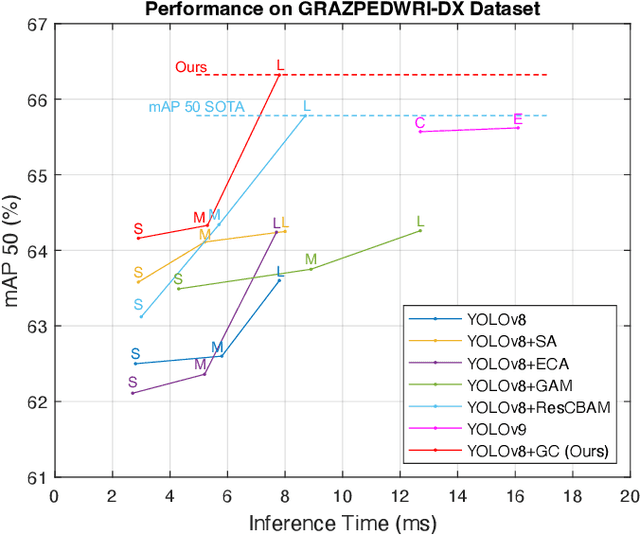
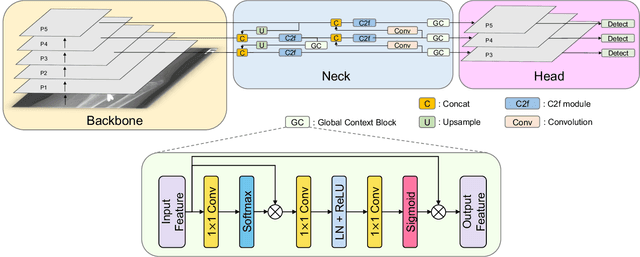
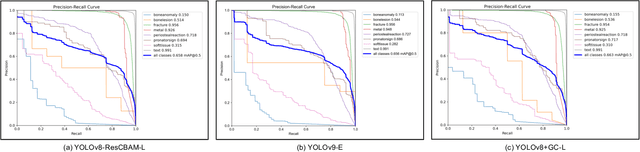
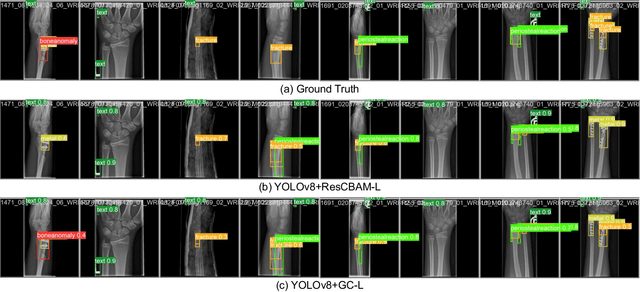
Children often suffer wrist injuries in daily life, while fracture injuring radiologists usually need to analyze and interpret X-ray images before surgical treatment by surgeons. The development of deep learning has enabled neural network models to work as computer-assisted diagnosis (CAD) tools to help doctors and experts in diagnosis. Since the YOLOv8 models have obtained the satisfactory success in object detection tasks, it has been applied to fracture detection. The Global Context (GC) block effectively models the global context in a lightweight way, and incorporating it into YOLOv8 can greatly improve the model performance. This paper proposes the YOLOv8+GC model for fracture detection, which is an improved version of the YOLOv8 model with the GC block. Experimental results demonstrate that compared to the original YOLOv8 model, the proposed YOLOv8-GC model increases the mean average precision calculated at intersection over union threshold of 0.5 (mAP 50) from 63.58% to 66.32% on the GRAZPEDWRI-DX dataset, achieving the state-of-the-art (SOTA) level. The implementation code for this work is available on GitHub at https://github.com/RuiyangJu/YOLOv8_Global_Context_Fracture_Detection.