 Add to Chrome
 Add to Firefox
 Add to Edge
How to Guide LLM Generation: Dual-Surrogate Guided Search for Automated Heuristic Design
Jul 15, 2026
Large language models (LLMs) have made automated heuristic design (AHD) increasingly practical by generating executable heuristic code from task descriptions and evaluator feedback. Yet under a limited query and evaluation budget, search efficiency depends critically on a pre-generation decision. Before each LLM query and black-box evaluation, the system must choose which archived heuristics to reuse as parents and which generation operator should transform them. Existing methods typically choose such actions with predefined rules, leaving the expected outcome of each concrete operator-parent action only indirectly modeled. Therefore, we propose \emph{\fullmethod{}} (\method{}), a surrogate-guided action-selection module for operator-parent selection in LLM-based AHD. \method{} guides the LLM code-generation process by scoring pre-generation actions with two complementary surrogates. Specifically, a transition surrogate is proposed to predict the latent distribution of the child representation induced by an operator-parent action, while an instance-conditioned utility surrogate is proposed to estimate the expected performance of sampled child latents. Moreover, we propose an uncertainty-aware acquisition rule that combines predicted utility, utility uncertainty, and transition uncertainty to select the next LLM generation action. Across a diverse heuristic-design suite, \method{} is competitive with strong LLM-AHD baselines, and ablation and action-selection analyses suggest that its behavior goes beyond simple archive ranking or fixed operator preferences.

Learning to Transfer for Evolutionary Multitasking
Jun 20, 2024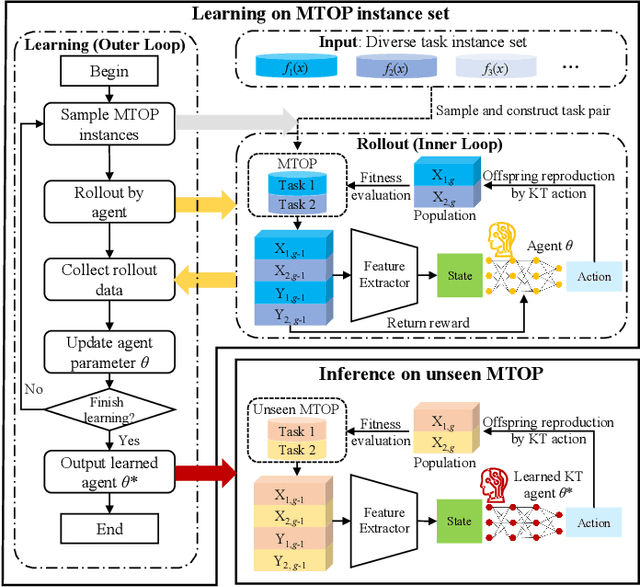
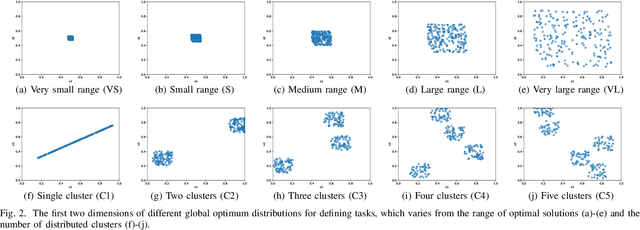
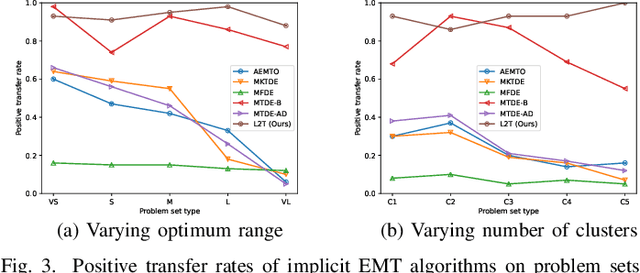

Evolutionary multitasking (EMT) is an emerging approach for solving multitask optimization problems (MTOPs) and has garnered considerable research interest. The implicit EMT is a significant research branch that utilizes evolution operators to enable knowledge transfer (KT) between tasks. However, current approaches in implicit EMT face challenges in adaptability, due to the use of a limited number of evolution operators and insufficient utilization of evolutionary states for performing KT. This results in suboptimal exploitation of implicit KT's potential to tackle a variety of MTOPs. To overcome these limitations, we propose a novel Learning to Transfer (L2T) framework to automatically discover efficient KT policies for the MTOPs at hand. Our framework conceptualizes the KT process as a learning agent's sequence of strategic decisions within the EMT process. We propose an action formulation for deciding when and how to transfer, a state representation with informative features of evolution states, a reward formulation concerning convergence and transfer efficiency gain, and the environment for the agent to interact with MTOPs. We employ an actor-critic network structure for the agent and learn it via proximal policy optimization. This learned agent can be integrated with various evolutionary algorithms, enhancing their ability to address a range of new MTOPs. Comprehensive empirical studies on both synthetic and real-world MTOPs, encompassing diverse inter-task relationships, function classes, and task distributions are conducted to validate the proposed L2T framework. The results show a marked improvement in the adaptability and performance of implicit EMT when solving a wide spectrum of unseen MTOPs.