 Add to Chrome
 Add to Firefox
 Add to Edge
RAMSeS: Robust and Adaptive Model Selection for Time-Series Anomaly Detection Algorithms
Feb 25, 2026
Time-series data vary widely across domains, making a universal anomaly detector impractical. Methods that perform well on one dataset often fail to transfer because what counts as an anomaly is context dependent. The key challenge is to design a method that performs well in specific contexts while remaining adaptable across domains with varying data complexities. We present the Robust and Adaptive Model Selection for Time-Series Anomaly Detection RAMSeS framework. RAMSeS comprises two branches: (i) a stacking ensemble optimized with a genetic algorithm to leverage complementary detectors. (ii) An adaptive model-selection branch identifies the best single detector using techniques including Thompson sampling, robustness testing with generative adversarial networks, and Monte Carlo simulations. This dual strategy exploits the collective strength of multiple models and adapts to dataset-specific characteristics. We evaluate RAMSeS and show that it outperforms prior methods on F1.

Fast Wireless Sensor Anomaly Detection based on Data Stream in Edge Computing Enabled Smart Greenhouse
Jul 28, 2021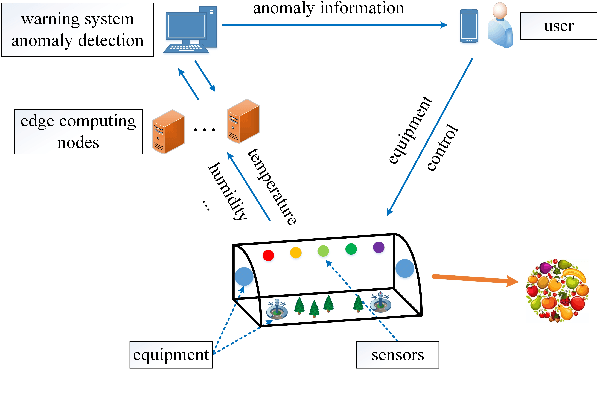
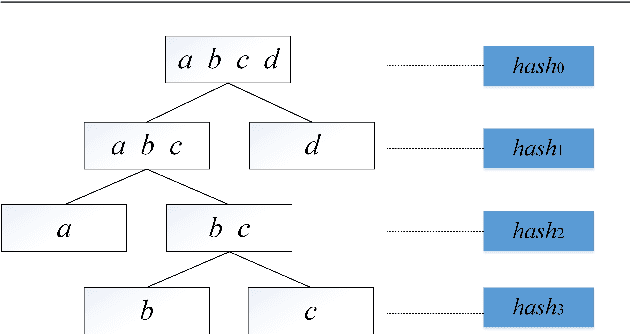
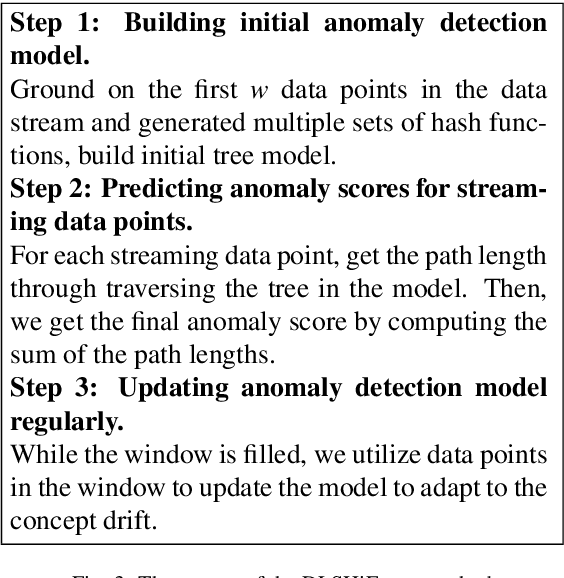
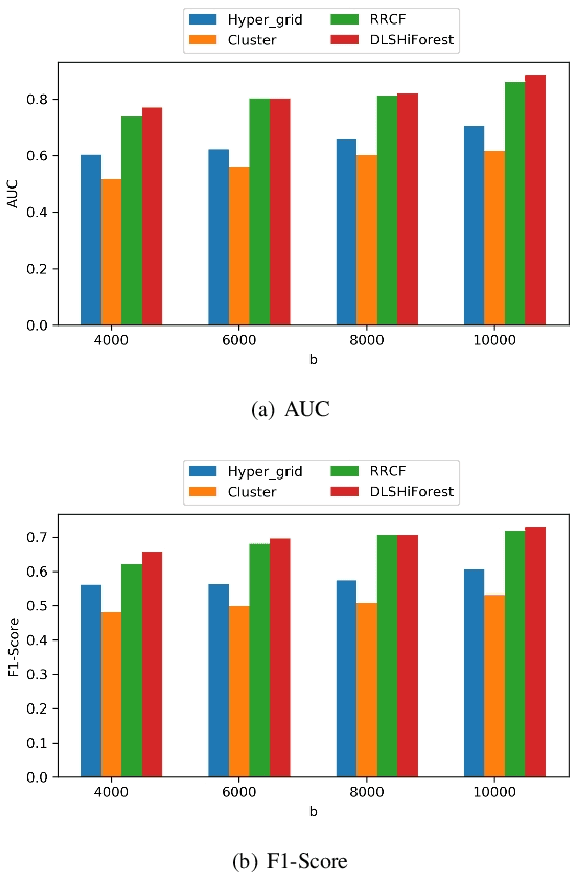
Edge computing enabled smart greenhouse is a representative application of Internet of Things technology, which can monitor the environmental information in real time and employ the information to contribute to intelligent decision-making. In the process, anomaly detection for wireless sensor data plays an important role. However, traditional anomaly detection algorithms originally designed for anomaly detection in static data have not properly considered the inherent characteristics of data stream produced by wireless sensor such as infiniteness, correlations and concept drift, which may pose a considerable challenge on anomaly detection based on data stream, and lead to low detection accuracy and efficiency. First, data stream usually generates quickly which means that it is infinite and enormous, so any traditional off-line anomaly detection algorithm that attempts to store the whole dataset or to scan the dataset multiple times for anomaly detection will run out of memory space. Second, there exist correlations among different data streams, which traditional algorithms hardly consider. Third, the underlying data generation process or data distribution may change over time. Thus, traditional anomaly detection algorithms with no model update will lose their effects. Considering these issues, a novel method (called DLSHiForest) on basis of Locality-Sensitive Hashing and time window technique in this paper is proposed to solve these problems while achieving accurate and efficient detection. Comprehensive experiments are executed using real-world agricultural greenhouse dataset to demonstrate the feasibility of our approach. Experimental results show that our proposal is practicable in addressing challenges of traditional anomaly detection while ensuring accuracy and efficiency.