 Add to Chrome
 Add to Firefox
 Add to Edge
Multi-Agent Transformer for Queue-Level XR Traffic Scheduling in TSN Networks
Aug 05, 2026
Time-Sensitive Networking (TSN) and Mobile Edge Computing (MEC) hold strong potential for enabling ultra-reliable low-latency communication for time-sensitive applications, such as eXtended Reality (XR). However, the widespread adoption of XR introduces significant challenges due to co-located services in MEC environments, leading to contention for shared network resources. Moreover, XR traffic types have distinct characteristics and criticality in terms of timing requirements, further increasing the complexity and dynamics of such environments. Although reinforcement learning has shown promise for TSN scheduling optimization in dynamic network scenarios, existing approaches rely on centralized or high-level multi-agent designs and are typically tailored to periodic and predictable industrial traffic, limiting their applicability to XR workloads. As a result, these approaches suffer from (i) limited ability to capture inter-queue dependencies due to coarse-grained control, and (ii) poor adaptability to highly dynamic and heterogeneous XR traffic. To address these gaps, we propose a multi-agent reinforcement learning approach for queue-level XR traffic scheduling. We adopt the multi-agent transformer (MAT) to model inter-queue dependencies via attention over agents' observations and actions, enabling implicit coordination across heterogeneous co-located XR applications. Our simulation results show that the proposed method outperforms baselines, achieving up to 71.42% latency reduction and up to 83.2% reduction in failure rate, while consistently achieving high reliability across all queues.

Multi-Agent Reinforcement Learning for Online Traffic Scheduling in Time-Sensitive Application
Aug 05, 2026Time-sensitive networking (TSN) is increasingly integrated into mobile edge computing (MEC) to support applications with stringent latency requirements, such as extended reality (XR). However, existing TSN scheduling solutions predominantly rely on static optimization techniques or centralized learning models that are based on fixed traffic patterns, limiting their effectiveness in dynamic environments. In practice, MEC environments often host multiple co-located XR traffic flows whose characteristics evolve over time, creating complex inter-queue dependencies that current schedulers fail to capture. Addressing these challenges requires adaptive, decentralized scheduling mechanisms capable of coordinating multiple TSN queues under varying traffic conditions. To this end, this paper proposes a multi-agent reinforcement learning (MARL) framework for TSN scheduling, where each TSN queue is modeled as an autonomous agent. The Heterogeneous-Agent Proximal Policy Optimization (HAPPO) algorithm is employed to explicitly model inter-agent dependencies and jointly optimize service delivery across queues. The simulation results demonstrate that the proposed approach reduces average frame waiting times by up to 26.8% and worst-case delays by approximately 16.8%, highlighting its effectiveness in dynamic XR-driven MEC scenarios.
Generalizable Multi-Task Learning for Wireless Networks Using Prompt Decision Transformers
Jun 03, 2026Future wireless networks demand rapid adaptation to highly heterogeneous environments and dynamic task configurations, necessitating a shift from conventional rule-based and optimization-driven radio resource management (RRM) toward artificial intelligence (AI)-driven RRM. AI-driven approaches can learn complex nonlinear relationships, generalize across diverse network conditions and enable real-time, scalable and autonomous decision-making. Among RRM techniques, coordinated multipoint (CoMP) transmission is pivotal for mitigating inter-cell interference and enhancing cell-edge performance, thereby improving quality of experience (QoE) in dense deployments. However, optimal multi-cell selection remains a complex combinatorial challenge as it requires jointly optimizing over many possible serving-cell combinations under dynamic traffic and channel conditions. Despite their success, conventional deep reinforcement learning (DRL) methods such as proximal policy optimization (PPO) suffer from poor sample efficiency, limited generalization, and costly retraining when state and action spaces change. To address these bottlenecks, we propose a Prompt Decision Transformer (PromptDT) based multi-task learning framework capable of learning across diverse network configurations and reformulating multi-cell selection as a sequence modeling problem. By leveraging offline trajectories and task-specific prompts, PromptDT enables scalable learning across diverse network configurations, including varying base stations and user equipment counts, and scheduler policies. Experimental results demonstrate that PromptDT improves QoE by up to 49% in multi-task settings compared to baselines, with performance scaling positively alongside model capacity. Moreover, PromptDT generalizes effectively to unseen tasks, achieving robust few-shot adaptation to new network configurations without retraining or fine-tuning.
Edge Learning via Federated Split Decision Transformers for Metaverse Resource Allocation
Feb 18, 2026Mobile edge computing (MEC) based wireless metaverse services offer an untethered, immersive experience to users, where the superior quality of experience (QoE) needs to be achieved under stringent latency constraints and visual quality demands. To achieve this, MEC-based intelligent resource allocation for virtual reality users needs to be supported by coordination across MEC servers to harness distributed data. Federated learning (FL) is a promising solution, and can be combined with reinforcement learning (RL) to develop generalized policies across MEC-servers. However, conventional FL incurs transmitting the full model parameters across the MEC-servers and the cloud, and suffer performance degradation due to naive global aggregation, especially in heterogeneous multi-radio access technology environments. To address these challenges, this paper proposes Federated Split Decision Transformer (FSDT), an offline RL framework where the transformer model is partitioned between MEC servers and the cloud. Agent-specific components (e.g., MEC-based embedding and prediction layers) enable local adaptability, while shared global layers in the cloud facilitate cooperative training across MEC servers. Experimental results demonstrate that FSDT enhances QoE for up to 10% in heterogeneous environments compared to baselines, while offloadingnearly 98% of the transformer model parameters to the cloud, thereby reducing the computational burden on MEC servers.
Smart Jamming Attack and Mitigation on Deep Transfer Reinforcement Learning Enabled Resource Allocation for Network Slicing
Oct 07, 2024Network slicing is a pivotal paradigm in wireless networks enabling customized services to users and applications. Yet, intelligent jamming attacks threaten the performance of network slicing. In this paper, we focus on the security aspect of network slicing over a deep transfer reinforcement learning (DTRL) enabled scenario. We first demonstrate how a deep reinforcement learning (DRL)-enabled jamming attack exposes potential risks. In particular, the attacker can intelligently jam resource blocks (RBs) reserved for slices by monitoring transmission signals and perturbing the assigned resources. Then, we propose a DRL-driven mitigation model to mitigate the intelligent attacker. Specifically, the defense mechanism generates interference on unallocated RBs where another antenna is used for transmitting powerful signals. This causes the jammer to consider these RBs as allocated RBs and generate interference for those instead of the allocated RBs. The analysis revealed that the intelligent DRL-enabled jamming attack caused a significant 50% degradation in network throughput and 60% increase in latency in comparison with the no-attack scenario. However, with the implemented mitigation measures, we observed 80% improvement in network throughput and 70% reduction in latency in comparison to the under-attack scenario.
Self-Play Ensemble Q-learning enabled Resource Allocation for Network Slicing
Aug 19, 2024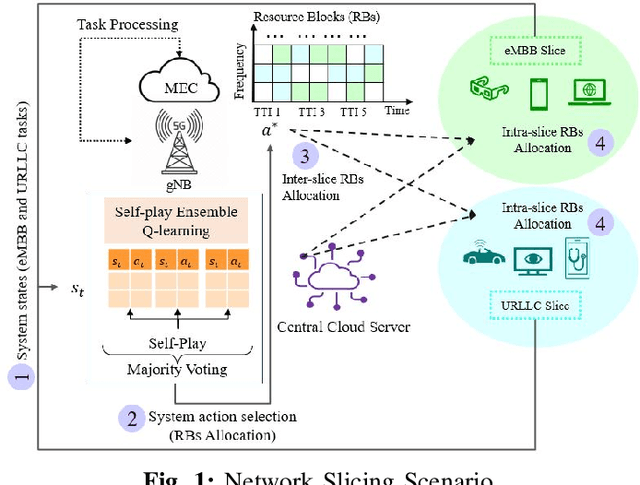
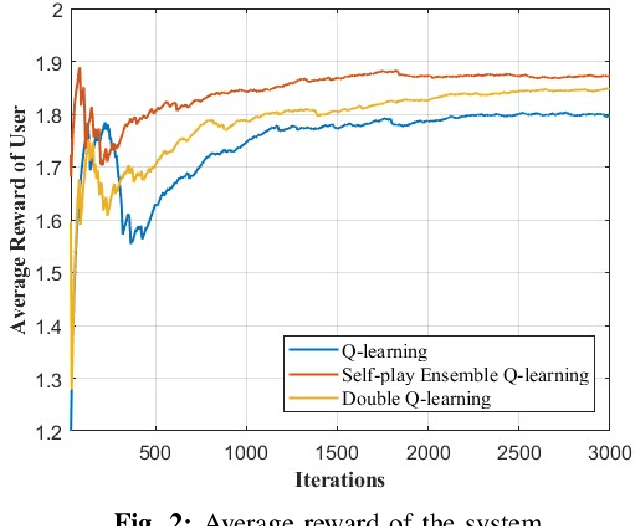
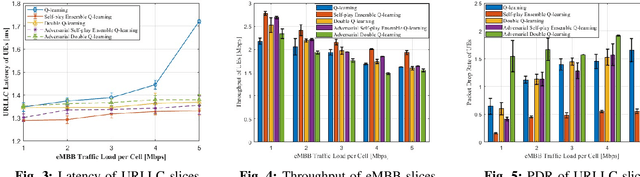
In 5G networks, network slicing has emerged as a pivotal paradigm to address diverse user demands and service requirements. To meet the requirements, reinforcement learning (RL) algorithms have been utilized widely, but this method has the problem of overestimation and exploration-exploitation trade-offs. To tackle these problems, this paper explores the application of self-play ensemble Q-learning, an extended version of the RL-based technique. Self-play ensemble Q-learning utilizes multiple Q-tables with various exploration-exploitation rates leading to different observations for choosing the most suitable action for each state. Moreover, through self-play, each model endeavors to enhance its performance compared to its previous iterations, boosting system efficiency, and decreasing the effect of overestimation. For performance evaluation, we consider three RL-based algorithms; self-play ensemble Q-learning, double Q-learning, and Q-learning, and compare their performance under different network traffic. Through simulations, we demonstrate the effectiveness of self-play ensemble Q-learning in meeting the diverse demands within 21.92% in latency, 24.22% in throughput, and 23.63\% in packet drop rate in comparison with the baseline methods. Furthermore, we evaluate the robustness of self-play ensemble Q-learning and double Q-learning in situations where one of the Q-tables is affected by a malicious user. Our results depicted that the self-play ensemble Q-learning method is more robust against adversarial users and prevents a noticeable drop in system performance, mitigating the impact of users manipulating policies.
An Optimal Multi-UAV Deployment Model for UAV-assisted Smart Farming
Jul 28, 2022


Next-generation wireless networks will deploy UAVs dynamically as aerial base stations (UAV-BSs) to boost the wireless network coverage in the out of reach areas. To provide an efficient service in stochastic environments, the optimal number of UAV-BSs, their locations, and trajectories must be specified appropriately for different scenarios. Such deployment requires an intelligent decision-making mechanism that can deal with various variables at different times. This paper proposes a multi UAV-BS deployment model for smart farming, formulated as a Multi-Criteria Decision Making (MCDM) method to find the optimal number of UAV-BSs to monitor animals' behavior. This model considers the effect of UAV-BSs' signal interference and path loss changes caused by users' mobility to maximize the system's efficiency. To avoid collision among UAV-BSs, we split the considered area into several clusters, each covered by a UAV-BS. Our simulation results suggest up to 11x higher deployment efficiency than the benchmark clustering algorithm.
Energy and Service-priority aware Trajectory Design for UAV-BSs using Double Q-Learning
Oct 26, 2020


Next-generation mobile networks have proposed the integration of Unmanned Aerial Vehicles (UAVs) as aerial base stations (UAV-BS) to serve ground nodes. Despite having advantages of using UAV-BSs, their dependence on the on-board, limited-capacity battery hinders their service continuity. Shorter trajectories can save flying energy, however, UAV-BSs must also serve nodes based on their service priority since nodes' service requirements are not always the same. In this paper, we present an energy-efficient trajectory optimization for a UAV assisted IoT system in which the UAV-BS considers the IoT nodes' service priorities in making its movement decisions. We solve the trajectory optimization problem using Double Q-Learning algorithm. Simulation results reveal that the Q-Learning based optimized trajectory outperforms a benchmark algorithm, namely Greedily-served algorithm, in terms of reducing the average energy consumption of the UAV-BS as well as the service delay for high priority nodes.