 Add to Chrome
 Add to Firefox
 Add to Edge
AutoRelAnnotator: Calibrated Model Cascades for Cost-Efficient Relevance Evaluation in Sponsored Search
Jun 24, 2026
How can we generate high-quality relevance annotations at scale without the cost and delays of human labeling? Relevance annotations are the backbone of search ranking systems which is needed for training data preparation, NDCG evaluation, and root cause analysis. However, human annotation is slow and off-the-shelf LLMs suffer from accuracy on domain-specific tasks. We propose a calibrated model cascade, a systematic approach for cost-efficient offline relevance annotation by routing queries through progressively larger fine-tuned classifiers. Our central insight is that accuracy and cost are orthogonal optimizations: domain-specific fine-tuning drives accuracy, cascading drives cost, and per-class isotonic calibration adds a small but reliable gain on top. Our contribution is threefold: (a) we decompose the gains and show that fine-tuning contributes 20 accuracy points while cascading is approximately accuracy-neutral but halves compute cost, (b) we introduce per-class isotonic calibration as one component of the cascade, contributing a small but statistically significant gain (+0.6 points over the strongest calibration baseline), and (c) we validate the system in production across six offline use cases, processing 150M+ annotations and enabling faster experimentation cycles. Our work is a building block for scalable, high-quality offline annotation pipelines in search and advertising systems.

Unified Multi-Task Relevance Modeling for E-Commerce: Comparing Task Routing Architectures Across LLMs and Cross-Encoders
Jun 22, 2026How can we build a single relevance model that handles six different entity pair relationship types in e commerce from query product matching to product type similarity when each task has different data volumes, different semantic requirements, and potentially conflicting learning signals? This question is important because current industry practice relies on separate models for each task, preventing knowledge transfer and producing inconsistent relevance signals. Our work is driven by the following insight: encoder based and decoder only models encode task identity through different mechanisms, so the choice of task routing architecture how task identity is communicated to the shared model affects these two families in asymmetric ways. As our key novelty, we combine three ideas: (a) a unified multi task framework that jointly trains on six entity pair tasks under a shared three point relevance scale, (b) a systematic comparison of three task routing architectures (text prefix routing, multi head classification, and multihead with private transformer layers) across both LoRA adapted LLMs and fully finetuned cross encoders, and (c) a majority vote ensemble that exploits the diversity induced by private layer routing. First, we show that the MHP Ensemble (multi head with private layers) achieves 89.96% accuracy on 453K test examples the highest across all configurations . Second, we show that removing text prefixes without private layers causes severe degradation for decoder only LLMs while cross encoders remain robust , suggesting an encoder decoder asymmetry in task identity encoding. Third, we show that multi task training yields up to 14% improvement on low resource tasks over single task baselines.
INSPIRE: Intent-aware Neural Sponsored Product Retrieval for E-commerce
Jun 22, 2026Walmart holds the largest share of the U.S. ecommerce grocery market, where food and beverage categories generate some of the highest search traffic and, consequently, drive a substantial portion of sponsored search revenue. At this scale, even small mismatches between user intent and retrieved products can lead to losses in both user engagement and monetization. Yet, understanding user intent in grocery search is inherently challenging. Queries are typically short, ambiguous, and highly diverse, often underspecifying critical preferences. From the advertisers perspective, many products are explicitly designed to target specific intents such as dietary preferences or size variants and must be surfaced at the right moment to be effective. Thus, we propose INSPIRE (Intent aware Neural Sponsored Product Retrieval for Ecommerce), an intent aware retrieval framework for sponsored search that leverages structured intent signals to better align user queries with relevant food and beverage products. INSPIRE represents intent as a set of structured, multi dimensional attributes derived from both user queries and product content, capturing explicit signals (e.g., brand, flavor) as well as implicit preferences (e.g., dietary constraints, cuisine types) that are often not directly expressed in queries. We develop a weakly supervised intent learning pipeline, where a large language model serves as a teacher to generate structured intent annotations from product titles and descriptions. We then distill these annotations by using them to finetune a lightweight student LLM model through LoRA based supervised finetuning that predicts intent attributes. We then introduce an intent augmented dense retrieval framework, where predicted intents are incorporated into query and product representations within a biencoder, enabling more precise matching between queries and sponsored products.
Scaling Dense Retrieval with LLM-Annotated Training Data: Structured Mining and Progressive Curriculum for E-Commerce Sponsored Search
Jun 22, 2026How can we generate high-quality training data for dense retrieval models at production scale, without relying on click signals or manual annotation? This question is critical for e-commerce sponsored search, where click-based training suffers from position bias and tail-query sparsity, and manual labeling at the scale of hundreds of millions of query-item pairs is economically infeasible. Our work is driven by the following insight: heterogeneous retrieval systems disagree on most items they retrieve, and this disagreement creates a natural source of structured training signal -- easy positives where all systems agree, hard positives that only lexical systems find, and hard negatives that fool exactly one system. As our key novelty, we combine three ideas into an end-to-end pipeline: (a) multi-channel retrieval mining with rank metadata from three production systems, (b) graded-relevance annotation by a calibrated three-model cascade ) that reaches 89.1% agreement with trained human annotators, and (c) three-stage progressive curriculum training that organizes 240M+ training examples across five difficulty levels. We deploy the trained two-tower BERT model on Walmart's sponsored search and evaluate it against 30K queries labeled by trained third-party human annotators. First, we show that the system achieves +5.1% NDCG@10 over the click-trained production baseline, with the largest gain on tail queries . Second, we show that embarrassing retrievals (rating 0) drop from 8.7% to 3.5%. Third, a two-week online A/B test with tens of millions of ad requests per arm confirms +2.80% ad spend, +1.4% CTR, +2.8% eCPM, and +2.9% click conversion rate. Overall, our work provides a practical and scalable blueprint for replacing click-based training with structured LLM-annotated supervision in production retrieval systems.
Unified Supervision for Walmart's Sponsored Search Retrieval via Joint Semantic Relevance and Behavioral Engagement Modeling
Apr 10, 2026Modern search systems rely on a fast first stage retriever to fetch relevant items from a massive catalog of items. Deployed search systems often use user engagement signals to supervise bi-encoder retriever training at scale, because these signals are continuously logged from real traffic and require no additional annotation effort. However, engagement is an imperfect proxy for semantic relevance. Items may receive interactions due to popularity, promotion, attractive visuals, titles, or price, despite weak query-item relevance. These limitations are further accentuated in Walmart's e-commerce sponsored search. User engagement on ad items is often structurally sparse because the frequency with which an ad is shown depends on factors beyond relevance such as whether the advertiser is currently running that ad, the outcome of the auction for available ad slots, bid competitiveness, and advertiser budget. Thus, even highly relevant query ad pairs can have limited engagement signals simply due to limited impressions. We propose a bi-encoder training framework for Walmart's sponsored search retrieval in e-commerce that uses semantic relevance as the primary supervision signal, with engagement used only as a preference signal among relevant items. Concretely, we construct a context-rich training target by combining 1. graded relevance labels from a cascade of cross-encoder teacher models, 2. a multichannel retrieval prior score derived from the rank positions and cross-channel agreement of retrieval systems running in production, and 3. user engagement applied only to semantically relevant items to refine preferences. Our approach outperforms the current production system in both offline evaluation and online AB tests, yielding consistent gains in average relevance and NDCG.
Unified Supervision for Walmarts Sponsored Search Retrieval via Joint Semantic Relevance and Behavioral Engagement Modeling
Apr 09, 2026Modern search systems rely on a fast first stage retriever to fetch relevant items from a massive catalog of items. Deployed search systems often use user engagement signals to supervise bi-encoder retriever training at scale, because these signals are continuously logged from real traffic and require no additional annotation effort. However, engagement is an imperfect proxy for semantic relevance. Items may receive interactions due to popularity, promotion, attractive visuals, titles, or price, despite weak query-item relevance. These limitations are further accentuated in Walmart's e-commerce sponsored search. User engagement on ad items is often structurally sparse because the frequency with which an ad is shown depends on factors beyond relevance such as whether the advertiser is currently running that ad, the outcome of the auction for available ad slots, bid competitiveness, and advertiser budget. Thus, even highly relevant query ad pairs can have limited engagement signals simply due to limited impressions. We propose a bi-encoder training framework for Walmart's sponsored search retrieval in e-commerce that uses semantic relevance as the primary supervision signal, with engagement used only as a preference signal among relevant items. Concretely, we construct a context-rich training target by combining 1. graded relevance labels from a cascade of cross-encoder teacher models, 2. a multichannel retrieval prior score derived from the rank positions and cross-channel agreement of retrieval systems running in production, and 3. user engagement applied only to semantically relevant items to refine preferences. Our approach outperforms the current production system in both offline evaluation and online AB tests, yielding consistent gains in average relevance and NDCG.
A Survey on Data Curation for Visual Contrastive Learning: Why Crafting Effective Positive and Negative Pairs Matters
Feb 12, 2025Visual contrastive learning aims to learn representations by contrasting similar (positive) and dissimilar (negative) pairs of data samples. The design of these pairs significantly impacts representation quality, training efficiency, and computational cost. A well-curated set of pairs leads to stronger representations and faster convergence. As contrastive pre-training sees wider adoption for solving downstream tasks, data curation becomes essential for optimizing its effectiveness. In this survey, we attempt to create a taxonomy of existing techniques for positive and negative pair curation in contrastive learning, and describe them in detail.
Active Learning for Improved Semi-Supervised Semantic Segmentation in Satellite Images
Oct 15, 2021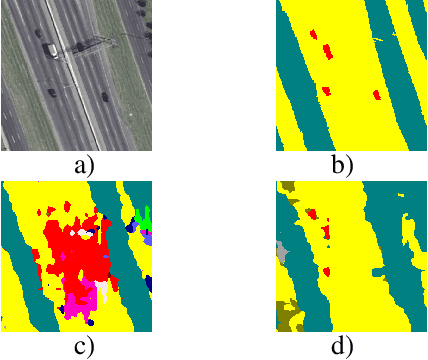

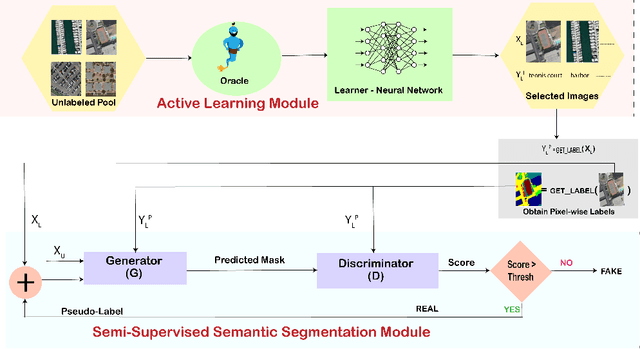
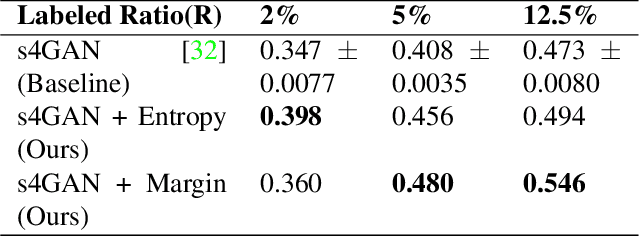
Remote sensing data is crucial for applications ranging from monitoring forest fires and deforestation to tracking urbanization. Most of these tasks require dense pixel-level annotations for the model to parse visual information from limited labeled data available for these satellite images. Due to the dearth of high-quality labeled training data in this domain, there is a need to focus on semi-supervised techniques. These techniques generate pseudo-labels from a small set of labeled examples which are used to augment the labeled training set. This makes it necessary to have a highly representative and diverse labeled training set. Therefore, we propose to use an active learning-based sampling strategy to select a highly representative set of labeled training data. We demonstrate our proposed method's effectiveness on two existing semantic segmentation datasets containing satellite images: UC Merced Land Use Classification Dataset and DeepGlobe Land Cover Classification Dataset. We report a 27% improvement in mIoU with as little as 2% labeled data using active learning sampling strategies over randomly sampling the small set of labeled training data.