 Add to Chrome
 Add to Firefox
 Add to Edge
Scaling Dense Retrieval with LLM-Annotated Training Data: Structured Mining and Progressive Curriculum for E-Commerce Sponsored Search
Jun 22, 2026
How can we generate high-quality training data for dense retrieval models at production scale, without relying on click signals or manual annotation? This question is critical for e-commerce sponsored search, where click-based training suffers from position bias and tail-query sparsity, and manual labeling at the scale of hundreds of millions of query-item pairs is economically infeasible. Our work is driven by the following insight: heterogeneous retrieval systems disagree on most items they retrieve, and this disagreement creates a natural source of structured training signal -- easy positives where all systems agree, hard positives that only lexical systems find, and hard negatives that fool exactly one system. As our key novelty, we combine three ideas into an end-to-end pipeline: (a) multi-channel retrieval mining with rank metadata from three production systems, (b) graded-relevance annotation by a calibrated three-model cascade ) that reaches 89.1% agreement with trained human annotators, and (c) three-stage progressive curriculum training that organizes 240M+ training examples across five difficulty levels. We deploy the trained two-tower BERT model on Walmart's sponsored search and evaluate it against 30K queries labeled by trained third-party human annotators. First, we show that the system achieves +5.1% NDCG@10 over the click-trained production baseline, with the largest gain on tail queries . Second, we show that embarrassing retrievals (rating 0) drop from 8.7% to 3.5%. Third, a two-week online A/B test with tens of millions of ad requests per arm confirms +2.80% ad spend, +1.4% CTR, +2.8% eCPM, and +2.9% click conversion rate. Overall, our work provides a practical and scalable blueprint for replacing click-based training with structured LLM-annotated supervision in production retrieval systems.

Unified Supervision for Walmart's Sponsored Search Retrieval via Joint Semantic Relevance and Behavioral Engagement Modeling
Apr 10, 2026Modern search systems rely on a fast first stage retriever to fetch relevant items from a massive catalog of items. Deployed search systems often use user engagement signals to supervise bi-encoder retriever training at scale, because these signals are continuously logged from real traffic and require no additional annotation effort. However, engagement is an imperfect proxy for semantic relevance. Items may receive interactions due to popularity, promotion, attractive visuals, titles, or price, despite weak query-item relevance. These limitations are further accentuated in Walmart's e-commerce sponsored search. User engagement on ad items is often structurally sparse because the frequency with which an ad is shown depends on factors beyond relevance such as whether the advertiser is currently running that ad, the outcome of the auction for available ad slots, bid competitiveness, and advertiser budget. Thus, even highly relevant query ad pairs can have limited engagement signals simply due to limited impressions. We propose a bi-encoder training framework for Walmart's sponsored search retrieval in e-commerce that uses semantic relevance as the primary supervision signal, with engagement used only as a preference signal among relevant items. Concretely, we construct a context-rich training target by combining 1. graded relevance labels from a cascade of cross-encoder teacher models, 2. a multichannel retrieval prior score derived from the rank positions and cross-channel agreement of retrieval systems running in production, and 3. user engagement applied only to semantically relevant items to refine preferences. Our approach outperforms the current production system in both offline evaluation and online AB tests, yielding consistent gains in average relevance and NDCG.
Unified Supervision for Walmarts Sponsored Search Retrieval via Joint Semantic Relevance and Behavioral Engagement Modeling
Apr 09, 2026Modern search systems rely on a fast first stage retriever to fetch relevant items from a massive catalog of items. Deployed search systems often use user engagement signals to supervise bi-encoder retriever training at scale, because these signals are continuously logged from real traffic and require no additional annotation effort. However, engagement is an imperfect proxy for semantic relevance. Items may receive interactions due to popularity, promotion, attractive visuals, titles, or price, despite weak query-item relevance. These limitations are further accentuated in Walmart's e-commerce sponsored search. User engagement on ad items is often structurally sparse because the frequency with which an ad is shown depends on factors beyond relevance such as whether the advertiser is currently running that ad, the outcome of the auction for available ad slots, bid competitiveness, and advertiser budget. Thus, even highly relevant query ad pairs can have limited engagement signals simply due to limited impressions. We propose a bi-encoder training framework for Walmart's sponsored search retrieval in e-commerce that uses semantic relevance as the primary supervision signal, with engagement used only as a preference signal among relevant items. Concretely, we construct a context-rich training target by combining 1. graded relevance labels from a cascade of cross-encoder teacher models, 2. a multichannel retrieval prior score derived from the rank positions and cross-channel agreement of retrieval systems running in production, and 3. user engagement applied only to semantically relevant items to refine preferences. Our approach outperforms the current production system in both offline evaluation and online AB tests, yielding consistent gains in average relevance and NDCG.
Enhanced E-Commerce Attribute Extraction: Innovating with Decorative Relation Correction and LLAMA 2.0-Based Annotation
Dec 09, 2023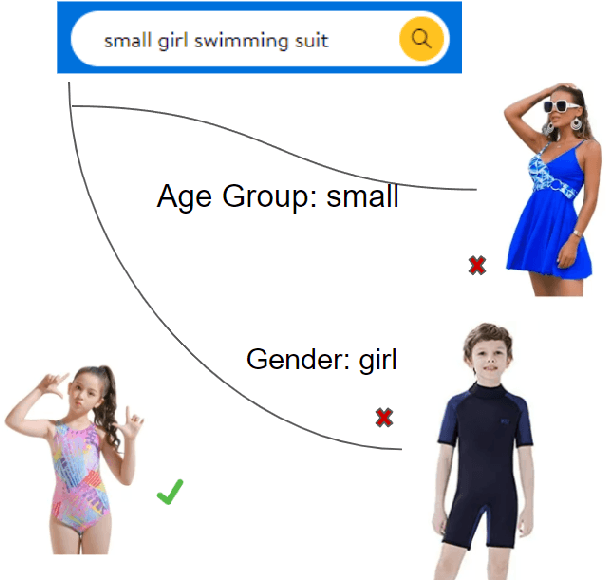
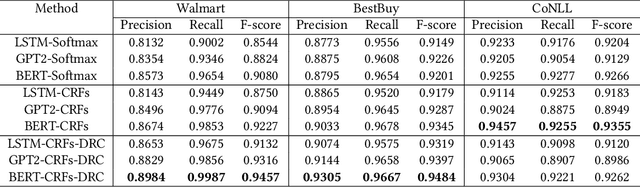
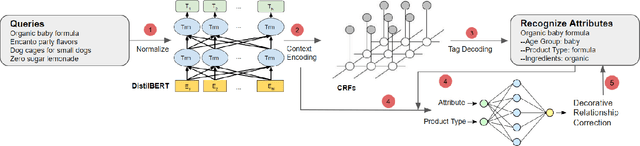
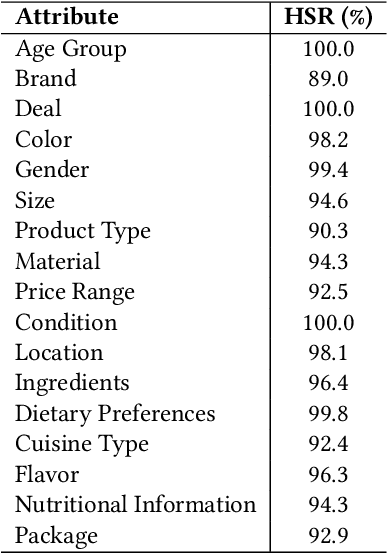
The rapid proliferation of e-commerce platforms accentuates the need for advanced search and retrieval systems to foster a superior user experience. Central to this endeavor is the precise extraction of product attributes from customer queries, enabling refined search, comparison, and other crucial e-commerce functionalities. Unlike traditional Named Entity Recognition (NER) tasks, e-commerce queries present a unique challenge owing to the intrinsic decorative relationship between product types and attributes. In this study, we propose a pioneering framework that integrates BERT for classification, a Conditional Random Fields (CRFs) layer for attribute value extraction, and Large Language Models (LLMs) for data annotation, significantly advancing attribute recognition from customer inquiries. Our approach capitalizes on the robust representation learning of BERT, synergized with the sequence decoding prowess of CRFs, to adeptly identify and extract attribute values. We introduce a novel decorative relation correction mechanism to further refine the extraction process based on the nuanced relationships between product types and attributes inherent in e-commerce data. Employing LLMs, we annotate additional data to expand the model's grasp and coverage of diverse attributes. Our methodology is rigorously validated on various datasets, including Walmart, BestBuy's e-commerce NER dataset, and the CoNLL dataset, demonstrating substantial improvements in attribute recognition performance. Particularly, the model showcased promising results during a two-month deployment in Walmart's Sponsor Product Search, underscoring its practical utility and effectiveness.