 Add to Chrome
 Add to Firefox
 Add to Edge
Reading Order Inference for Complex Document Layouts
Jul 01, 2026
Reading order inference remains a critical bottleneck in the digitization of complex historical manuscripts, where pages contain multiple spatially interleaved reading streams, the canonical example being the Glossa Ordinaria layout, in which a central text is surrounded by commentaries that wrap around it in non-rectangular, non-convex regions. We present a training-free, graph-based framework: each OCR text line becomes a node in a directed candidate-transition graph, edges are scored by a weighted additive ensemble of two lightweight language-model signals (causal language model conditional likelihood and BERT next-sentence prediction, NSP; a third sentence-embedding signal was evaluated but did not improve reading order), and the global reading order is recovered as a degree-constrained directed path cover. To avoid the cascading "edge-theft" failures of greedy edge selection, we propose a max-regret inference rule that prioritizes commitments with high opportunity cost. We evaluate on synthetic Glossa Ordinaria grid layouts, on 23 ALTO page geometries (10 historical source pages plus mirrored and flipped variants), and on a 140-page multi-column English subset of OmniDocBench, comparing our method against the canonical recursive XY-cut (PaddleOCR PP-StructureV3) and two LayoutReader variants (layout-only and text+layout) on identical inputs. On wrap-around Glossa layouts our method recovers 95% of ground-truth successor edges on average vs. XY-cut's 50%; on the OmniDocBench multi-column subset it reaches 88% macro edge accuracy versus XY-cut's 75% and LayoutReader's 25%. The LayoutReader baselines transfer poorly due to a word-level vs. line-level granularity mismatch. We additionally verify mirror-invariance under horizontal and vertical page reflections: Our method changes by less than 1 percentage point, classical XY-cut by 2 points, and LayoutReader-T by up to 8 points.

Complex Layout Classification in the Wild: A Low-Resource Approach with Layout-Preserving Augmentations
Jun 15, 2026Many digitized corpora suffer from low resources because annotations may be scarce, page scans are noisy and of poor resolution, or layouts are structurally complex in ways that negatively affect the quality of automatic transcription. Developing robust classification models for low-resource languages is inhibited by the lack of large-scale annotated data and by the frequent semantic complexity of page layouts. To this end, we have curated a complex-layout dataset, manually classified into eight distinct layout types based on their separator regions. To overcome data scarcity, we propose a novel training strategy in the form of a CNN-based classifier that employs strong, domain-aware augmentations to improve generalization. We utilize narrow anisotropic Gaussian masking to suppress incidental textual details while preserving essential separations, compelling the model to learn global geometric arrangements. Additionally, we implement reflection-induced label transformations to enrich the training distribution while maintaining label consistency across asymmetric categories. The results demonstrate that layout-specific augmentations can substantially improve page-level layout classification under severe annotation scarcity.
Bag of Bags: Adaptive Visual Vocabularies for Genizah Join Image Retrieval
Apr 09, 2026A join is a set of manuscript fragments identified as originally emanating from the same manuscript. We study manuscript join retrieval: Given a query image of a fragment, retrieve other fragments originating from the same physical manuscript. We propose Bag of Bags (BoB), an image-level representation that replaces the global-level visual codebook of classical Bag of Words (BoW) with a fragment-specific vocabulary of local visual words. Our pipeline trains a sparse convolutional autoencoder on binarized fragment patches, encodes connected components from each page, clusters the resulting embeddings with per image $k$-means, and compares images using set to set distances between their local vocabularies. Evaluated on fragments from the Cairo Genizah, the best BoB variant (viz.\@ Chamfer) achieves Hit@1 of 0.78 and MRR of 0.84, compared to 0.74 and 0.80, respectively, for the strongest BoW baseline (BoW-RawPatches-$χ^2$), a 6.1\% relative improvement in top-1 accuracy. We furthermore study a mass-weighted BoB-OT variant that incorporates cluster population into prototype matching and present a formal approximation guarantee bounding its deviation from full component-level optimal transport. A two-stage pipeline using a BoW shortlist followed by BoB-OT reranking provides a practical compromise between retrieval strength and computational cost, supporting applicability to larger manuscript collections.
Learner Attentiveness and Engagement Analysis in Online Education Using Computer Vision
Nov 30, 2024
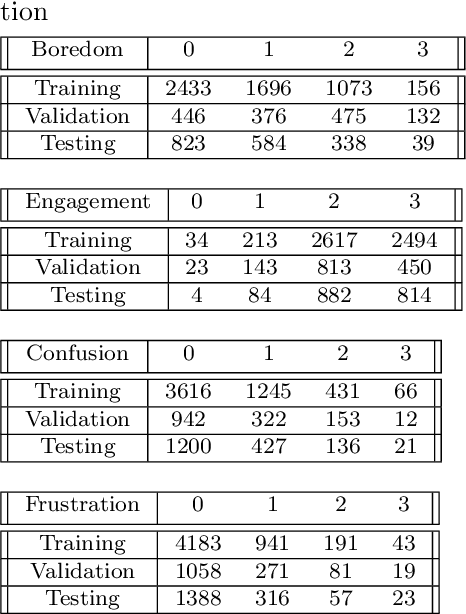
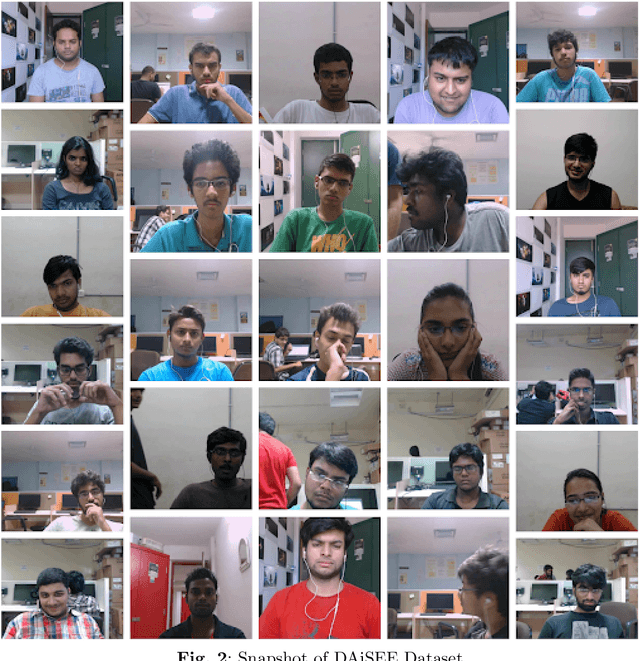
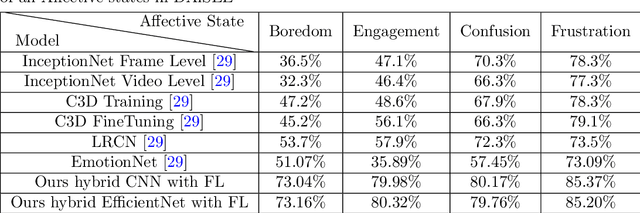
In recent times, online education and the usage of video-conferencing platforms have experienced massive growth. Due to the limited scope of a virtual classroom, it may become difficult for instructors to analyze learners' attention and comprehension in real time while teaching. In the digital mode of education, it would be beneficial for instructors to have an automated feedback mechanism to be informed regarding learners' attentiveness at any given time. This research presents a novel computer vision-based approach to analyze and quantify learners' attentiveness, engagement, and other affective states within online learning scenarios. This work presents the development of a multiclass multioutput classification method using convolutional neural networks on a publicly available dataset - DAiSEE. A machine learning-based algorithm is developed on top of the classification model that outputs a comprehensive attentiveness index of the learners. Furthermore, an end-to-end pipeline is proposed through which learners' live video feed is processed, providing detailed attentiveness analytics of the learners to the instructors. By comparing the experimental outcomes of the proposed method against those of previous methods, it is demonstrated that the proposed method exhibits better attentiveness detection than state-of-the-art methods. The proposed system is a comprehensive, practical, and real-time solution that is deployable and easy to use. The experimental results also demonstrate the system's efficiency in gauging learners' attentiveness.