 Add to Chrome
 Add to Firefox
 Add to Edge
Bag of Bags: Adaptive Visual Vocabularies for Genizah Join Image Retrieval
Apr 09, 2026
A join is a set of manuscript fragments identified as originally emanating from the same manuscript. We study manuscript join retrieval: Given a query image of a fragment, retrieve other fragments originating from the same physical manuscript. We propose Bag of Bags (BoB), an image-level representation that replaces the global-level visual codebook of classical Bag of Words (BoW) with a fragment-specific vocabulary of local visual words. Our pipeline trains a sparse convolutional autoencoder on binarized fragment patches, encodes connected components from each page, clusters the resulting embeddings with per image $k$-means, and compares images using set to set distances between their local vocabularies. Evaluated on fragments from the Cairo Genizah, the best BoB variant (viz.\@ Chamfer) achieves Hit@1 of 0.78 and MRR of 0.84, compared to 0.74 and 0.80, respectively, for the strongest BoW baseline (BoW-RawPatches-$χ^2$), a 6.1\% relative improvement in top-1 accuracy. We furthermore study a mass-weighted BoB-OT variant that incorporates cluster population into prototype matching and present a formal approximation guarantee bounding its deviation from full component-level optimal transport. A two-stage pipeline using a BoW shortlist followed by BoB-OT reranking provides a practical compromise between retrieval strength and computational cost, supporting applicability to larger manuscript collections.

Segmentation of Ink and Parchment in Dead Sea Scroll Fragments
Nov 16, 2024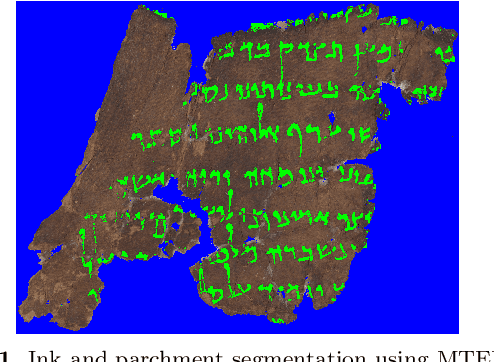
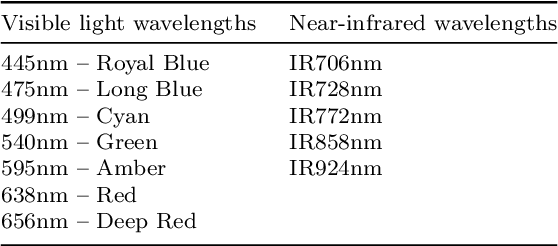
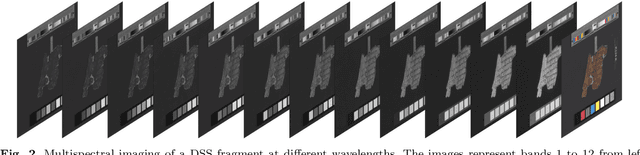
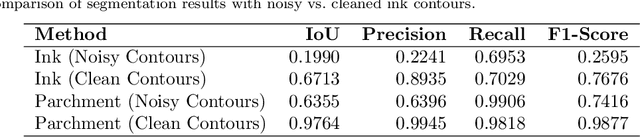
The discovery of the Dead Sea Scrolls over 60 years ago is widely regarded as one of the greatest archaeological breakthroughs in modern history. Recent study of the scrolls presents ongoing computational challenges, including determining the provenance of fragments, clustering fragments based on their degree of similarity, and pairing fragments that originate from the same manuscript -- all tasks that require focusing on individual letter and fragment shapes. This paper presents a computational method for segmenting ink and parchment regions in multispectral images of Dead Sea Scroll fragments. Using the newly developed Qumran Segmentation Dataset (QSD) consisting of 20 fragments, we apply multispectral thresholding to isolate ink and parchment regions based on their unique spectral signatures. To refine segmentation accuracy, we introduce an energy minimization technique that leverages ink contours, which are more distinguishable from the background and less noisy than inner ink regions. Experimental results demonstrate that this Multispectral Thresholding and Energy Minimization (MTEM) method achieves significant improvements over traditional binarization approaches like Otsu and Sauvola in parchment segmentation and is successful at delineating ink borders, in distinction from holes and background regions.
Segmenting Dead Sea Scroll Fragments for a Scientific Image Set
Jun 21, 2024

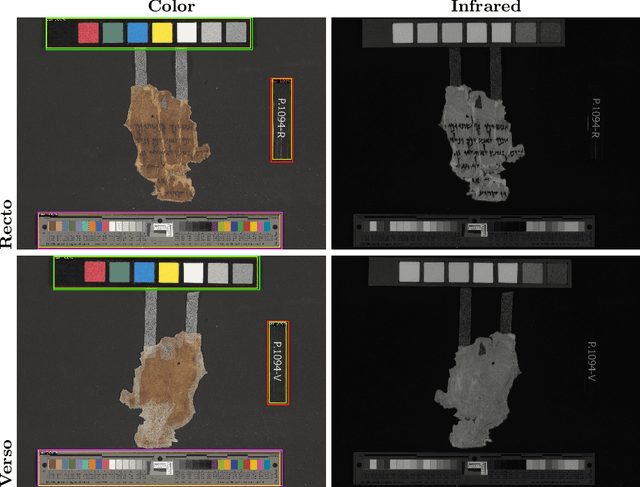
This paper presents a customized pipeline for segmenting manuscript fragments from images curated by the Israel Antiquities Authority (IAA). The images present challenges for standard segmentation methods due to the presence of the ruler, color, and plate number bars, as well as a black background that resembles the ink and varying backing substrates. The proposed pipeline, consisting of four steps, addresses these challenges by isolating and solving each difficulty using custom tailored methods. Further, the usage of a multi-step pipeline will surely be helpful from a conceptual standpoint for other image segmentation projects that encounter problems that have proven intractable when applying any of the more commonly used segmentation techniques. In addition, we create a dataset with bar detection and fragment segmentation ground truth and evaluate the pipeline steps qualitatively and quantitatively on it. This dataset is publicly available to support the development of the field. It aims to address the lack of standard sets of fragment images and evaluation metrics and enable researchers to evaluate their methods in a reliable and reproducible manner.