 Add to Chrome
 Add to Firefox
 Add to Edge
A Cross-Layered Multi-Drone Coordination for Medical Supply Delivery during Disaster Response Management
May 10, 2026
Autonomous drone fleets have immense potential in medical supply delivery during disaster incident response. However, coordinating multiple drones in such settings introduces compounding challenges: dynamic environmental hazards such as wind, obstacles, and intermittent network connectivity, constrained energy budgets, and the need to serve patient locations fairly under deadlines and triage-based priority while optimizing schedule utilization. In this paper, we present CEDA, a novel CTDE Deep Q-Network algorithm for cooperative multi-drone medical delivery, designed to jointly optimize triage-priority-aware routing, multi-agent coordination, and energy-efficient navigation under dynamic uncertainty. CEDA introduces a Priority-Preserving Fair Scheduling strategy, in which a structured reward function encodes both triage weights and complementary fairness mechanisms ensuring no patient class is starved of service. We evaluate CEDA in a simulated grid environment featuring dynamic hazard zones, stochastic action failures, and dynamically spawning patients across three triage priority levels, as well as in a PX4 SITL validation using two X500 quadrotors controlled via MAVSDK in offboard position mode. Simulation results demonstrate that CEDA achieves a delivery completion rate above 85%, reduces obstacle collisions by over 90% across training, and delivers an average of 6 patients per episode with a triage efficiency of 0.82. CEDA preserves clinical priority ordering, Critical patients are served first, while achieving near-zero mortality across lower-triage classes, confirming that priority-weighted routing does not condemn Stable or Urgent patients to neglect. PX4 SITL validation further demonstrates that the learned policy remains executable and triage-coherent under practical communication constraints and realistic multi-drone coordination in disaster response settings.

When Algorithms Manage Humans: A Double Machine Learning Approach to Estimating Nonlinear Effects of Algorithmic Control on Gig Worker Performance and Wellbeing
Dec 25, 2025A central question for the future of work is whether person centered management can survive when algorithms take on managerial roles. Standard tools often miss what is happening because worker responses to algorithmic systems are rarely linear. We use a Double Machine Learning framework to estimate a moderated mediation model without imposing restrictive functional forms. Using survey data from 464 gig workers, we find a clear nonmonotonic pattern. Supportive HR practices improve worker wellbeing, but their link to performance weakens in a murky middle where algorithmic oversight is present yet hard to interpret. The relationship strengthens again when oversight is transparent and explainable. These results show why simple linear specifications can miss the pattern and sometimes suggest the opposite conclusion. For platform design, the message is practical: control that is only partly defined creates confusion, but clear rules and credible recourse can make strong oversight workable. Methodologically, the paper shows how Double Machine Learning can be used to estimate conditional indirect effects in organizational research without forcing the data into a linear shape.
Predicting Demand for Air Taxi Urban Aviation Services using Machine Learning Algorithms
Mar 26, 2021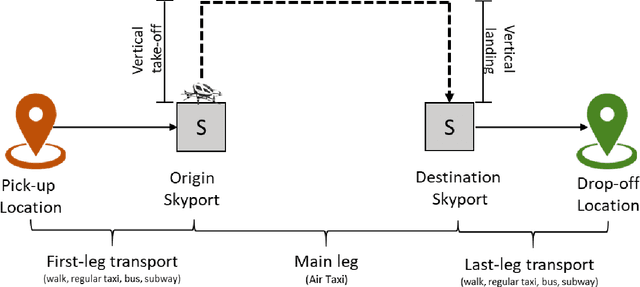
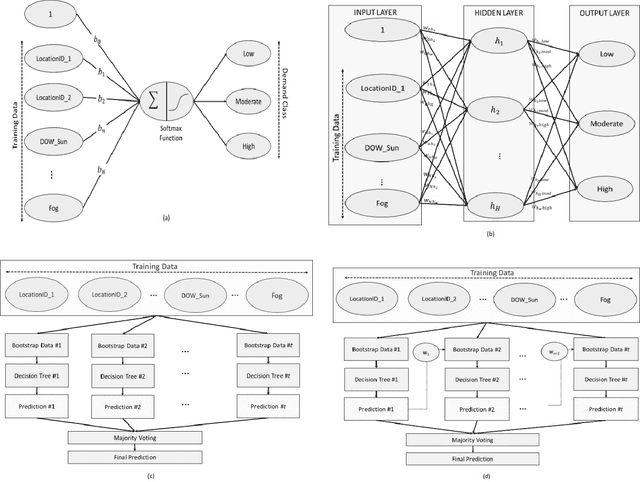
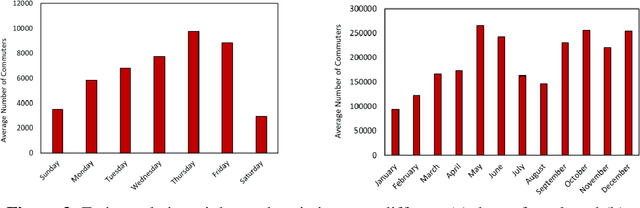
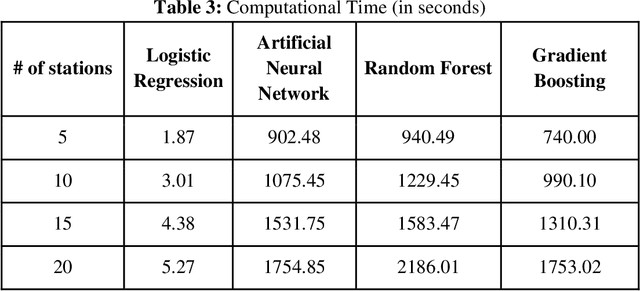
This research focuses on predicting the demand for air taxi urban air mobility (UAM) services during different times of the day in various geographic regions of New York City using machine learning algorithms (MLAs). Several ride-related factors (such as month of the year, day of the week and time of the day) and weather-related variables (such as temperature, weather conditions and visibility) are used as predictors for four popular MLAs, namely, logistic regression, artificial neural networks, random forests, and gradient boosting. Experimental results suggest gradient boosting to consistently provide higher prediction performance. Specific locations, certain time periods and weekdays consistently emerged as critical predictors.
* 24 pages, 3 figures, 4 tables
Discovering Airline-Specific Business Intelligence from Online Passenger Reviews: An Unsupervised Text Analytics Approach
Dec 14, 2020
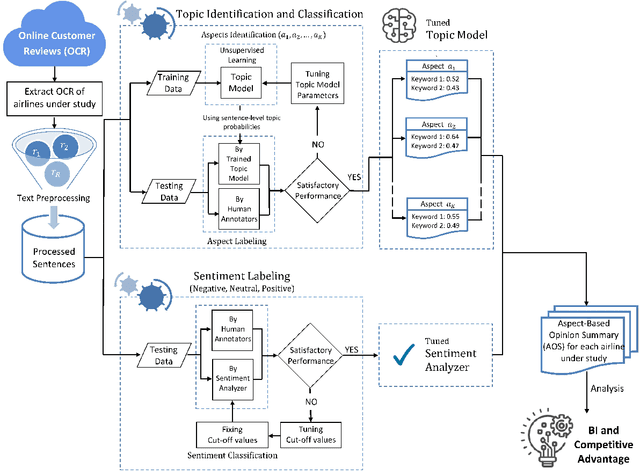
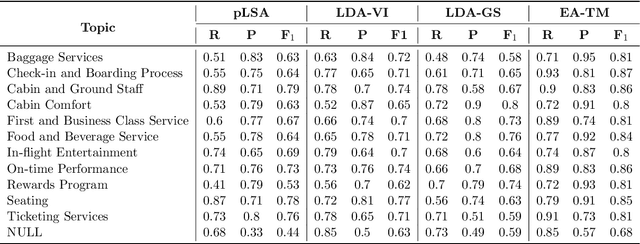
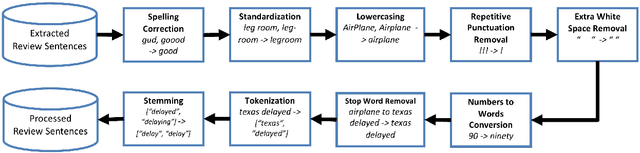
To understand the important dimensions of service quality from the passenger's perspective and tailor service offerings for competitive advantage, airlines can capitalize on the abundantly available online customer reviews (OCR). The objective of this paper is to discover company- and competitor-specific intelligence from OCR using an unsupervised text analytics approach. First, the key aspects (or topics) discussed in the OCR are extracted using three topic models - probabilistic latent semantic analysis (pLSA) and two variants of Latent Dirichlet allocation (LDA-VI and LDA-GS). Subsequently, we propose an ensemble-assisted topic model (EA-TM), which integrates the individual topic models, to classify each review sentence to the most representative aspect. Likewise, to determine the sentiment corresponding to a review sentence, an ensemble sentiment analyzer (E-SA), which combines the predictions of three opinion mining methods (AFINN, SentiStrength, and VADER), is developed. An aspect-based opinion summary (AOS), which provides a snapshot of passenger-perceived strengths and weaknesses of an airline, is established by consolidating the sentiments associated with each aspect. Furthermore, a bi-gram analysis of the labeled OCR is employed to perform root cause analysis within each identified aspect. A case study involving 99,147 airline reviews of a US-based target carrier and four of its competitors is used to validate the proposed approach. The results indicate that a cost- and time-effective performance summary of an airline and its competitors can be obtained from OCR. Finally, besides providing theoretical and managerial implications based on our results, we also provide implications for post-pandemic preparedness in the airline industry considering the unprecedented impact of coronavirus disease 2019 (COVID-19) and predictions on similar pandemics in the future.