 Add to Chrome
 Add to Firefox
 Add to Edge
SAVeD: A First-Person Social Media Video Dataset for ADAS-equipped vehicle Near-Miss and Crash Event Analyses
Dec 19, 2025
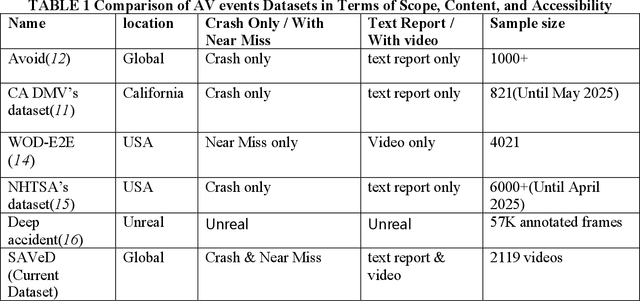
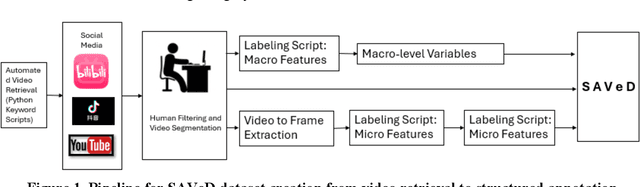
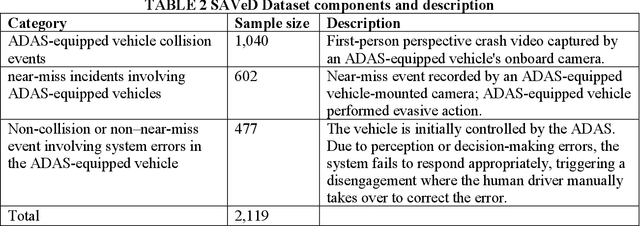
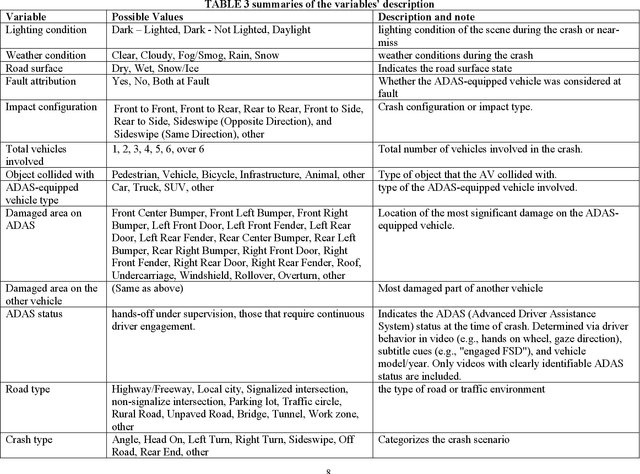
The advancement of safety-critical research in driving behavior in ADAS-equipped vehicles require real-world datasets that not only include diverse traffic scenarios but also capture high-risk edge cases such as near-miss events and system failures. However, existing datasets are largely limited to either simulated environments or human-driven vehicle data, lacking authentic ADAS (Advanced Driver Assistance System) vehicle behavior under risk conditions. To address this gap, this paper introduces SAVeD, a large-scale video dataset curated from publicly available social media content, explicitly focused on ADAS vehicle-related crashes, near-miss incidents, and disengagements. SAVeD features 2,119 first-person videos, capturing ADAS vehicle operations in diverse locations, lighting conditions, and weather scenarios. The dataset includes video frame-level annotations for collisions, evasive maneuvers, and disengagements, enabling analysis of both perception and decision-making failures. We demonstrate SAVeD's utility through multiple analyses and contributions: (1) We propose a novel framework integrating semantic segmentation and monocular depth estimation to compute real-time Time-to-Collision (TTC) for dynamic objects. (2) We utilize the Generalized Extreme Value (GEV) distribution to model and quantify the extreme risk in crash and near-miss events across different roadway types. (3) We establish benchmarks for state-of-the-art VLLMs (VideoLLaMA2 and InternVL2.5 HiCo R16), showing that SAVeD's detailed annotations significantly enhance model performance through domain adaptation in complex near-miss scenarios.

StyleRec: A Benchmark Dataset for Prompt Recovery in Writing Style Transformation
Apr 06, 2025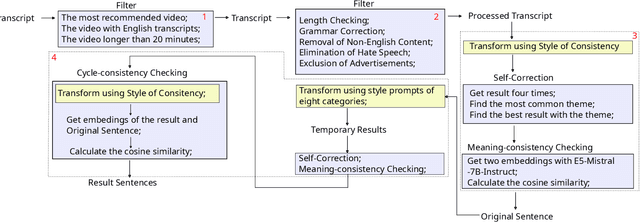
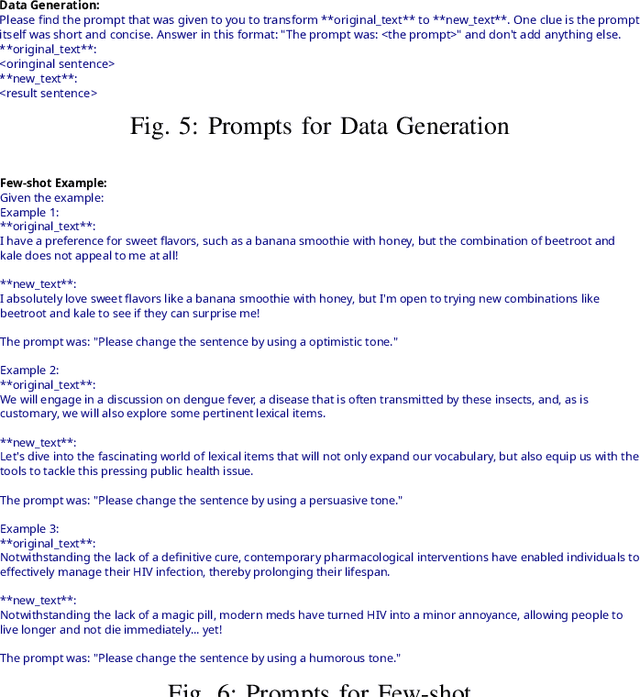
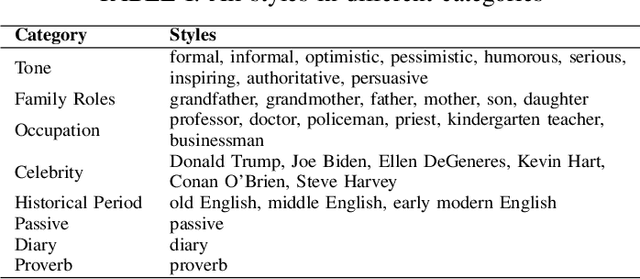
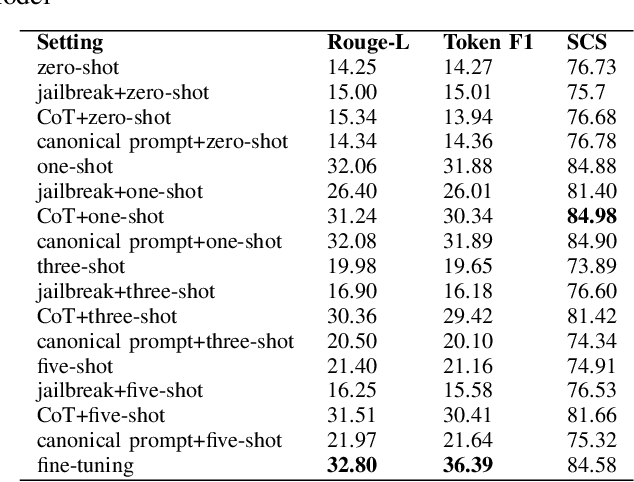
Prompt Recovery, reconstructing prompts from the outputs of large language models (LLMs), has grown in importance as LLMs become ubiquitous. Most users access LLMs through APIs without internal model weights, relying only on outputs and logits, which complicates recovery. This paper explores a unique prompt recovery task focused on reconstructing prompts for style transfer and rephrasing, rather than typical question-answering. We introduce a dataset created with LLM assistance, ensuring quality through multiple techniques, and test methods like zero-shot, few-shot, jailbreak, chain-of-thought, fine-tuning, and a novel canonical-prompt fallback for poor-performing cases. Our results show that one-shot and fine-tuning yield the best outcomes but highlight flaws in traditional sentence similarity metrics for evaluating prompt recovery. Contributions include (1) a benchmark dataset, (2) comprehensive experiments on prompt recovery strategies, and (3) identification of limitations in current evaluation metrics, all of which advance general prompt recovery research, where the structure of the input prompt is unrestricted.