 Add to Chrome
 Add to Firefox
 Add to Edge
Towards Accurate UAV Image Perception: Guiding Vision-Language Models with Stronger Task Prompts
Dec 08, 2025
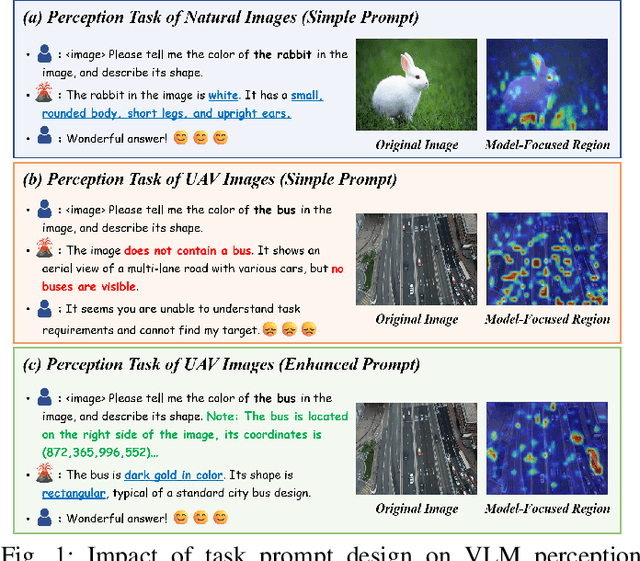
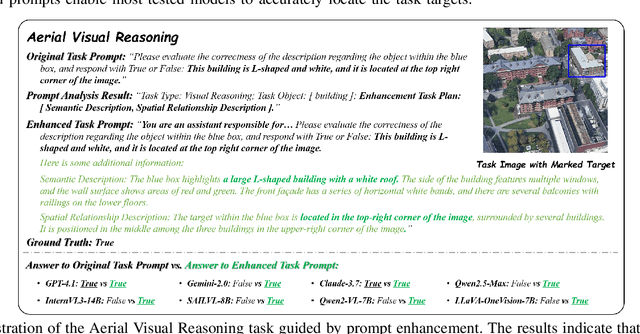
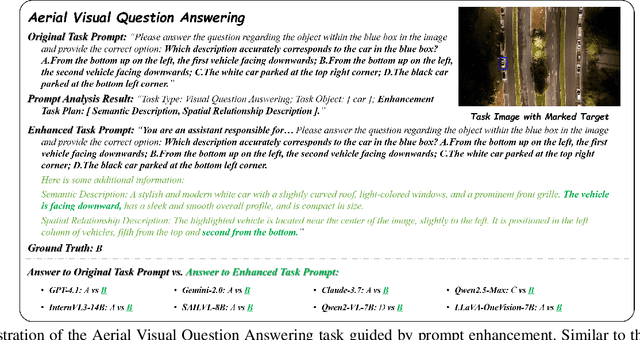
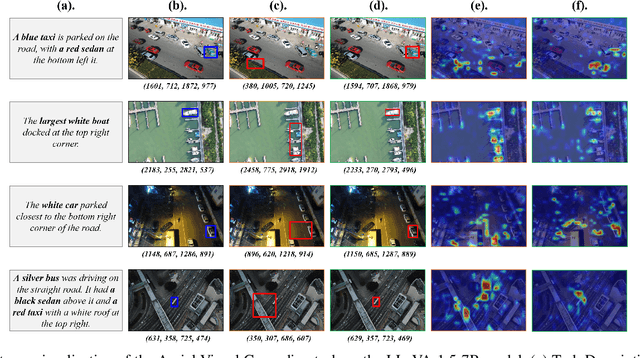
Existing image perception methods based on VLMs generally follow a paradigm wherein models extract and analyze image content based on user-provided textual task prompts. However, such methods face limitations when applied to UAV imagery, which presents challenges like target confusion, scale variations, and complex backgrounds. These challenges arise because VLMs' understanding of image content depends on the semantic alignment between visual and textual tokens. When the task prompt is simplistic and the image content is complex, achieving effective alignment becomes difficult, limiting the model's ability to focus on task-relevant information. To address this issue, we introduce AerialVP, the first agent framework for task prompt enhancement in UAV image perception. AerialVP proactively extracts multi-dimensional auxiliary information from UAV images to enhance task prompts, overcoming the limitations of traditional VLM-based approaches. Specifically, the enhancement process includes three stages: (1) analyzing the task prompt to identify the task type and enhancement needs, (2) selecting appropriate tools from the tool repository, and (3) generating enhanced task prompts based on the analysis and selected tools. To evaluate AerialVP, we introduce AerialSense, a comprehensive benchmark for UAV image perception that includes Aerial Visual Reasoning, Aerial Visual Question Answering, and Aerial Visual Grounding tasks. AerialSense provides a standardized basis for evaluating model generalization and performance across diverse resolutions, lighting conditions, and both urban and natural scenes. Experimental results demonstrate that AerialVP significantly enhances task prompt guidance, leading to stable and substantial performance improvements in both open-source and proprietary VLMs. Our work will be available at https://github.com/lostwolves/AerialVP.

BEDI: A Comprehensive Benchmark for Evaluating Embodied Agents on UAVs
May 23, 2025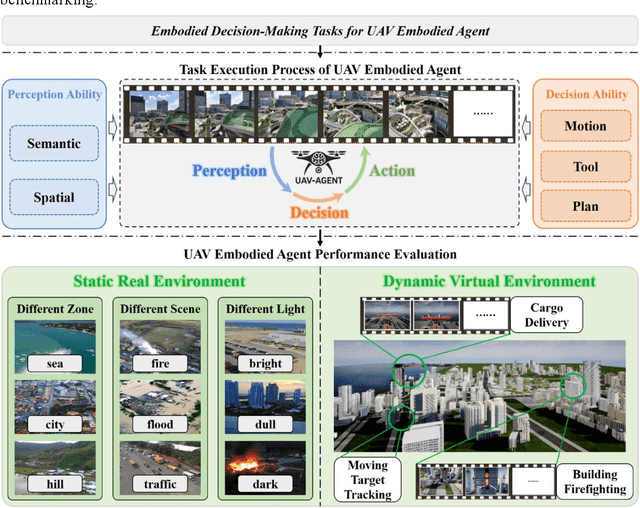
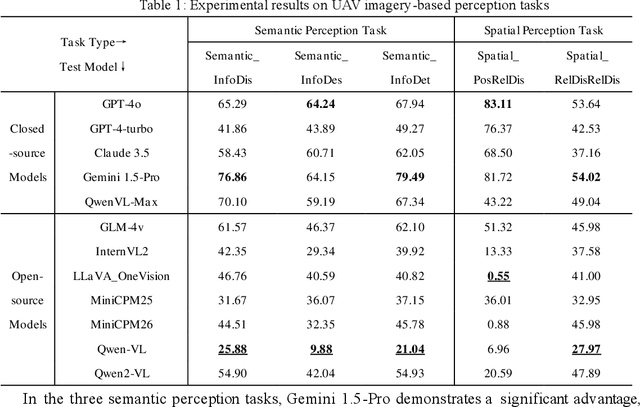
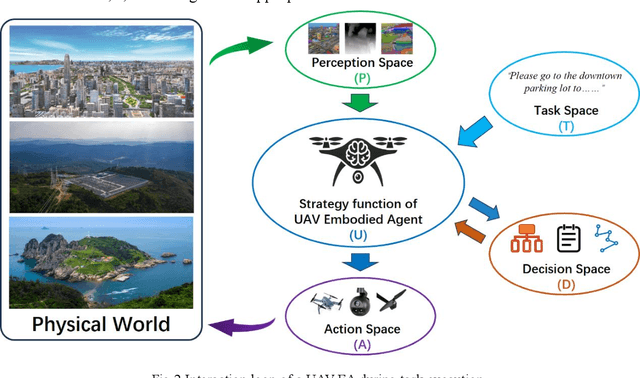
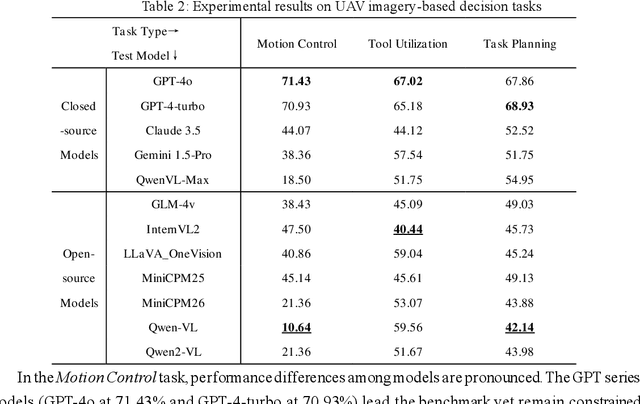
With the rapid advancement of low-altitude remote sensing and Vision-Language Models (VLMs), Embodied Agents based on Unmanned Aerial Vehicles (UAVs) have shown significant potential in autonomous tasks. However, current evaluation methods for UAV-Embodied Agents (UAV-EAs) remain constrained by the lack of standardized benchmarks, diverse testing scenarios and open system interfaces. To address these challenges, we propose BEDI (Benchmark for Embodied Drone Intelligence), a systematic and standardized benchmark designed for evaluating UAV-EAs. Specifically, we introduce a novel Dynamic Chain-of-Embodied-Task paradigm based on the perception-decision-action loop, which decomposes complex UAV tasks into standardized, measurable subtasks. Building on this paradigm, we design a unified evaluation framework encompassing five core sub-skills: semantic perception, spatial perception, motion control, tool utilization, and task planning. Furthermore, we construct a hybrid testing platform that integrates static real-world environments with dynamic virtual scenarios, enabling comprehensive performance assessment of UAV-EAs across varied contexts. The platform also offers open and standardized interfaces, allowing researchers to customize tasks and extend scenarios, thereby enhancing flexibility and scalability in the evaluation process. Finally, through empirical evaluations of several state-of-the-art (SOTA) VLMs, we reveal their limitations in embodied UAV tasks, underscoring the critical role of the BEDI benchmark in advancing embodied intelligence research and model optimization. By filling the gap in systematic and standardized evaluation within this field, BEDI facilitates objective model comparison and lays a robust foundation for future development in this field. Our benchmark will be released at https://github.com/lostwolves/BEDI .