 Add to Chrome
 Add to Firefox
 Add to Edge
Qwen-BIM: developing large language model for BIM-based design with domain-specific benchmark and dataset
Feb 24, 2026
As the construction industry advances toward digital transformation, BIM (Building Information Modeling)-based design has become a key driver supporting intelligent construction. Despite Large Language Models (LLMs) have shown potential in promoting BIM-based design, the lack of specific datasets and LLM evaluation benchmarks has significantly hindered the performance of LLMs. Therefore, this paper addresses this gap by proposing: 1) an evaluation benchmark for BIM-based design together with corresponding quantitative indicators to evaluate the performance of LLMs, 2) a method for generating textual data from BIM and constructing corresponding BIM-derived datasets for LLM evaluation and fine-tuning, and 3) a fine-tuning strategy to adapt LLMs for BIM-based design. Results demonstrate that the proposed domain-specific benchmark effectively and comprehensively assesses LLM capabilities, highlighting that general LLMs are still incompetent for domain-specific tasks. Meanwhile, with the proposed benchmark and datasets, Qwen-BIM is developed and achieves a 21.0% average increase in G-Eval score compared to the base LLM model. Notably, with only 14B parameters, performance of Qwen-BIM is comparable to that of general LLMs with 671B parameters for BIM-based design tasks. Overall, this study develops the first domain-specific LLM for BIM-based design by introducing a comprehensive benchmark and high-quality dataset, which provide a solid foundation for developing BIM-related LLMs in various fields.

SatAOI: Delimitating Area of Interest for Swing-Arm Troweling Robot for Construction
May 08, 2025In concrete troweling for building construction, robots can significantly reduce workload and improve automation level. However, as a primary task of coverage path planning (CPP) for troweling, delimitating area of interest (AOI) in complex scenes is still challenging, especially for swing-arm robots with more complex working modes. Thus, this research proposes an algorithm to delimitate AOI for swing-arm troweling robot (SatAOI algorithm). By analyzing characteristics of the robot and obstacle maps, mathematical models and collision principles are established. On this basis, SatAOI algorithm achieves AOI delimitation by global search and collision detection. Experiments on different obstacle maps indicate that AOI can be effectively delimitated in scenes under different complexity, and the algorithm can fully consider the connectivity of obstacle maps. This research serves as a foundation for CPP algorithm and full process simulation of swing-arm troweling robots.
Impact of color and mixing proportion of synthetic point clouds on semantic segmentation
Dec 26, 2024
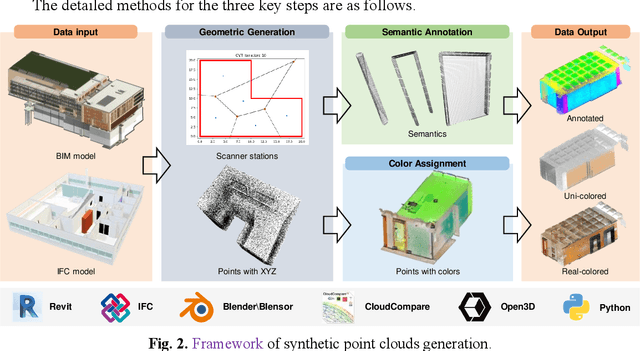
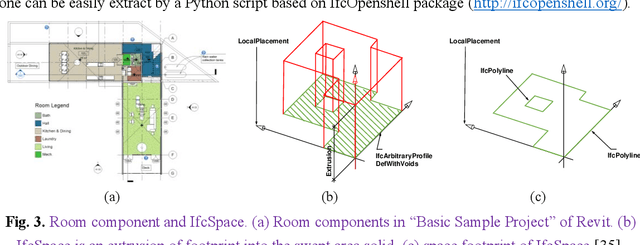
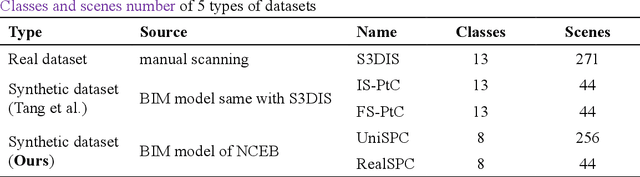
Semantic segmentation of point clouds is essential for understanding the built environment, and a large amount of high-quality data is required for training deep learning models. Despite synthetic point clouds (SPC) having the potential to compensate for the shortage of real data, how to exploit the benefits of SPC is still open. Therefore, this study systematically investigates how color and mixing proportion of SPC impact semantic segmentation for the first time. First, a new method to mimic the scanning process and generate SPC based on BIM is proposed, to create a synthetic dataset with consistent colors of BIM (UniSPC) and a synthetic dataset with real colors (RealSPC) respectively. Subsequently, by integrating with the S3DIS dataset, further experiments on PointNet, PointNet++, and DGCNN are conducted. Meanwhile, benchmark experiments and new evaluation metrics are introduced to better evaluate the performance of different models. Experiments show that synthetic color significantly impacts model performance, the performance for common components of the models trained with pure RealSPC is comparable to models with real data, and RealSPC contributes average improvements of 14.1% on overall accuracy and 7.3% on mIoU than UniSPC. Furthermore, the proportion of SPC also has a significant impact on the performance. In mixing training experiments, adding more than 70% SPC achieves an average of 3.9% on overall accuracy and 3.4% on mIoU better than benchmark on three models. It is also revealed that for large flat elements such as floors, ceilings, and walls, the SPC can even replace real point clouds without compromising model performance.