 Add to Chrome
 Add to Firefox
 Add to Edge
Spectral Discrepancy and Cross-modal Semantic Consistency Learning for Object Detection in Hyperspectral Image
Dec 20, 2025
Hyperspectral images with high spectral resolution provide new insights into recognizing subtle differences in similar substances. However, object detection in hyperspectral images faces significant challenges in intra- and inter-class similarity due to the spatial differences in hyperspectral inter-bands and unavoidable interferences, e.g., sensor noises and illumination. To alleviate the hyperspectral inter-bands inconsistencies and redundancy, we propose a novel network termed \textbf{S}pectral \textbf{D}iscrepancy and \textbf{C}ross-\textbf{M}odal semantic consistency learning (SDCM), which facilitates the extraction of consistent information across a wide range of hyperspectral bands while utilizing the spectral dimension to pinpoint regions of interest. Specifically, we leverage a semantic consistency learning (SCL) module that utilizes inter-band contextual cues to diminish the heterogeneity of information among bands, yielding highly coherent spectral dimension representations. On the other hand, we incorporate a spectral gated generator (SGG) into the framework that filters out the redundant data inherent in hyperspectral information based on the importance of the bands. Then, we design the spectral discrepancy aware (SDA) module to enrich the semantic representation of high-level information by extracting pixel-level spectral features. Extensive experiments on two hyperspectral datasets demonstrate that our proposed method achieves state-of-the-art performance when compared with other ones.

Video Anomaly Detection and Localization via Gaussian Mixture Fully Convolutional Variational Autoencoder
May 29, 2018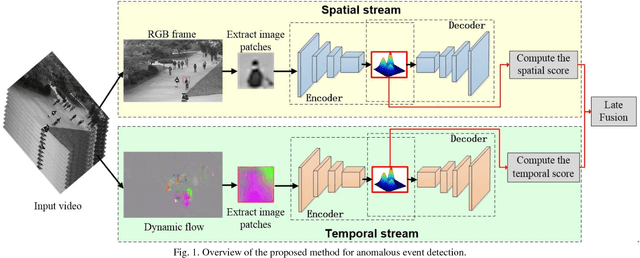
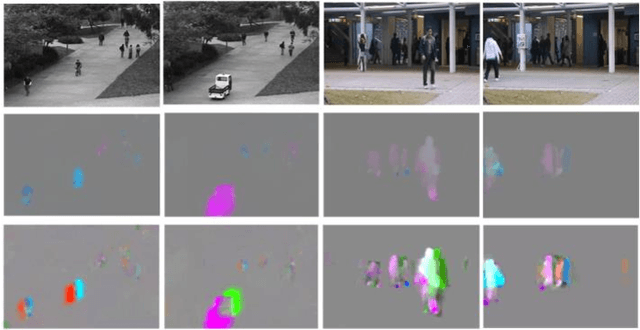
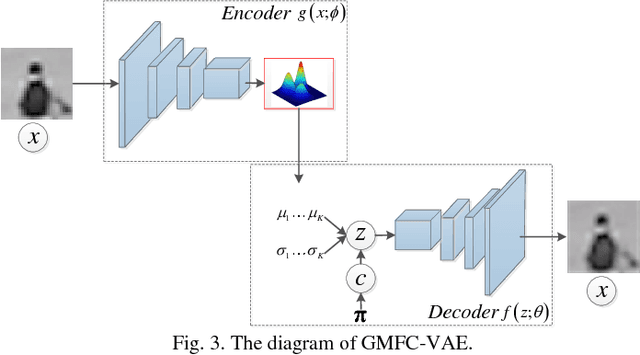
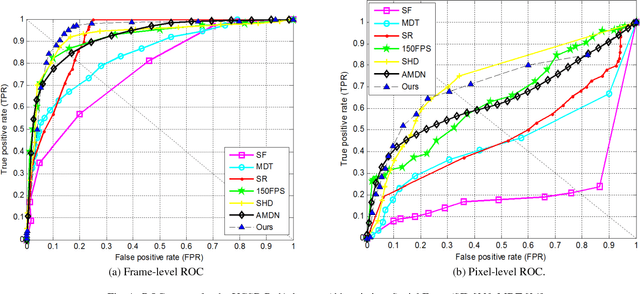
We present a novel end-to-end partially supervised deep learning approach for video anomaly detection and localization using only normal samples. The insight that motivates this study is that the normal samples can be associated with at least one Gaussian component of a Gaussian Mixture Model (GMM), while anomalies either do not belong to any Gaussian component. The method is based on Gaussian Mixture Variational Autoencoder, which can learn feature representations of the normal samples as a Gaussian Mixture Model trained using deep learning. A Fully Convolutional Network (FCN) that does not contain a fully-connected layer is employed for the encoder-decoder structure to preserve relative spatial coordinates between the input image and the output feature map. Based on the joint probabilities of each of the Gaussian mixture components, we introduce a sample energy based method to score the anomaly of image test patches. A two-stream network framework is employed to combine the appearance and motion anomalies, using RGB frames for the former and dynamic flow images, for the latter. We test our approach on two popular benchmarks (UCSD Dataset and Avenue Dataset). The experimental results verify the superiority of our method compared to the state of the arts.