 Add to Chrome
 Add to Firefox
 Add to Edge
BiFormer3D: Grid-Free Time-Domain Reconstruction of Head-Related Impulse Responses with a Spatially Encoded Transformer
Mar 30, 2026
Individualized head-related impulse responses (HRIRs) enable binaural rendering, but dense per-listener measurements are costly. We address HRIR spatial up-sampling from sparse per-listener measurements: given a few measured HRIRs for a listener, predict HRIRs at unmeasured target directions. Prior learning methods often work in the frequency domain, rely on minimum-phase assumptions or separate timing models, and use a fixed direction grid, which can degrade temporal fidelity and spatial continuity. We propose BiFormer3D, a time-domain, grid-free binaural Transformer for reconstructing HRIRs at arbitrary directions from sparse inputs. It uses sinusoidal spatial features, a Conv1D refinement module, and auxiliary interaural time difference (ITD) and interaural level difference (ILD) heads. On SONICOM, it improves normalized mean squared error (NMSE), cosine distance, and ITD/ILD errors over prior methods; ablations validate modules and show minimum-phase pre-processing is unnecessary.

RIR-Former: Coordinate-Guided Transformer for Continuous Reconstruction of Room Impulse Responses
Feb 03, 2026Room impulse responses (RIRs) are essential for many acoustic signal processing tasks, yet measuring them densely across space is often impractical. In this work, we propose RIR-Former, a grid-free, one-step feed-forward model for RIR reconstruction. By introducing a sinusoidal encoding module into a transformer backbone, our method effectively incorporates microphone position information, enabling interpolation at arbitrary array locations. Furthermore, a segmented multi-branch decoder is designed to separately handle early reflections and late reverberation, improving reconstruction across the entire RIR. Experiments on diverse simulated acoustic environments demonstrate that RIR-Former consistently outperforms state-of-the-art baselines in terms of normalized mean square error (NMSE) and cosine distance (CD), under varying missing rates and array configurations. These results highlight the potential of our approach for practical deployment and motivate future work on scaling from randomly spaced linear arrays to complex array geometries, dynamic acoustic scenes, and real-world environments.
A Two-Step Approach for Narrowband Source Localization in Reverberant Rooms
Sep 25, 2023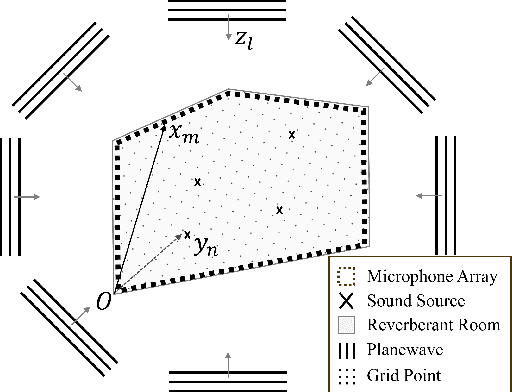
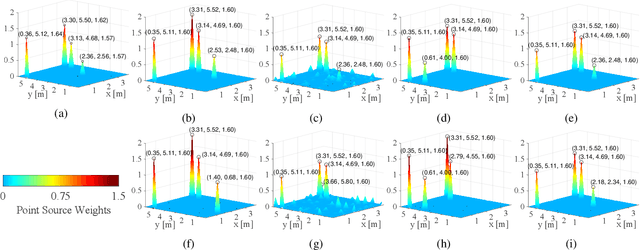
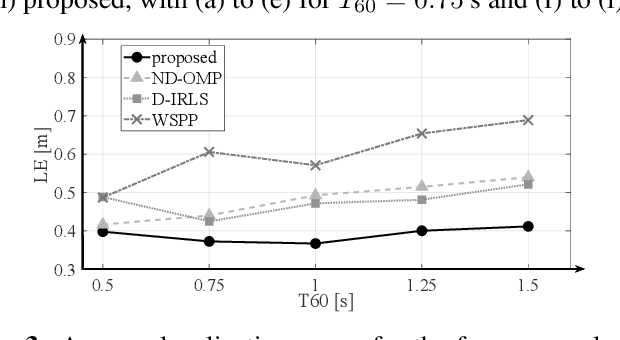
This paper presents a two-step approach for narrowband source localization within reverberant rooms. The first step involves dereverberation by modeling the homogeneous component of the sound field by an equivalent decomposition of planewaves using Iteratively Reweighted Least Squares (IRLS), while the second step focuses on source localization by modeling the dereverberated component as a sparse representation of point-source distribution using Orthogonal Matching Pursuit (OMP). The proposed method enhances localization accuracy with fewer measurements, particularly in environments with strong reverberation. A numerical simulation in a conference room scenario, using a uniform microphone array affixed to the wall, demonstrates real-world feasibility. Notably, the proposed method and microphone placement effectively localize sound sources within the 2D-horizontal plane without requiring prior knowledge of boundary conditions and room geometry, making it versatile for application in different room types.