 Add to Chrome
 Add to Firefox
 Add to Edge
Free-RBF-KAN: Kolmogorov-Arnold Networks with Adaptive Radial Basis Functions for Efficient Function Learning
Jan 13, 2026
Kolmogorov-Arnold Networks (KANs) have shown strong potential for efficiently approximating complex nonlinear functions. However, the original KAN formulation relies on B-spline basis functions, which incur substantial computational overhead due to De Boor's algorithm. To address this limitation, recent work has explored alternative basis functions such as radial basis functions (RBFs) that can improve computational efficiency and flexibility. Yet, standard RBF-KANs often sacrifice accuracy relative to the original KAN design. In this work, we propose Free-RBF-KAN, a RBF-based KAN architecture that incorporates adaptive learning grids and trainable smoothness to close this performance gap. Our method employs freely learnable RBF shapes that dynamically align grid representations with activation patterns, enabling expressive and adaptive function approximation. Additionally, we treat smoothness as a kernel parameter optimized jointly with network weights, without increasing computational complexity. We provide a general universality proof for RBF-KANs, which encompasses our Free-RBF-KAN formulation. Through a broad set of experiments, including multiscale function approximation, physics-informed machine learning, and PDE solution operator learning, Free-RBF-KAN achieves accuracy comparable to the original B-spline-based KAN while delivering faster training and inference. These results highlight Free-RBF-KAN as a compelling balance between computational efficiency and adaptive resolution, particularly for high-dimensional structured modeling tasks.

BumpNet: A Sparse Neural Network Framework for Learning PDE Solutions
Dec 19, 2025We introduce BumpNet, a sparse neural network framework for PDE numerical solution and operator learning. BumpNet is based on meshless basis function expansion, in a similar fashion to radial-basis function (RBF) networks. Unlike RBF networks, the basis functions in BumpNet are constructed from ordinary sigmoid activation functions. This enables the efficient use of modern training techniques optimized for such networks. All parameters of the basis functions, including shape, location, and amplitude, are fully trainable. Model parsimony and h-adaptivity are effectively achieved through dynamically pruning basis functions during training. BumpNet is a general framework that can be combined with existing neural architectures for learning PDE solutions: here, we propose Bump-PINNs (BumpNet with physics-informed neural networks) for solving general PDEs; Bump-EDNN (BumpNet with evolutionary deep neural networks) to solve time-evolution PDEs; and Bump-DeepONet (BumpNet with deep operator networks) for PDE operator learning. Bump-PINNs are trained using the same collocation-based approach used by PINNs, Bump-EDNN uses a BumpNet only in the spatial domain and uses EDNNs to advance the solution in time, while Bump-DeepONets employ a BumpNet regression network as the trunk network of a DeepONet. Extensive numerical experiments demonstrate the efficiency and accuracy of the proposed architecture.
In-Context Multi-Operator Learning with DeepOSets
Dec 18, 2025In-context Learning (ICL) is the remarkable capability displayed by some machine learning models to learn from examples in a prompt, without any further weight updates. ICL had originally been thought to emerge from the self-attention mechanism in autoregressive transformer architectures. DeepOSets is a non-autoregressive, non-attention based neural architecture that combines set learning via the DeepSets architecture with operator learning via Deep Operator Networks (DeepONets). In a previous study, DeepOSets was shown to display ICL capabilities in supervised learning problems. In this paper, we show that the DeepOSets architecture, with the appropriate modifications, is a multi-operator in-context learner that can recover the solution operator of a new PDE, not seen during training, from example pairs of parameter and solution placed in a user prompt, without any weight updates. Furthermore, we show that DeepOSets is a universal uniform approximator over a class of continuous operators, which we believe is the first result of its kind in the literature of scientific machine learning. This means that a single DeepOSets architecture exists that approximates in-context any continuous operator in the class to any fixed desired degree accuracy, given an appropriate number of examples in the prompt. Experiments with Poisson and reaction-diffusion forward and inverse boundary-value problems demonstrate the ability of the proposed model to use in-context examples to predict accurately the solutions corresponding to parameter queries for PDEs not seen during training.
DeepOSets: Non-Autoregressive In-Context Learning of Supervised Learning Operators
Oct 11, 2024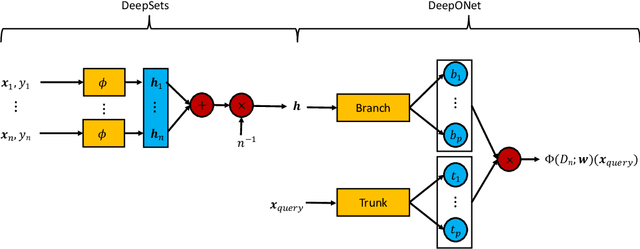
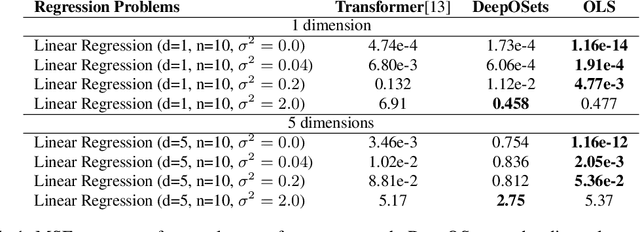
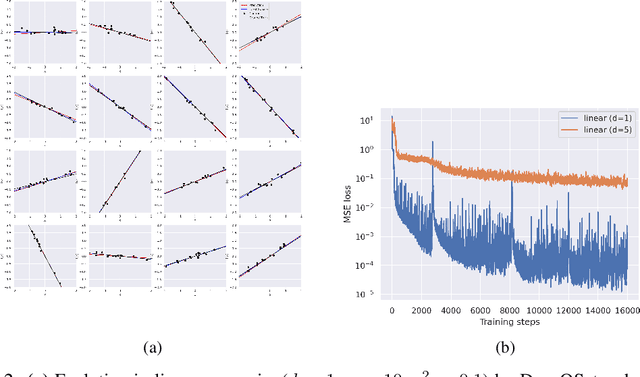
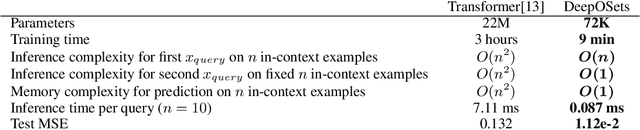
We introduce DeepSets Operator Networks (DeepOSets), an efficient, non-autoregressive neural network architecture for in-context operator learning. In-context learning allows a trained machine learning model to learn from a user prompt without further training. DeepOSets adds in-context learning capabilities to Deep Operator Networks (DeepONets) by combining it with the DeepSets architecture. As the first non-autoregressive model for in-context operator learning, DeepOSets allow the user prompt to be processed in parallel, leading to significant computational savings. Here, we present the application of DeepOSets in the problem of learning supervised learning algorithms, which are operators mapping a finite-dimensional space of labeled data into an infinite-dimensional hypothesis space of prediction functions. In an empirical comparison with a popular autoregressive (transformer-based) model for in-context learning of the least-squares linear regression algorithm, DeepOSets reduced the number of model weights by several orders of magnitude and required a fraction of training and inference time. Furthermore, DeepOSets proved to be less sensitive to noise, outperforming the transformer model in noisy settings.