 Add to Chrome
 Add to Firefox
 Add to Edge
TopoGS: Planar Reconstruction via Topology-aware 3D Gaussian Splatting
Jul 18, 2026
Extracting structured, parametric 3D representations from raw images remains a fundamental challenge in computer vision and graphics. While recent advancements in the 3D Gaussian Splatting (3DGS) pipeline integrate planar primitives to yield compact and editable geometry, these approaches typically treat planes as isolated, discrete sets. This lack of topological connectivity hinders robust geometric reasoning, leading to fragmented reconstructions and misaligned boundaries that fall short of the precision for rigorous spatial analysis and professional design workflows. To address this, we introduce TopoGS, the first 3DGS framework to explicitly integrate both planar and topological constraints for coherent 3D reconstruction. Specifically, we extract global 2D topological relationships from multi-view image segmentations and anchor Gaussian primitives to these structural elements. This formulation enables the joint optimization of plane parameters, rendering fidelity, and topological adjacency. By enforcing strict multi-view consistency alongside these topological constraints, our method significantly mitigates geometric misalignments and produces connected, structured 3D models. Extensive evaluations on the ScanNet++ dataset demonstrate that TopoGS achieves state-of-the-art performance, providing a highly robust solution for generating accurate, topologically sound, and visually faithful scene representations.

Split-and-Fit: Learning B-Reps via Structure-Aware Voronoi Partitioning
Jun 07, 2024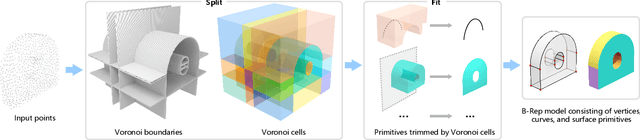
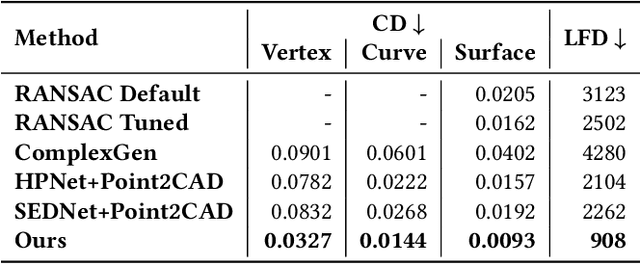
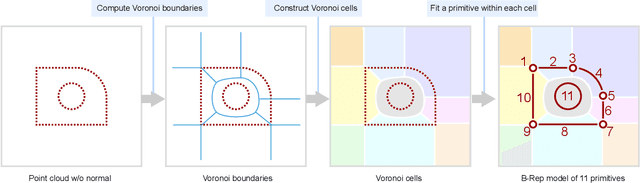
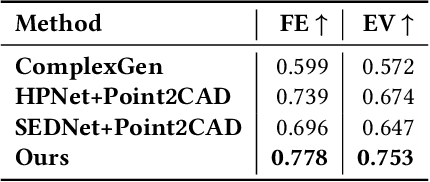
We introduce a novel method for acquiring boundary representations (B-Reps) of 3D CAD models which involves a two-step process: it first applies a spatial partitioning, referred to as the ``split``, followed by a ``fit`` operation to derive a single primitive within each partition. Specifically, our partitioning aims to produce the classical Voronoi diagram of the set of ground-truth (GT) B-Rep primitives. In contrast to prior B-Rep constructions which were bottom-up, either via direct primitive fitting or point clustering, our Split-and-Fit approach is top-down and structure-aware, since a Voronoi partition explicitly reveals both the number of and the connections between the primitives. We design a neural network to predict the Voronoi diagram from an input point cloud or distance field via a binary classification. We show that our network, coined NVD-Net for neural Voronoi diagrams, can effectively learn Voronoi partitions for CAD models from training data and exhibits superior generalization capabilities. Extensive experiments and evaluation demonstrate that the resulting B-Reps, consisting of parametric surfaces, curves, and vertices, are more plausible than those obtained by existing alternatives, with significant improvements in reconstruction quality. Code will be released on https://github.com/yilinliu77/NVDNet.