 Add to Chrome
 Add to Firefox
 Add to Edge
BackWeak: Backdooring Knowledge Distillation Simply with Weak Triggers and Fine-tuning
Nov 15, 2025
Knowledge Distillation (KD) is essential for compressing large models, yet relying on pre-trained "teacher" models downloaded from third-party repositories introduces serious security risks -- most notably backdoor attacks. Existing KD backdoor methods are typically complex and computationally intensive: they employ surrogate student models and simulated distillation to guarantee transferability, and they construct triggers in a way similar to universal adversarial perturbations (UAPs), which being not stealthy in magnitude, inherently exhibit strong adversarial behavior. This work questions whether such complexity is necessary and constructs stealthy "weak" triggers -- imperceptible perturbations that have negligible adversarial effect. We propose BackWeak, a simple, surrogate-free attack paradigm. BackWeak shows that a powerful backdoor can be implanted by simply fine-tuning a benign teacher with a weak trigger using a very small learning rate. We demonstrate that this delicate fine-tuning is sufficient to embed a backdoor that reliably transfers to diverse student architectures during a victim's standard distillation process, yielding high attack success rates. Extensive empirical evaluations on multiple datasets, model architectures, and KD methods show that BackWeak is efficient, simpler, and often more stealthy than previous elaborate approaches. This work calls on researchers studying KD backdoor attacks to pay particular attention to the trigger's stealthiness and its potential adversarial characteristics.

Cooperative Sentiment Agents for Multimodal Sentiment Analysis
Apr 19, 2024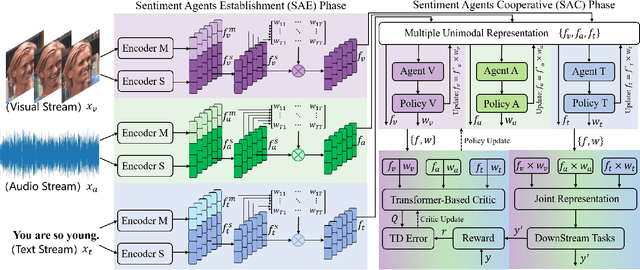
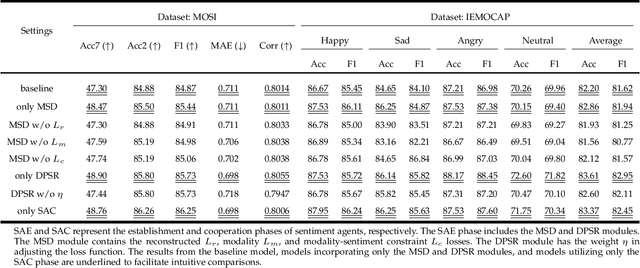
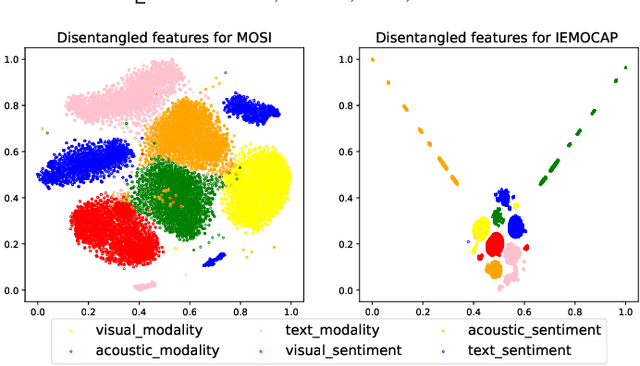
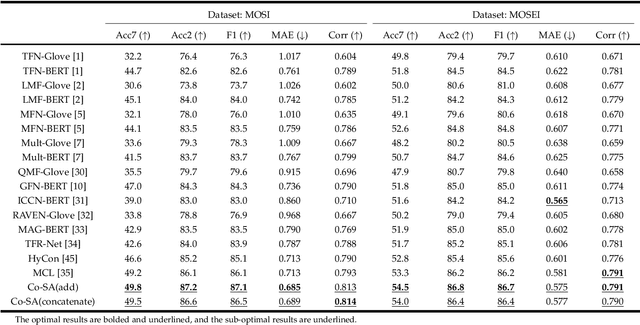
In this paper, we propose a new Multimodal Representation Learning (MRL) method for Multimodal Sentiment Analysis (MSA), which facilitates the adaptive interaction between modalities through Cooperative Sentiment Agents, named Co-SA. Co-SA comprises two critical components: the Sentiment Agents Establishment (SAE) phase and the Sentiment Agents Cooperation (SAC) phase. During the SAE phase, each sentiment agent deals with an unimodal signal and highlights explicit dynamic sentiment variations within the modality via the Modality-Sentiment Disentanglement (MSD) and Deep Phase Space Reconstruction (DPSR) modules. Subsequently, in the SAC phase, Co-SA meticulously designs task-specific interaction mechanisms for sentiment agents so that coordinating multimodal signals to learn the joint representation. Specifically, Co-SA equips an independent policy model for each sentiment agent that captures significant properties within the modality. These policies are optimized mutually through the unified reward adaptive to downstream tasks. Benefitting from the rewarding mechanism, Co-SA transcends the limitation of pre-defined fusion modes and adaptively captures unimodal properties for MRL in the multimodal interaction setting. To demonstrate the effectiveness of Co-SA, we apply it to address Multimodal Sentiment Analysis (MSA) and Multimodal Emotion Recognition (MER) tasks. Our comprehensive experimental results demonstrate that Co-SA excels at discovering diverse cross-modal features, encompassing both common and complementary aspects. The code can be available at https://github.com/smwanghhh/Co-SA.